How Can Digital Technology Change Public Discourse?
Thousands of people take to the streets in France every year—whether they’re “yellow vests” or not—to demand that their voices finally be heard a little more in the public debate, and above all, that their concerns be taken into account. What if digital tools could help them speak out more effectively and amplify their voices tenfold?
Jean Sallantin, University of Montpellier; Antsa Nasandratra Nirina Avo, University of Fianarantsoa; Mathieu Lafourcade, University of Montpellier and Véronique Pinet, University of Montpellier

This article is published as part of the upcoming Fête de la Science (October 5–13, 2019, in mainland France, and November 9–17 in overseas territories and internationally), of which The Conversation France is a partner. The theme of this year’s event is “To Tomorrow: Telling the Story of Science, Imagining the Future.” Find all the discussions and events in your region on the Fetedelascience.fr website.
Our experiments with digital debate tools have shown that formalization and the use of artificial intelligence (AI) bring a level of rationality to debates that enhances their effectiveness.
Thus, the digital debate will influence democratic life if it enables a greater number of citizens to participate directly in public discourse and if it avoids the biases currently found in in-person debates and online discussion forums.
The Pitfall of the Traditional Debate
Since it is difficult to follow a debate involving a very large number of participants, it would be desirable to develop artificial intelligence that assists everyone in studying and following the debates.
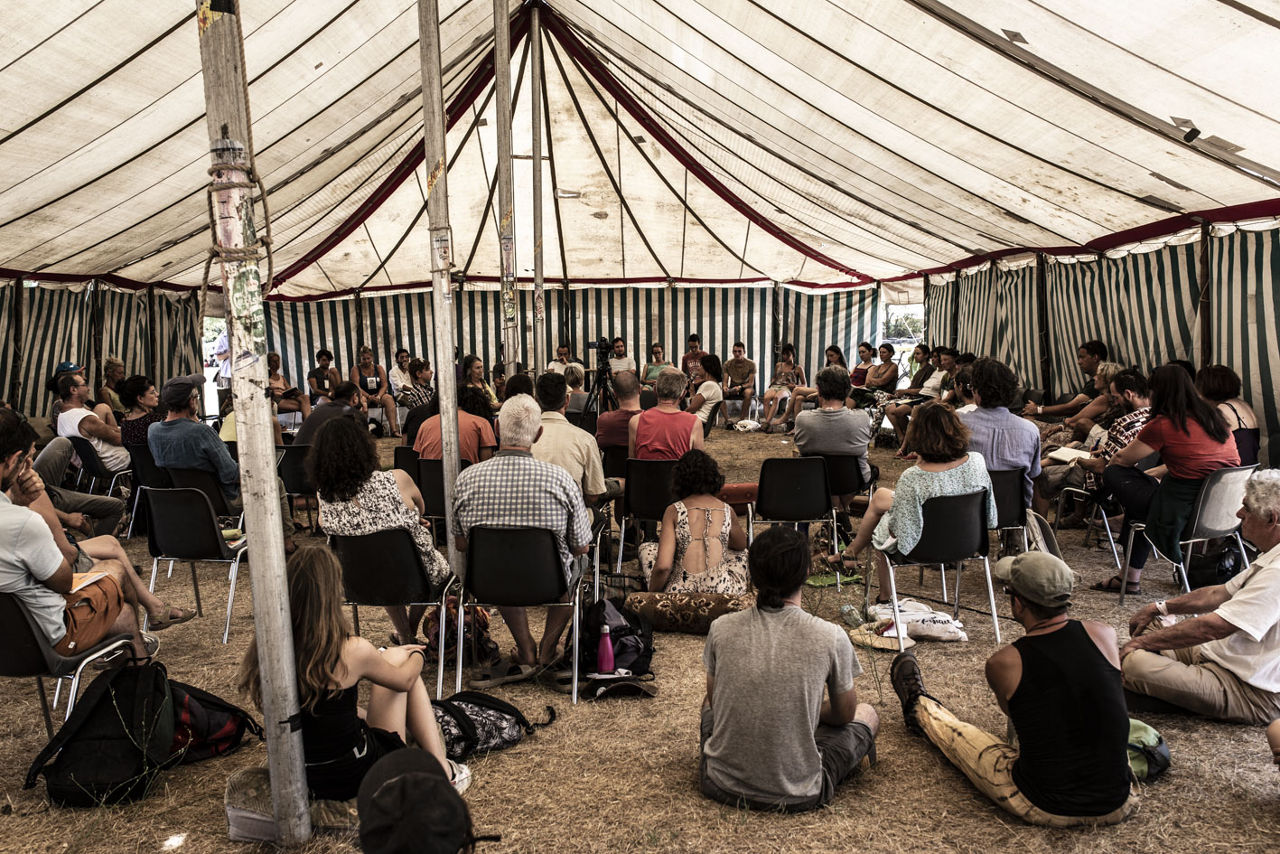
The efforts to streamline, formalize, and incorporate AI into the digital debate must demonstrate that it is an effective and well-controlled tool. We will introduce this approach and its tools by illustrating them using the discussions from the “Terre de convergence” eco-conference, which took place August 13–18 in Attuech (30).

Sébastien Pichot/Terre de convergence, Photo courtesy of the author
The Art of Calculating Well
Argumentation is related to logic—the “art of thinking correctly”—to rhetoric—the “art of speaking well”—and to dialectics—the “art of conversing well”—but it is not, as of yet, “the art of calculating well.”
However, two computational operations—indexing and classification—serve to structure the arguments in a debate. Indexing an argument here involves determining, from among all terms in the French language, those associated with it. The classification of arguments within an argumentative framework groups them into subclasses characterized by the common terms that index them. The artificial intelligence methods used here treat all arguments equally. They reveal the incompleteness of the argumentation through groupings of arguments that may seem irrelevant to participants, thereby encouraging them to supplement the argumentation with new arguments or through more precise indexing of existing arguments; there is no option here to remove arguments.
A traditional scientific approach is being used here to address the arguments in these debates. Scientists refine their arguments by reviewing the work of their peers and guiding their doctoral students, but they cannot systematically do so with regard to the arguments in a science-and-society debate if they have no way of identifying which ones specifically pertain to their field of expertise.
The mathematical formalization of digital debates focuses in particular on these processes of indexing arguments and classification, as it must demonstrate why the techniques used are capable of effectively guiding participants in clarifying and expanding upon the set of arguments.
The mathematical formalization of digital debate draws on topos to establish the methods of artificial intelligence used to structure debates.

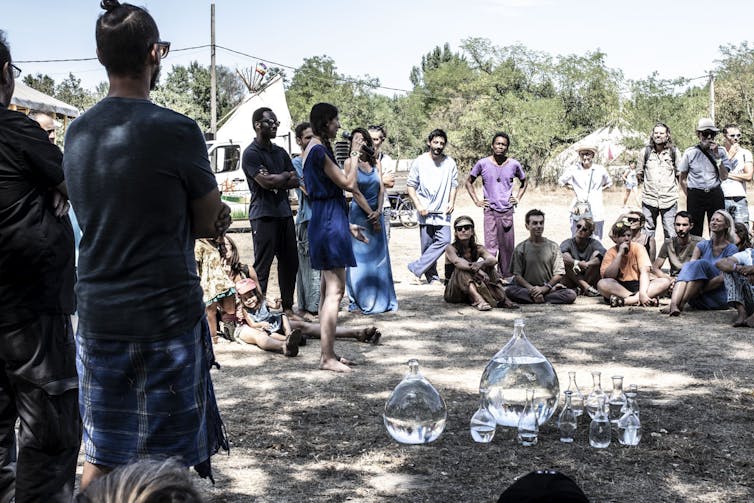
Sébastien Pichot/Terre de Convergences, Author provided
The "Terre de Convergence" Debates
The “Terre de convergence” eco-meeting is a project led by the Ministry of Ecological and Solidarity Transition. Approximately 2,000 people and 200 organizations participated. These meetings and the use of collaborative digital tools are intended to foster networking among local stakeholders in the transition.
Sébastien Pichot/Terre de Convergence, Author provided
The “Terre de Convergence” debates focus on issues such as energy, the environment, waste, food, and solidarity. They take into account the dimensions of personal development and community life, the local and the global, and the political sphere—ranging from genuine citizen participation to the ongoing engagement of elected officials. The online debates have laid the groundwork for the in-person debates and will continue to support them by expanding their audience.
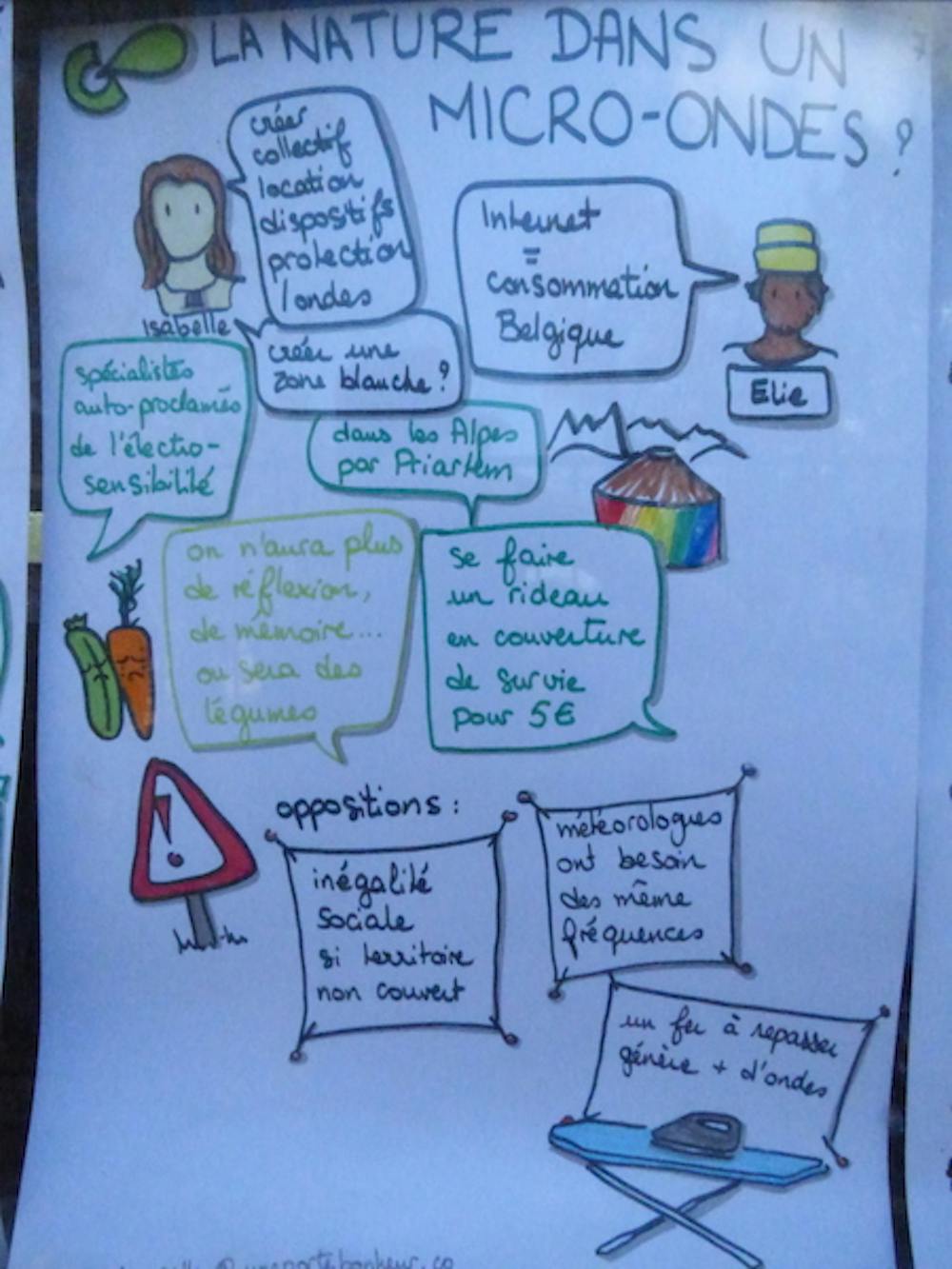
These debates highlight citizens’ desire to participate in decision-making regarding regional transition, a moratorium on 5G,collective housing, and the energy transition—its context and challenges.
Participants also addressed topics that might at first glance seem more distant: the situation of so-called “indigenous” peoples—an issue made even more relevant by the fires in the Amazon—and, finally, collaborative digital technology.
To understand the role of digital technology and AI in the digital debate, we invite you to join a discussion on a text by Edgar Morin.
Survivalism as an Example
To illustrate how AI intervenes, let’s consider an argument made in this debate regarding survivalism.
The IDEFIX indexing software is based on a web-based data acquisition program called JeuxDeMots. IDEFIX will be used to index this argument based on all French terms associated with it in the context of the “Terre de convergence” debates, thereby allowing participants to see how their argument relates to other arguments from all debates indexed by one of the associated terms.
Let's outline the sequence of steps that will be used to categorize the argument as falling under the topic of survivalism.
Text of the argument = “Survivalism marks the end of community life and a return to small groups that exclude social life.”
Terms of the argument = * survivalism * end of communal living * return to * small * group * groups * small group * exclusive * excluding * social life
Context in the eco-meeting (max=30) = * end of society | 3.257 * group of people | 2.585 * natural disaster | 2.242 * health crisis | 2.155 * collapse of industrial civilization | 2.044 * survivalism | 1.867 * economic crisis | 1.702 • th=0.5 • min=10 • max=20 • number of ideas=1,326
"Survivalism" was not initially a term used in the context of the argument. Therefore, a reinforcement learning technique is being used to boost its ranking, along with other terms that will rise in rank at the same time.
Terms for indexing the topic: group • the end of society • group of people • natural disaster • health crisis • collapse of industrial civilization • survivalism • economic crisis • life • survivalist •
Land of Convergence, Author provided
Eliminate false positives
To further assess the comprehensiveness of the argument, WEBRA—a machine learning software program developed by the CNRS—performs a formal conceptual analysis, identifying coincidences between terms that index the arguments in the current debate. When a debate has few arguments, it produces numerous false positives, such as the following: “small_finite_groups+” and “survivalist+.” We then know that we must expand the set of arguments to eliminate this false positive. In this way, these false positives provide effective starting points for quickly deepening the debate.
Many public debates focus on issues such as regional transition in response to climate change; they are largely open to the public and involve bringing together the perspectives of citizens, organizations, policymakers, and scientists.
For such debates to take place, artificial intelligence is needed to compensate for the human inability to read, index, and classify everything. However, the methods used by this AI must adhere to mathematical principles that ensure all arguments are treated equally. Furthermore, this AI must demonstrate its ability to learn from the arguments in order to appropriately solicit contributions from debate participants (it therefore does not intervene in the debate itself).
Jean Sallantin, emeritus research director at the CNRS, University of Montpellier; Antsa Nasandratra Nirina Avo, Researcher and Instructor in Mathematical Modeling of Argumentation, University of Fianarantsoa; Mathieu Lafourcade, artificial intelligence, natural language processing, automated reasoning, inference, machine learning, University of Montpellier and Véronique Pinet, Professor of Philosophy, University of Montpellier
This article is republished from The Conversation under a Creative Commons license. Readthe original article.