Coronavirus: The Impact on the Electricity Market
At this point, it is difficult to determine all the impacts the coronavirus pandemic will have on the electricity sector. Some effects will be felt in the short term, while others will be felt in the longer term. Intuitively, we can already begin to outline them.
Boris Solier, University of Montpellier and Jacques Percebois, University of Montpellier
Shutterstock
Electricity is a basic necessity, and like any public service, it is governed by three principles: continuity, equal treatment, and adaptability.
It is the first of these that is crucial here. There is no cause for concern on that front, as the operators (EDF, RTE, and Enedis) have plans in place to ensure that nuclear and thermal power plants will continue to operate—even with a 40% absenteeism rate in the event of a peak in the epidemic—and that the power grids will remain operational.
Priority is given to operational staff, who operate power plants and repair power lines. Support staff may continue working remotely. In fact, they must come to the site as little as possible to prevent the spread of infection to the staff who operate the power plants—particularly nuclear plants—as happened at the Flamanville Nuclear Power Plant, where the “pandemic plan” was activated on March 16, 2020.
A decline in electricity demand
Electricity demand fell in March, mainly due to the decline in economic activity. The electricity transmission system operator announced “a 15 percent decline” on March 18.
The issue at hand is the slowdown—or even complete shutdown—of industry, businesses, and public transportation (high-speed trains, subways, and streetcars). This situation is therefore likely to worsen.
The growing use of digital technology due to remote work and lockdowns (the digital sector typically accounts for about 10% of electricity consumption in France, and consumption in this sector is estimated to have increased by 40 to 50% during the pandemic) is not expected to offset the decline in electricity demand in other sectors—far from it.
It should also be noted that the Energy Regulatory Commission is asking EDF and RTE to stop applying the peak-hour system, which allows certain customers to benefit from rates that vary depending on the time of year—further evidence that electricity demand is declining. Under this system, the price paid by the end consumer is relatively low for much of the year, when consumption is low, but rises sharply during periods of high consumption—particularly in the winter—encouraging consumers to reduce their demand.
We can also expect daily peaks to be smoothed out, meaning that the electricity demand curve will flatten.
Traditionally, electricity consumption peaks around 8 a.m., when businesses begin their operations. The slowdown in economic activity and the lockdown measures put in place are thus helping to reduce this daily consumption peak and smooth out the demand curve. “The use of load-shedding programs to limit consumption peaks now appears to be of little use and could, moreover, lead to higher bills for the consumers affected,” the CRE further notes.

RTE
Electricity Prices
France currently has a surplus of electricity capacity, and temperatures are fairly mild, especially as we head into spring. There is therefore no cause for concern regarding the supply of electricity. Demand, on the other hand, is likely to decline sharply once again. This has had—and will continue to have—an impact on prices in the wholesale electricity market—and, by extension, on the revenues of electricity producers and suppliers (EDF and alternative suppliers).
Since power plants on the grid are dispatched in order of increasing marginal cost, the generation sources with the lowest variable costs (renewables and nuclear) are used first to meet electricity demand. Gas- and coal-fired thermal power plants, which have significantly higher variable production costs, will therefore be the most likely to be affected by a decline in consumption.
Admittedly, the price of natural gas is very low since it tracks the price of oil, which is itself in free fall, but the reduction in the production cost per kWh of thermal power will not alter the principle that priority is given to renewable energy sources (run-of-river hydroelectric, solar, and wind) and nuclear power. On the contrary, the decline in demand could accelerate the already underway decline of coal in electricity generation in Europe.
As the wholesale price per kWh falls, the price per kWh (including tax) for end consumers should also drop slightly. It’s worth noting that the cost of electricity accounts for only one-third of the bill we pay; the rest consists of transmission and distribution costs and taxes.
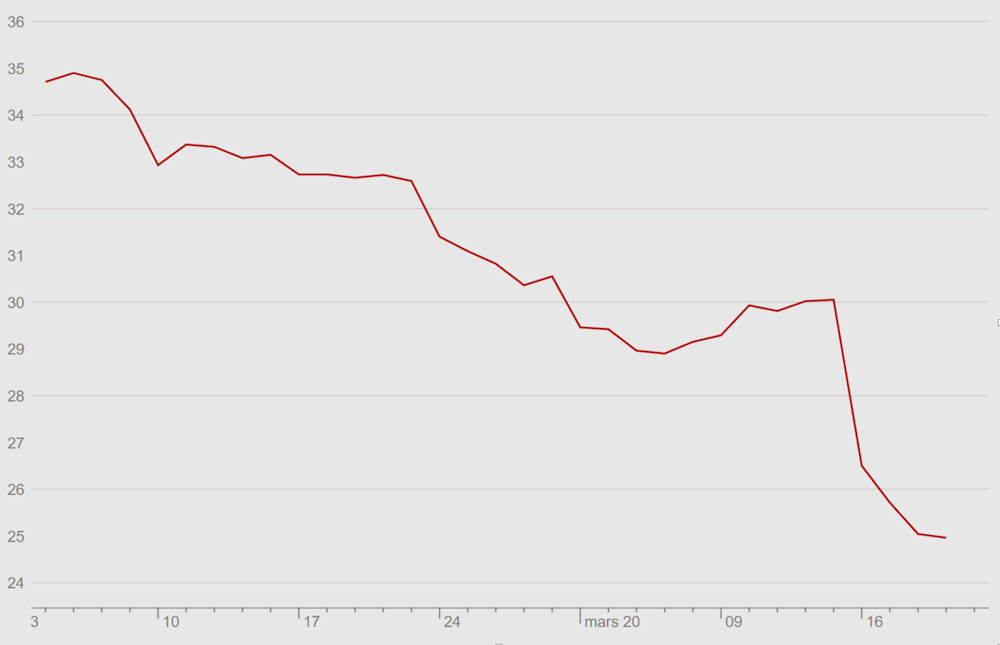
At the same time, the price per metric ton of CO₂ plummeted on the European market, falling in just a few weeks from 24 euros on March 10 to 15 euros on March 23, due to the decline in thermal power generation and, consequently,CO₂ emissions in Europe.
Although France’s electricity mix is more than 90% carbon-free, this is expected to further drive down wholesale prices due to interconnections with other Western European countries that emit moreCO2.
EEX, CC BY-NC-ND
Market Capitalization
The decline in revenue for electricity producers and suppliers will result in a drop in their stock market value. The market capitalization of these operators is expected to follow the trend observed across global stock markets.
Certain investments in electricity generation (such as gas-fired power plants) will become “stranded costs” because they will only be called upon to operate for a small number of hours per year, which will make it impossible for them to remain profitable.
Ultimately, this situation will likely lead to bankruptcies among the most vulnerable operators, or at least to a wave of mergers and acquisitions. This is true on a global scale, and probably in Europe as well; it is less certain in France, given the influence of the incumbent operator, which remains largely publicly owned.
A Decline in Investment Is on the Horizon
It is undoubtedly in the area of investment that the long-term effects will be most severe. The sustained decline in electricity demand—which is expected to continue if France enters a prolonged recession (negative economic growth)—will be accompanied by a drop in operators’ revenues and cash flow.
Consequently, we should expect not only the postponement of certain nuclear renovation investments but also a reduction in investments in new projects (renewable energy and even new nuclear power).
Similarly, the plunge in oil prices significantly increases the relative cost of investments in low-carbon energy and risks undermining energy efficiency—due to a lack of financial resources and because end consumers’ electricity bills will have fallen slightly. The fight against global warming and efforts to reduce energy consumption are likely to take a back seat in the coming months for many economic actors—starting with public policymakers.
It is likely that, for all these reasons, the process of liberalizing the energy sector will be slowed down and the reform of the electricity market postponed indefinitely.
Let's also not forget that electricity accounts for only a quarter of the Final energy consumption in France. Petroleum products account for the bulk of this consumption (46 percent). The situation in other sectors will also have a direct or indirect impact on the electricity sector. It is difficult to anticipate all the interactions, especially since it is unclear how long the global crisis will last or what its longer-term effects on the economy will be.
Boris Solier, Associate Professor of Economics, Research Associate at Art-Dev and the Chair in Climate Economics, University of Montpellier and Jacques Percebois, Professor Emeritus of Economics, Research Associate at the Climate Economics Chair (Paris-Dauphine), University of Montpellier
This article is republished from The Conversation under a Creative Commons license. Readthe original article.