Toads, fish, and nematode worms: the space station's odd menagerie
They are called “model organisms”: flies, mice, zebrafish, frogs, and nematode worms—all animals that researchers use for experiments, particularly because their biological structures are simpler than those of humans.
Simon Galas, University of Montpellier
This is crucial for basic biology and human health research, and it can be done both on Earth and in space. A prime example is NASA’s very recent “Worm in Space” mission, launched in December 2018, which sent 360,000 Caenorhabditis elegans roundworms into space!
Animal experimentation in space is nothing new. A review of missions conducted by NASA from 1965 to 2011 reveals no fewer than 382 experiments carried out on various platforms: the Gemini capsule, biological research satellites, NASA shuttles, the NASA/MIR platform, and more recently, aboard the International Space Station (ISS), which has been in low Earth orbit since the 2000s.
The goal is to better understand the effects of the space environment on living systems, and on humans in particular. Astronauts, in fact, undergo gradual physiological changes that become more pronounced as their stay progresses. These changes can lead to an increased risk of various conditions, including fractures, vision impairment, intracranial pressure, anemia, muscle atrophy, acute radiation syndrome, and immune system dysfunction. The use of model organisms subjected to the same stresses as astronauts helps prevent the onset of these problems.
NASA
Model organisms were also used very early on in space missions to determine the fundamental behaviors of living organisms. For example: How does Earth’s gravitational force influence living organisms and their development from the moment of fertilization? Answering this question required the use of numerous model organisms (plants, insects, fish, amphibians, and small mammals) and no fewer than fifty experiments conducted in space.
A Fertile Toad
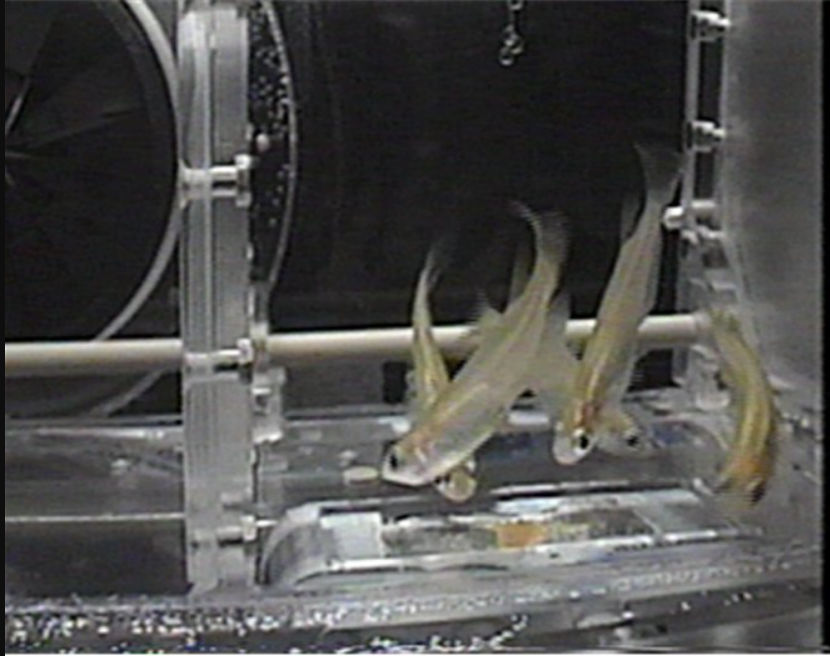
As early as 1965, frog eggs and fruit fly (Drosophila melanogaster) larvae carried aboard the Gemini mission showed normal development in the absence of gravity. Embryonic development was also tested in space during a famous 1992 experiment (Frog Embryology Experiment, Space Shuttle Spacelab Japan mission STS-47) conducted with a frog known as Xenopus (Xenopus laevis), which showed that Earth’s gravity was not required for ovulation, fertilization, embryonic development, or the formation of tadpoles capable of swimming.
NASA
Experiments on other models have shown that the most important processes of reproduction and development are independent of the strength of gravity. One such experiment, conducted in 1979 during the Russian Cosmos 1129 mission, demonstrated the ability of pregnant rats to carry pregnancies to term. However, subsequent experiments on very young rats revealed sensorimotor deficits and demonstrated reduced growth of motor neurons, thus indicating the existence of a period of sensitivity to gravitational force in the sensorimotor system during post-embryonic development.
Significant experiments have also been conducted in the fields of microbiology and infectious diseases. Given the growing importance attached to our microbiome—which weighs about 2 kg—we quickly become concerned about any changes that might occur to our microbial commensals in space!
Virulence in Space
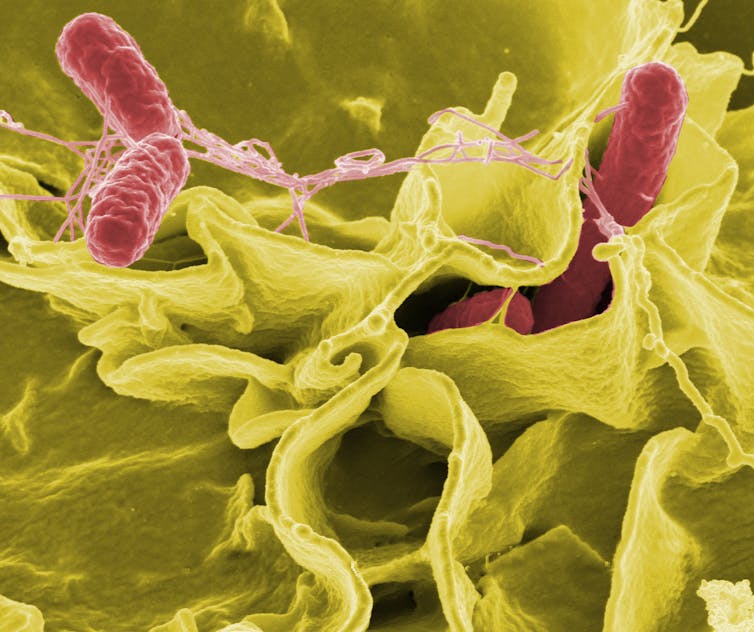
In 2006 and 2007, bacteria such as Salmonella enterica typhimurium (the pathogen that causes salmonellosis), Pseudomonas aeruginosa (nosocomial infections), Candida albicans (the fungus responsible for candidiasis), and Streptococcus pneumoniae (which causes pneumonia)—when sent into space—exhibited virulence traits that control cultures on Earth had not developed. Analysis of these bacteria revealed that their increased virulence in space was due to a single gene (Hfq), thereby demonstrating the immediate relevance of this discovery not only for preparing astronauts for their journeys but also for gaining a better understanding of these infectious bacterial agents, which are becoming increasingly resistant to treatment and are responsible for numerous deaths each year on Earth.
Wikipedia
Another important topic: Astronauts’ muscles change rapidly in space due to microgravity. Experiments to assess muscle changes in rats in space were conducted as early as 1965 by NASA. These experiments demonstrated a rapid decrease in muscle contraction strength, an increase in muscle contraction speed (velocity), a decrease in endurance accompanied by increased muscle fatigue, and a shortening of muscle fiber length. This last phenomenon has been linked, in both rats and humans, to the fetal posture adopted in space, which leads to gradual muscle atrophy.
The changes in muscle physiology observed in rats during spaceflight have been confirmed in humans and have led to the development of a set of exercises (walking and jogging on a treadmill) that astronauts are required to perform every day for 2 hours and 30 minutes in order to slow down these changes, which affect the muscles—sometimes very rapidly—at the beginning of a space mission.
The list below provides examples of observations made on model organisms during space missions related to human health:
- Chickens, geckos, quail, mice, and rats for studies on bone physiology in space;
- Fruit flies (Drosophila), human cell cultures, mice, and rats for observations on the immune system's responses to microgravity;
- Bacteria, fungi, cultured human cells, and yeast for observations on microbial growth and virulence;
- Chickens, mice, nematodes, and rats for studies on muscle physiology in space.
- Crickets, fish, quail, mice, newts, rats, toads, and snails for neurophysiological studies.
"Worm in Space"

NASA
The “Worm in Space” mission this December 2018 spotlights the nematode Caenorhabditis elegans. This non-parasitic roundworm, one millimeter long, can be found on most continents and feeds on bacteria in decaying fungi, plants, or fruit.
No fewer than three major discoveries in modern biology have already been made thanks to its meticulous observation, notably the mechanisms of apoptosis (programmed cell death) and the onset of cancer resulting from abnormalities in this process. Nematodes are an ideal model for studying how apoptosis functions in space in order to prevent the risk of cancer in astronomers. They are associated, on the one hand, with exposure to hazardous radiation in space and, on the other hand, with possible alterations in the normal functioning of apoptosis, which is responsible for eliminating cells damaged by radiation.
This little worm is no stranger to spaceflight. During the STS-42 mission, conducted in 1992 aboard the space shuttle Discovery, the nematodes were able to mate and reproduce over two generations without any apparent problems. But a few years later, the STS-76 mission, conducted in 1996 aboard the space shuttle Atlantis, revealed something entirely different! An abnormal mutation rate was observed in the nematodes, indicating for the first time a direct effect of cosmic rays on living organisms.
Worms Survive the Columbia Disaster
Following these experiments, it was proposed that nematodes be used in space as dosimeters to inform astronauts about the risks of mutations caused by cosmic rays. The nematodes were also on board the space shuttle Columbia on February1, 2003, for the STS-107 mission. A tragic accident during the mission caused an explosion that shattered the spacecraft and killed all seven crew members. However, scientists managed to recover, from debris from the Columbia that fell in Texas, a 4-kg container holding the nematodes from the scientific expedition. They had survived. Protected inside their container, they had already reproduced over several generations.
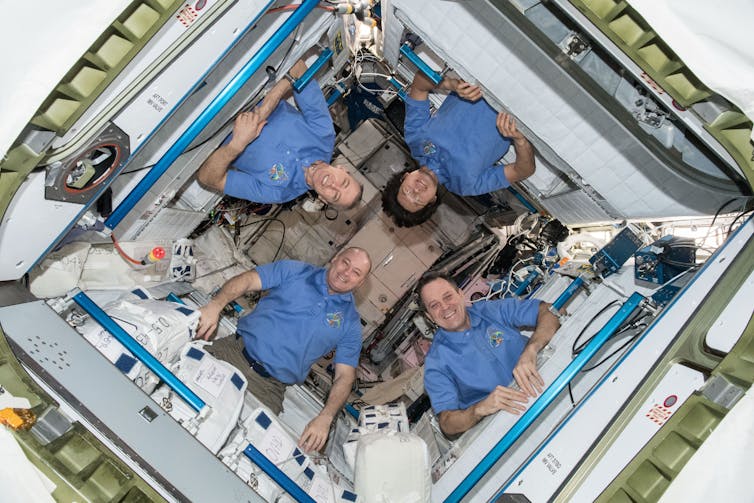
Let’s return to the “Worm in Space” mission. On Monday, December 3, the Soyuz MS-11 capsule docked with the International Space Station carrying three astronauts and nearly 360,000 Caenorhabditis elegans nematodes. This experiment is designed to study the 40% muscle loss that affects astronauts during long-duration missions. This loss is comparable to the muscle loss observed in men aged 40 to 80 as part of a natural process known as sarcopenia.
The muscles of the nematode
Placed in special bags with their artificial food, the nematodes will remain there for six and a half days, after which they will be frozen and then returned to Earth for analysis in 2019. Several experiments will be conducted. One of them involves studying a control group of normal nematodes against another group of nematodes in which genes important for the normal functioning of insulin have been modified. This hormone is known to be linked to the mechanisms of senescence and aging through its effect on glucose utilization by tissues, particularly muscles. The use of genetically modified Caenorhabditis elegans with variations in glucose utilization will help better define insulin’s role in the process of sarcopenia. This study aims to better understand why human muscles weaken as people age, in relation to the role of insulin.
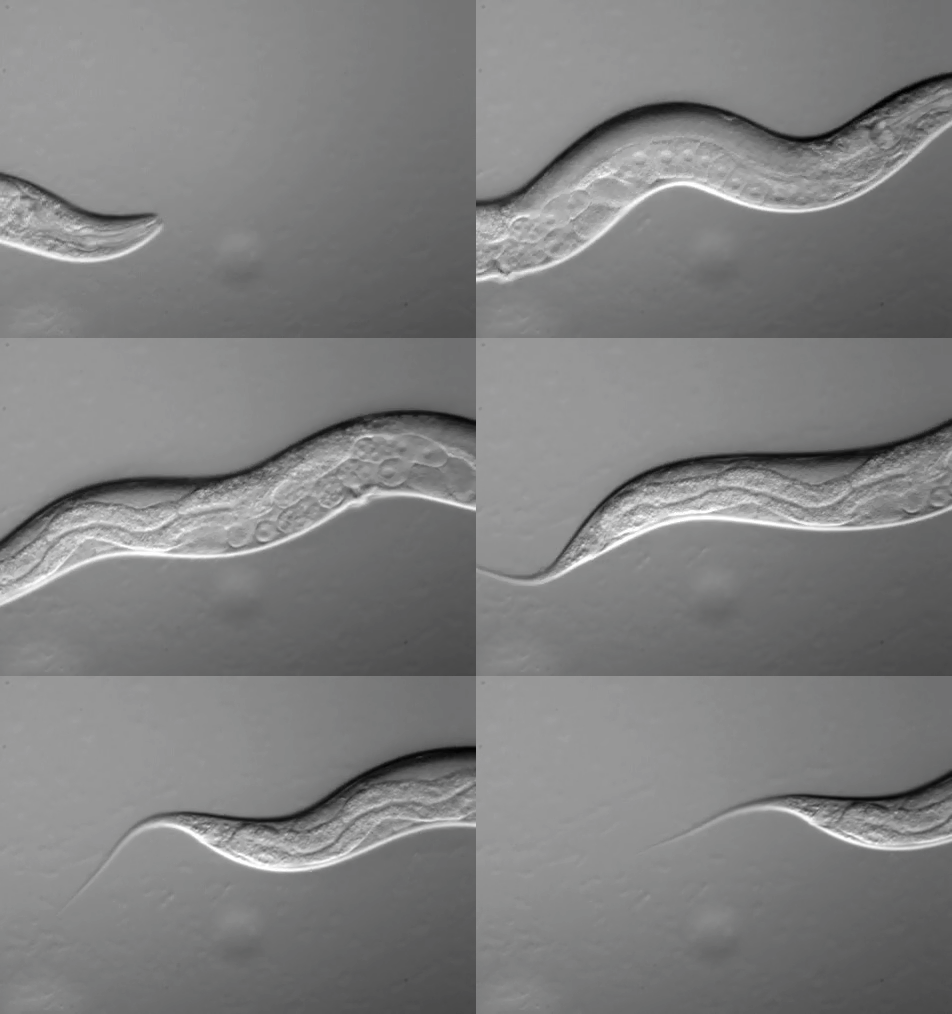
Another experiment will aim to determine whether the expression of certain genes in C. elegans is altered by exposure to microgravity. During previous missions, it was observed that the expression of 150 genes in the nematode was reduced during a stay in space. This set of 150 identified genes will be studied again during this mission to determine whether certain drugs can prevent or slow muscle loss during spaceflight. A complementary experiment will examine the functioning of the nematode’s motor neurons, which trigger muscle contraction.
Other possibilities are emerging. One example is the development of automated systems that would allow nematodes to be sent to other planets to study their fate over multiple generations. The general idea behind these space experiments is to better understand how humans live in space in order to prepare for missions to Mars. And, here on Earth, to better understand how the human body functions by observing the biological processes at work in the hostile environment of space.
Simon Galas, Professor of Genetics and Molecular Biology of Aging, CNRS – School of Pharmacy, University of Montpellier
This article is republished from The Conversation under a Creative Commons license. Readthe original article.