Creationists Against Science: The Situation in France
In our first article, we discussed the challenges associated with training teachers to effectively convey knowledge about the theory of evolution. Unfortunately, there is another challenge on the ground, one related to creationism.
Marc-André SELOSSE, National Museum of Natural History (MNHN) – Sorbonne Universities and Bernard GODELLE, University of Montpellier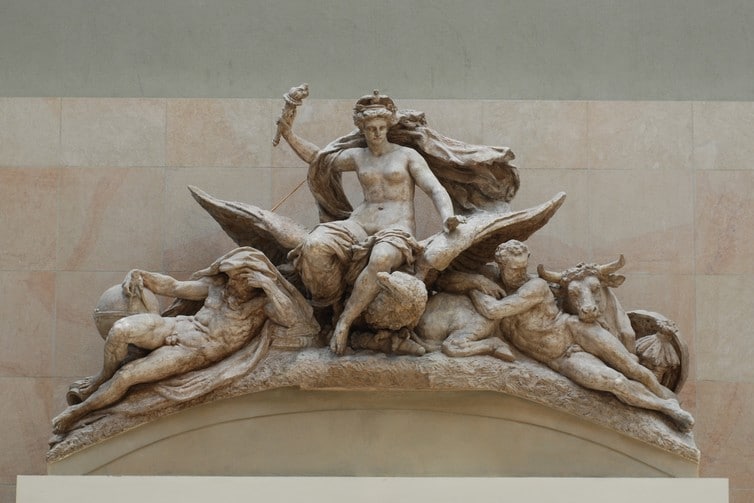
Carpeaux/Wikimedia, CC BY
Christian creationism has become less prominent, especially since John Paul II wrote that “new knowledge leads us to recognize the theory of evolution as more than just a hypothesis,” a view echoed by Pope Francis in 2014: “Evolution in nature is not incompatible with the concept of creation.” Even though these positions are not particularly divisive, the impact of Christian prejudices persists in more or less visible forms, and it is extremely difficult for science to free itself from them entirely.
With the stated goal of fostering dialogue between science and religion, various organizations and foundations support scientists who are creationists or who hold somewhat fringe viewpoints. Thus Anne Dambricourt-Malassé Did she see her anti-Darwinian ideas spread by a self-proclaimed “Interdisciplinary University of Paris“. In a more subtle way, but involving millions of dollars, the wealthy Templeton Foundation It funds a wide range of research, while promoting positive moral values and dialogue that are hard to criticize. Beyond the “Christian” objections to Darwinism, the fact that the projects funded by the Templeton Foundation are rooted in a positive moral framework illustrates just how much Darwinism is a source of discomfort for anyone who naturally desires human life to have meaning. This helps explain the funding of
works on altruism by Martin Nowak, whose views are somewhat unconventional in this field of research.


YouTube
The creationist movement active on the ground in France is predominantly Muslim: this comes as a surprise, since the Old Testament typically has little influence on this religion. Beyond Koranic texts and schools that preach against evolution, a notable campaign was led by Arun Yahya, a Turkish preacher (who has also been convicted multiple times in his home country): beginning in 2006, he sent the two volumes of the Atlas of Creation free of charge to thousands of schools and universities across Europe. These large-format books, richly illustrated in color but riddled with factual errors, explain the fallacy of evolution and how the truth is found in the Quran.
A major argument is the absence of transitional forms in the continuum of life, forcefully demonstrated through “morphing” animations illustrating the hypothetical intermediates between fish and frogs, reptiles and birds, etc.—which, of course, do not exist. However, according to the theory of evolution, there is no absolute need for “missing links” (since evolution can make leaps), nor is there a need for them to still exist today (since they may be extinct)! It is telling that creationism exploits a misunderstanding of the mechanisms of evolution—in short, a flaw in education…
The Need to Teach
The publication of this creationist book brought together faculty from universities and secondary schools around the need to teach evolution. This led to a national symposium at La Villette in November 2008, titled “Teaching Evolution.” Alas! Faced with certain indoctrinated students, the task can sometimes turn into a nightmare: some students go through the motions while inwardly rejecting the lesson, while others openly refuse to listen. Some teachers avoid even saying the word “evolution,” as stating the facts and engaging in reflection present fewer difficulties.
It is troubling that educational research currently provides very little support or methodology to help teachers who are left to their own devices in navigating these difficult pedagogical challenges. Thus, despite teaching efforts, a two-tiered society is taking shape, in which those who accept evolution receive a more in-depth education on its mechanisms, while others reject it—often as a prelude to rejecting other values as well.
What should I do tomorrow?
One possible solution relates directly to education and goes beyond the issue of evolution. There is indeed concern about excessive mistrust of vaccines and biotechnology, or about consumers’ gullibility when faced with dubious products or pseudoscientific practices: the reactions of citizens (and even politicians) are not always rational. But isn’t all of this due to a single, underlying lack of education?

NASA JSC Features/Wikipedia
Rather than worrying about each of these problems separately, shouldn’t we provide a more solid scientific education and ensure that the next generation has a greater capacity for critical thinking? To achieve this, we would need more instruction in the experimental sciences. Rather than debating how to allocate class hours among disciplines, it would make much more sense to reflect on how to make the best use of all available class time. If the scientific method and critical thinking regarding issues related to living organisms and the environment are developed only during the weekly Life and Earth Sciences class (or not at all, in programs where this instruction is absent), there is cause for concern about the choices tomorrow’s citizens will make regarding their diet, healthcare, environmental management, and child-rearing. This meager foundation explains why citizens make absurd personal and societal decisions.
But where can we free up some time? Today, the teaching of French and math is too isolated: couldn’t we partially integrate these two subjects into science education? It makes no sense to study music theory before playing music, when you’re actually practicing music theory while you play… Writing a biology argument or doing calculations in physics is also a way to practice French and math.
 The current introduction of interdisciplinary approaches in secondary education may provide an opportunity for such innovation. In the future, placing greater emphasis on teaching the scientific method in biology would address many shortcomings: it would help align students’ worldview with that of science and enable them to understand the world’s challenges from a holistic perspective, particularly with regard to evolution.
Marc-André SELOSSE, Professor at the National Museum of Natural History, Visiting Professor at the Universities of Gdańsk (Poland) and Viçosa (Brazil), National Museum of Natural History (MNHN) – Sorbonne Universities and Bernard GODELLE, Professor of Human Evolutionary Biology, University of Montpellier
The original version This article was published on The Conversation.