Cranial deformation: practiced by the Incas, it is also a universal custom
Barbarism, torture, savagery—these are the first words that come to mind when skull deformations are mentioned. In 1931, the English anthropologist J. Dingwall made the following observation: “It is likely that this curious yet widespread custom of artificially deforming the skull is the least understood of all the ethnic mutilations that have been passed down since ancient times.”
Jérome Thomas, University of Montpellier
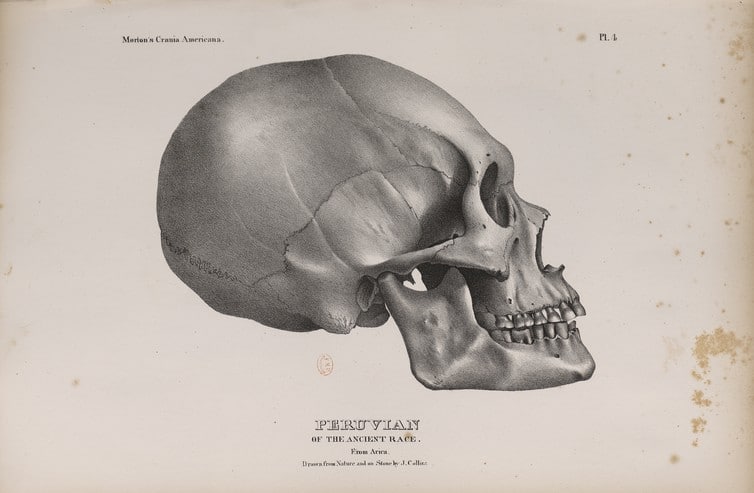
Indeed, they provoke condemnation and horror, disgust and dismay, and bear the—supposed—hallmarks of societies that are underdeveloped and, above all, exotic, far removed from our European lands.
Alien Skulls
Beyond an almost visceral revulsion, these deformities also give rise to numerous fantasies and spark the imagination. They are said to be proof of the existence of extraterrestrial races with superior intelligence that colonized our planet in ancient times.
In 2012, a newspaper ran the headline “Alien Skeletons?” regarding the discovery in Mexico of human remains with deformed skulls. In the19th century, anthropologists such as von Tschudi even disputed the artificial nature of skull deformations.
Far from these clichés and sensationalism, the manipulation of the occiput, on the contrary, offers a vast field of study on the relationship to the body in its cultural, social, ethnic, and religious dimensions.
Influencing head growth to deliberately alter its shape is a widespread practice among humans.

J. Thomas, Author provided
An ancient and universal practice
The artificial deformation of newborns’ skulls is an ancient, universal tradition. From Europe to the Americas, including Africa, Asia, and Oceania, no region was exempt from skull shaping.
The earliest evidence of this practice dates back to around 45,000 B.C. in Iraq. However, researchers continue to debate whether the skull fragments discovered show signs of deformation.
On the American continent, this custom has accompanied the development of Andean communities since at least the6th millennium B.C. and became a nearly universal practice. In a collection of 500 Peruvian skeletons housed in Paris, only 60 show no signs of deformation. At many excavated sites in Mesoamerica, individuals with deformed skulls account for more than 90% of the cases observed. In Mexico, the oldest deformed skull discovered by archaeologists is estimated to date from 8500–7000 BCE.
In South America, cranial deformations most likely developed along the Pacific coast around 3500–3000 BCE.

National Museum of Archaeology, Anthropology, and History of Peru in Lima, Author provided
Some societies made remarkable use of this practice. The Chinchorro culture (c. 7000 BCE to c. 1100 BCE), which flourished in the far north of Chile and southern Peru, practiced a very pronounced form of deformation beginning in thethird millennium. Several ethnic groups adopted these customs, the best known of which include the Paracas (600 BCE–100 CE), Nazca (200 BCE–600 CE), and Tiwanaku (c. 700–c. 1200 CE) cultures around Lake Titicaca.
These practices remained widespread in these regions even as the Incas came to dominate much of the Cordillera beginning in the mid-15th century. A number of communities under their rule had long practiced artificially deforming the occiput of infants, following the example of their conquerors.
In 1557, the Italian philosopher Girolamo Cardano listed the regions where these practices were still carried out: Cuba, Mexico, Cumana (Venezuela), Porto Velho (Brazil), and Peru. In the 1550s, the priest Cieza de León mentioned that north of Cali, in Colombia, lived a people whose heads he described as long and broad, adding that in many regions children had deformed heads, which delighted their parents.
The Spaniards were deeply impressed by this custom, which seemed so strange to them. Indeed, by the16th century, it was practiced only exceptionally and sporadically in a few regions of Northern Europe.
The Spaniards fought fiercely against this practice. They sensed, more than they understood, the religious dimension of these deformations. At theThird Council of Lima (1585), religious authorities decided to impose a stricter ban on cranial deformations and to punish them severely: 20 lashes for anyone who deformed their head. Yet the practice persisted for a long time.
How did the Incas do it?
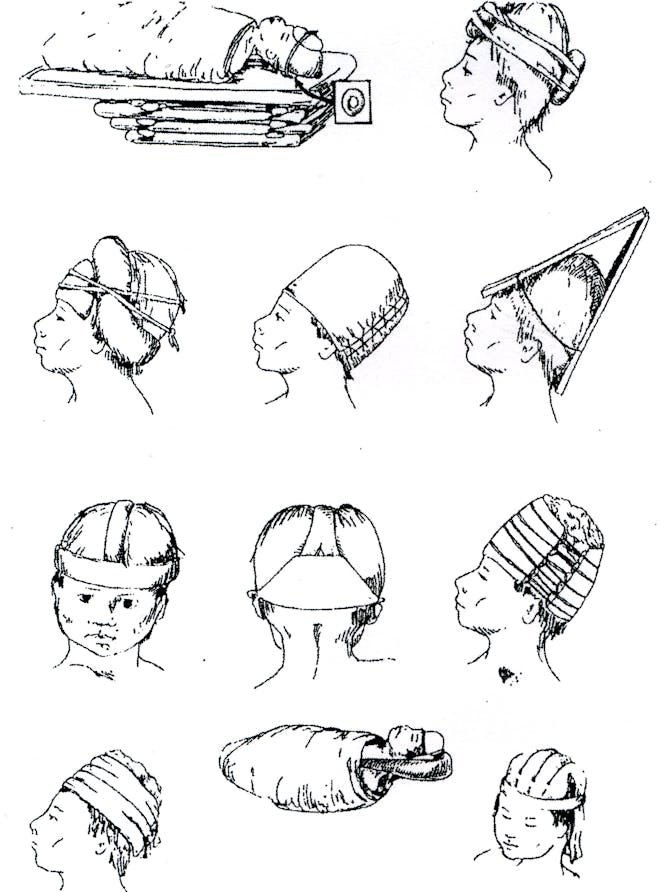
Several techniques are used to reshape skulls. They are universal. A child’s skull is very malleable, and this flexibility makes it possible to reshape it before its final form is established. The cranial vault is remarkably pliable and well-suited to this type of manipulation. Final ossification does not occur until the age of six. The sutures of the cranial vault allow for some mobility between the bones, and external compressive forces—such as splints or strips—cause the sutures to widen as they bear the direct effects of these forces.

J.T., Author provided
Heads were deformed using several methods, with the flattening affecting either the top of the skull or the sides. Three types of head-shaping devices were used: the cradle, in which the deformation was achieved by applying pressure to the head of the newborn while it lay immobilized in a wooden cradle; the wooden strips, in which the head was clamped between two pieces of wood placed across the forehead and the back of the neck, thereby flattening the skull from front to back. This is the flattening known as the “tabular type”; finally, there are bindings or headbands, often called chuco, in which the skull is compressed from birth using a very tight bandage. This is the “annular or circular” type. This last technique is the one most frequently described by the Spanish in what was once the Inca Empire.
Deforming skulls to bind the soul to the body
But why did the Incas deform skulls?
Skull shaping allows people to distinguish one group from another, indelibly imprints group identity on the body, adorns and beautifies individuals, signifies social status, and reflects religion, cosmology, beliefs, and initiation rites.
However, researchers have focused primarily on the cultural, social, and ethnic dimensions of these practices, even though the religious dimension is fundamental.
The head represents the center of an individual’s spiritual life. It is the seat of vital force and symbolizes the spirit. The animic force—that is, a beneficial and spiritual power—present in the head is perceived as a beneficial power that bestows strength, authority, and vitality upon its bearer and can be appropriated provided it is controlled. The head can be associated with two main characteristics: it metaphorically represents the cosmos, and it is the vessel of the soul.
In Inca cosmology, there is a bodily dichotomy: front/back—the Incas associated the front of the body with the past and clarity, and the back with the future and darkness—and a dichotomy of high/low, with the head corresponding to the upper world, that of the ideal body represented by the celestial bodies. Finally, several spiritual principles surround and animate the human body. One of the most important is animu, a term borrowed from the Spanish anima, “soul,” which is a “spiritual force” that is not limited to humans.
The animu is distributed throughout the body but can be concentrated in certain areas and bodily substances: primarily the head, the blood, and the heart. The animu is a vital force that animates all things, whether human beings, plants, animals, or elements of the landscape. The animu originates at the solar plexus, circulates throughout the body, and exits through the head at death. Firmly pressing down on a child’s head at birth therefore becomes an imperative and vital step, as the soul is not yet firmly anchored to the newborn’s body, which can lead to the loss of the animu. Indeed, the fontanelle is not yet fully closed in infants.
In order to anchor the soul to the body, the use of technical methods, such as cranial deformation, is essential and imperative. Deforming the head means hardening and sealing the body, solidifying it, and restoring order to at least one of its openings.
J.T., Author provided
Although they have since disappeared, they were still practiced in the Andes by the Chama, a community settled in northeastern Peru, in the mid-20th centurye In the 19th century, cranial deformations were evidence of a universal practice found across all social strata.
 While in our contemporary societies, practices involving bodily modification are perceived as markers of identity formation and the assertion of a “sovereign self,” this interpretive framework should not be applied to older civilizations—and those of the Andes in particular. Doing so would overlook a fundamental element necessary for understanding them: their cosmological and religious dimension. Symbolically, in these societies, the manipulation of the occiput—like any form of body adornment—plays a vital role, as it distinguishes, adorns, and protects. It wards off harmful foreign influences and protects the body—and its most vulnerable parts—from spells. Manipulating the head, the most visible and exposed part of the body, sends a powerful signal. It is an extremely important symbolic language, and the Peruvian peoples were no exception.
Jérome Thomas, Researcher, University of Montpellier
The original version This article was published on The Conversation.