The Cost of Nuclear Electricity: The Details of the Mechanism Proposed by the Government for the New EPR2 Reactors
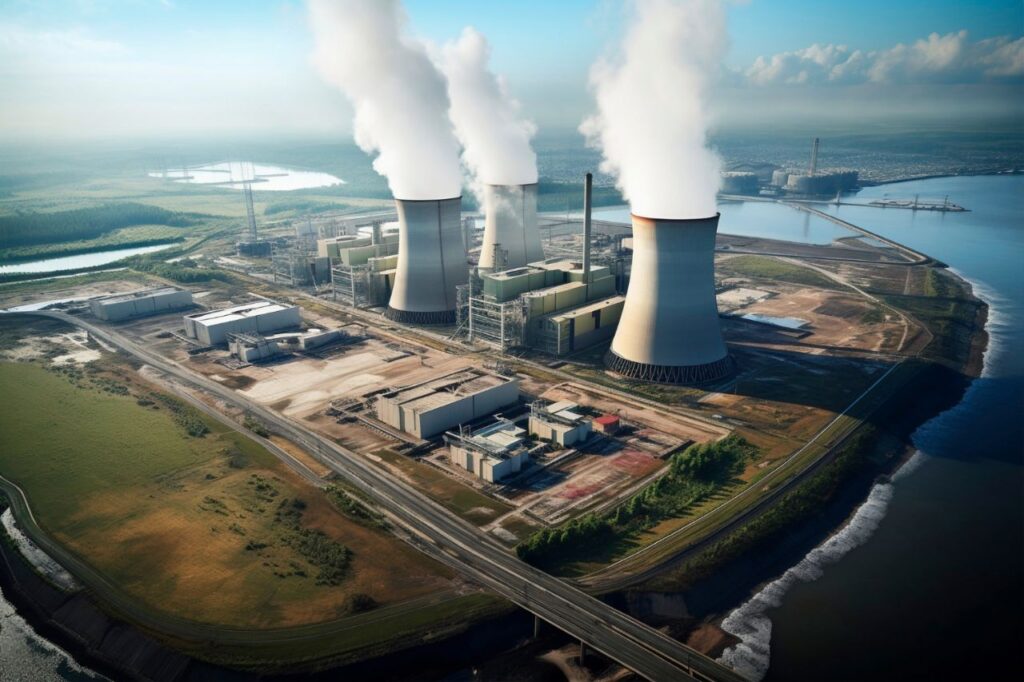
A cornerstone of France’s energy strategy to gradually replace its aging nuclear fleet and achieve carbon neutrality, the construction of six new EPR2 reactors—an optimized version of the EPR—located in pairs at the Penly, Gravelines, and Bugey sites, represents a colossal industrial undertaking.
Alexis Vessat, University of Montpellier
THE ESSENTIALS
- To finance the six future EPR2 nuclear reactors, France has proposed an unprecedented financial mechanism to the European Union: the “contract for difference.”
- Far from being a simple price guarantee, this mechanism subtly redistributes economic risks among the government, EDF, and consumers.
- The question arises as to whether all the lessons from the previous system—the Regulated Access to Historic Nuclear Electricity (Arenh)—have been fully absorbed.
Preliminary work has already begun in Penly and then in Gravelines, but the final investment decision is expected by the end of 2026. While the first plants are not expected to come online until 2038, the terms agreed upon between the government, EDF, and consumers for sharing costs—and, in particular, for stabilizing prices in the event that production falls short of forecasts—must be defined well in advance.
To that end, the French government has proposed to the European Commission an innovative financial arrangement to stabilize revenue from electricity generation over a 40-year period, relying in particular on contracts for difference. These contracts are governed by the new 2024 European regulation on the organization of the electricity market, a model that France is adopting here.
The goal is to reduce the risk of lost revenue for the producer, make the project easier to finance, and limit the cost of capital. However, the proposed scheme for the EPR2 reactors involves some new complexities. It remains to be seen whether the government and consumers will come out ahead.
From the ARENH to the “contract for difference”: distinct objectives
To understand the implications of the future EPR2 contract, it is necessary to consider it in relation to the formerRegulated Access to Historic Nuclear Electricity (Arenh) program. This system, which was in effect from 2011 to 2025, sought to share the profits from a fleet of reactors that had already been fully depreciated by requiring EDF to sell a fixed volume of electricity at a regulated price (42 euros/MWh) to its competitors.
The new contract for difference (CfD) addresses a contrasting challenge: that of making tens of billions of euros in new investments financially viable, even though the wholesale market sets prices on an hourly basis based on short-term production costs. However, building power plants requires visibility spanning nearly half a century—something this short-term market cannot offer to financiers—hence the proposed mechanism.
The Electricity Market: A Guide
- The wholesale market: This is the virtual market where electricity is bought and sold in large quantities among producers (such as EDF), suppliers (who resell it to consumers), and traders, before it enters the grid.
- The spot market (or day-ahead market): A component of the wholesale market where electricity is traded for delivery the following day, on an hourly basis. Its price fluctuates significantly depending on weather conditions, demand, and the availability of power plants.
- Marginal cost: In the spot market, the hourly equilibrium price is determined by the cost of the last power plant called upon to meet demand (often a gas-fired plant). It reflects the short-term equilibrium but does not guarantee that a nuclear power plant’s fixed costs will be covered over a 40-year period.
- The Contract for Difference (CfD): A “smoothing” financial instrument that does not replace the wholesale market. The generator continues to sell its electricity on the market at the daily price, then settles its actual revenue with the government ex post based on a price agreed upon in advance.
Unlike the ARENH, the CfD does not remove electricity from the wholesale market: EDF sells its generation on the spot market, and then a financial balancing mechanism kicks in ex post (that is, after the fact). The government therefore does not set any feed-in tariff; instead, it provides the market with protection against the risk of revenue loss in order to limit the cost of capital.
A payment calculated based on theoretical production
The basic principle of a two-way contract for difference is simple: the utility will sell electricity from the new reactors on the wholesale market. Then, at the end of the year, the market price is compared to a “strike price,” set in advance by the contract. If the market price was lower than the strike price, the government will pay the difference to EDF. If it was higher, EDF will pay the surplus back to the government.
What sets the EPR2 contract apart is the basis for this calculation. In principle, the price difference will not be multiplied by the reactors’ actual output, but by a fixed reference volume, initially estimated at more than 66 TWh per year for the six reactors.
Let’s look at a concrete example. Imagine a reference volume of 60 TWh, an exercise price of 100 euros per megawatt-hour (MWh), and a year in which actual production fell to 36 terawatt-hours (TWh) due to outages, adverse weather conditions, or maintenance requirements. To isolate the mechanism, let’s assume that sales are made at the average price for the year, disregard other revenues, and assume prices above the variable cost of production.
- If market prices fall to 50 €/MWh, then the government will compensate for the 50 € difference on the entire 60 TWh (or 3 billion euros).
- EDF's total revenue amounted to 4.8 billion euros, compared with just 3.6 billion if the contract had covered only actual production.
The reference volume thus protects the project’s financing against production risks when prices are low. But does this mechanism also protect the government (and, indirectly, consumers and taxpayers) when electricity prices skyrocket?
A Fundamental Asymmetry
If the market price exceeds the strike price while production is low, strictly applying the reference volume would force EDF to make payments for electricity it was unable to sell. To avoid this extreme situation, the draft contract introduces an adjustment clause.
As soon as production falls below a certain threshold (which rises along with the market price, so that, for a given level of production, the clause applies only when the price is high enough), the payment due to the government is then calculated based on actual production, plus a flat-rate component equal to a percentage denoted as X (yet to be determined, capped at 10%) of the exercise price multiplied by the reference volume.
Contrary to what a quick reading might suggest, this 10% cap does not represent the maximum limit on the total amount of the royalty payment. This 10% cap applies to the component added to the royalty calculated based on actual production. In other words, the total royalty payment continues to increase with the price when the clause is active.
This formula thus creates an asymmetry between periods of low prices and periods of high prices. Let's return to our example:
- If the price is 50 euros below the strike price, the government pays compensation calculated based on the theoretical 60 TWh.
- If the price is 50 euros above the exercise price, the producer’s payment to the government is recalculated based on the adjusted tax base.
All possible cases can be represented by the following table, still based on the assumptions of the example and with the percentage X assumed to be at its maximum of 10%:
Above the exercise price, as noted above, EDF’s payment is calculated based on the reference volume of 60 TWh or, when the adjustment clause applies, on the actual production of 36 TWh, plus the flat-rate component (0.6 billion euros in our example).
In this example, both calculations result in the same payment for a price of 125 €/MWh; above that level, the second calculation yields a lower amount, and it is this amount that is used. Consequently, with production remaining unchanged, EDF’s revenue remains at 3 billion euros and is no longer dependent on the market price. The last column shows, for comparison, the revenue from a contract based solely on actual production, with no flat-rate component (3.6 billion euros).
This asymmetry can be understood as a way to preserve the operator’s financial viability in the event of a major technical failure combined with very high market prices.
Lessons from the Past and Risks for the Future
This asymmetry raises the question of whether the operator still has an incentive to run its power plants at maximum capacity, and to what extent the government will be able to adjust the key parameters of this calculation as economic conditions change.
Indeed, a contract that is too protective of EDF could disconnect the generator from the realities of the grid. Conversely, if every megawatt generated during periods of high demand is subject to an excessive levy, the incentive to operate the industrial facilities diminishes. The European Commission, which is currently reviewing the French proposal, has tentatively concluded that payment based on the reference volume can maintain effective incentives for operation and maintenance, but now wishes to ensure that the mechanism does not create distortions in the electricity market or result in undue overcompensation.
The provision also affects incentives to generate electricity. When it applies—assuming the annual reference price remains unchanged—each additional megawatt-hour increases the electricity producer’s payment to the government (the difference between the reference price and the exercise price). The producer remains incentivized to generate electricity only when the price obtained covers this additional levy and the corresponding costs. The proper calibration of the contract parameters must therefore balance securing financing with incentives to operate the reactors.
The recent history of nuclear regulation in France, moreover, calls for caution. One of the main pitfalls of the ARENH system was the freeze on its administered price (42 euros/MWh), which remained virtually unchanged for fourteen years even as it became obsolete, since the decree that was supposed to establish the method for updating it never took effect.
For the EPR2 reactors, the proposed contract stipulates that six key parameters—including the reference volume and the definition of the reference price—may be revised periodically, in principle every five years. This is a major step forward in adapting the contract to changes in actual costs and market conditions. However, the more a contract is subject to revision, the more transparent and independent the updating method must be to avoid any regulatory or political risks.
This 40-year contract does not necessarily entail a fixed cost for the government, which will instead act as a buffer: the government will pay if market prices fall and recoup revenue if they soar. The publication of the final figures will make it possible to assess whether the balance achieved will truly protect consumers.
Alexis Vessat, Energy Economist and Postdoctoral Researcher at the University of Montpellier, University of Montpellier
This article is republished from The Conversation under a Creative Commons license. Readthe original article.