Bees are buzzing at the Béziers University Institute of Technology
Since June 1, 2015, the Béziers University Institute of Technology (IUT) has installed two hives of Caucasian bees on its roof for educational and research purposes.
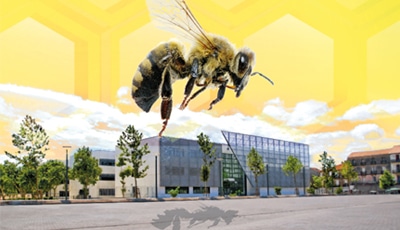 This project has multiple objectives: to help raise awareness among students and, more broadly, the general public about the decline of bees; to contribute to the protection of local biodiversity through the pollinating role of bees; to engage faculty and students in various innovative educational projects related to “connected hives”; and to participate in innovative technical, technological, and scientific projects related to beekeeping and research.
An Apiary 2.0!
“You’ve got an e-miel!” That’s the name of the IUT’s collaborative project that will connect beehives to the Internet. The concept is simple: the hives are equipped with sensors, cameras, and other measuring devices that allow beekeepers, researchers, or members of the public to monitor, analyze, or simply observe them. This project aims to provide researchers with new tools to better understand CCD (Colony Collapse Disorder).
Students from the IUT’s three departments—networks and telecommunications, marketing techniques, and multimedia and Internet professions—will work on study projects to develop a “smart hive” connected to the Internet that transmits images and physical data (temperature, humidity, etc.). The goal is to put this innovative hive into operation in the spring of 2016.
As part of this project, the IUT is collaborating with leading scientific research laboratories in this field; their teams have contributed to the development of the project’s specifications.
The Decline of Honeybees
Particularly noticeable in Europe since the early 2000s, this syndrome manifests as beehives suddenly losing almost all their bees at the end of winter or even during the warmer months. This crisis is naturally a cause for concern among beekeepers, as well as ecologists and other agricultural experts, due to the impact of reduced pollination on our agricultural economy. According to the French National Institute for Agricultural Research ( Research , INRA), 84% of crop species in Europe depend directly on pollinators, more than 90% of which are bees.