Healthcare workers are rallying to defend public hospitals
Symbolic funerals, moments of silence, declarations of love… In recent years, in the face of the erosion of the public hospital system, many healthcare workers have turned to original forms of protest that center on death and love. It is a way of reminding people that healthcare is not a commodity but a pillar of society.
Ludivine Perray-Redslob, EM Lyon Business School; Agathe Morinière, University of Montpellier and Nathalie Clavijo, TBS Education
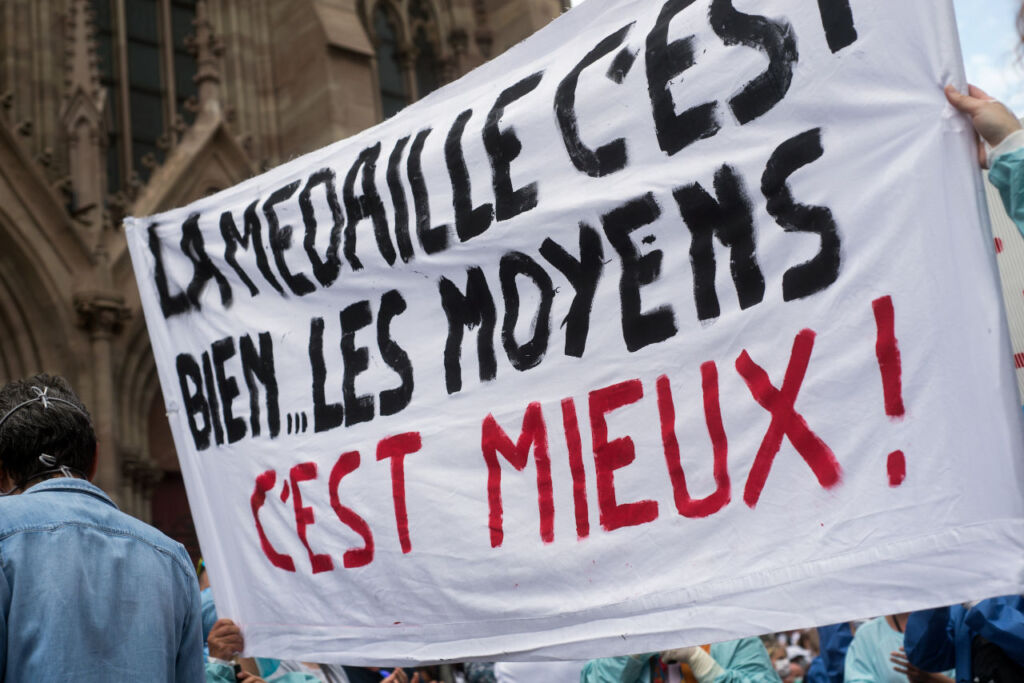
Insufficient resources, staff shortages, violence in emergency rooms, bed closures, and burnout among healthcare staff… warning signs have been multiplying in French publichospitals since the implementation of reforms under the “new public management” initiative.
Last January, the emergency room staff at the Rennes Hospital (Ille-et-Vilaine) went on strike following the deaths of two patients who were waiting on stretchers. In Aix-en-Provence (Bouches-du-Rhône), that same month, a patient waiting for a spot in the emergency room died before she could be treated. On January 8, 2026, Health Minister Stéphanie Rist reported “strain in all emergency departments.” All these events illustrate the ongoing nature of the problem.
However, since 2019, in response to these recurring situations, two coalitions of healthcare workers—the Collectif Inter-Urgences and the Collectif Inter-Hôpitaux—have been raising awareness about the human consequences of these profit-driven healthcare policies by taking to the streets and social media.
We conducted a four-year investigation into these two collectives and collected texts, songs, music videos, photographs, videos, and drawings—either produced by the healthcare workers themselves or shared by these collectives on social media. In their demands, healthcare workers draw on death and love as political languages to examine our collective relationship to care, public service, and solidarity.
Symbolically “killing off” the hospital to raise awareness
Coffins carried through the streets, funeral processions, moments of silence organized in front of hospitals: at first glance, these scenes may seem surprising. Why symbolically “bury” the public hospital when healthcare workers are fighting to save it? Because the symbolism of death acts as a wake-up call. By staging the death of the hospital, healthcare workers seek to raise awareness: without a collective response, this essential pillar of our society risks disappearing. These mourning rituals give visible form to a slow and often invisible process: the gradual erosion of the public health care system.
Death also serves as a reminder of a self-evident truth that accounting logic tends to obscure: hospitals are vital infrastructure. We all depend on them, sooner or later. In this sense, death is not merely an end; it becomes a political language for expressing the urgency of action.
Highlighting the Vulnerability of Healthcare Workers
The protests are not limited to the hospital as an institution. They also draw attention to the bodies of those who work there. During some demonstrations, healthcare workers simulate their own deaths in public spaces, lying on the ground with a syringe symbolically pointed at their heads. Others stage scenes of suffocation to denounce working conditions that have become stifling.
These images are powerful, and at times shocking. Yet they reflect a reality that has been extensively documented in certain departments: excessive workloads, the inability to take breaks, a sense that time is racing by, conflicting values, psychological distress, burnout, and even suicides. By exposing their vulnerability, healthcare workers are breaking away from the heroic—yet dangerous—image of caregivers driven by a calling that transcends their physiological, psychological, and human needs.
They thus remind us that caregivers also need protection and that, when healthcare workers’ occupational health deteriorates, patients suffer the consequences.
Declaring Your Love at a Public Hospital
Alongside these depictions of death, another symbol runs through the protests: love. Banners proclaiming “I love my hospital,” heart-shaped Post-it notes stuck to the walls, letters addressed to the public hospital in the style of love letters… Healthcare workers have invited citizens to express their attachment to this institution. This love is anything but naive. It is deeply political. By declaring their love for the public hospital, citizens are asserting that healthcare cannot be reduced to a market-driven service. They are reminding us that the hospital embodies the values of solidarity, equality, and care for the most vulnerable.
Love then becomes an act of resistance: to love the public hospital is to refuse to let it be managed solely on the basis of profitability.
A Collective Responsibility
These protests outline an ethic of life and death, in which care is conceived as a collective responsibility, relying both on public infrastructure and on human relationships that acknowledge our vulnerabilities and our universal interdependence. The acts of love, solidarity, and compassion highlighted in these movements remind us that care is not merely a technical act, but a human relationship grounded in attentiveness to others.
The ethics of life and death as conceived in these movements also involves making care a public matter. In other words, it means collectively committing to bringing to light what is usually hidden: vulnerable bodies, degrading situations, and the gradual demise of the public hospital system.
The crisis in public hospitals is not just a management issue. It raises a fundamental question: what place do we want to give to healthcare in our society? Do we accept that some lives are worth less than others because of a lack of resources? Or do we view healthcare as a common good that we must collectively preserve?
By drawing on the themes of death and love, caregivers invite society to reflect on the conditions necessary for a life worth living and on what we are willing to do to preserve those conditions.
Ludivine Perray-Redslob, Associate Professor of Accounting, EM Lyon Business School; Agathe Morinière, Lecturer and Researcher, University of Montpellier and Nathalie Clavijo, Ph.D. in Management Science, TBS Education
This article is republished from The Conversation under a Creative Commons license. Readthe original article.