“Drop Odyssey”: a serious game to understand the water cycle
On Tuesday, September 23, the European Institute of Membranes (IEM) at the University of Montpellier will host the official launch of “Drop Odyssey,” an educational game focused on the water cycle and water conservation. Designed by Julie Mendret, a researcher at the University of Montpellier renowned for her work on water, and by the educational game design studio DOWiNO, this serious game aims to raise awareness among people of all ages about the critical issues related to water resources, from its collection to its return to the natural environment. The event will be attended by Philippe Augé, President of the University of Montpellier; David Cornu, Director ofIEM; Lionel Torres, Director of Polytech Montpellier; and Grégory Vallée, Director of the Montpellier Méditerranée Métropole Water Authority.
An immersive and educational game
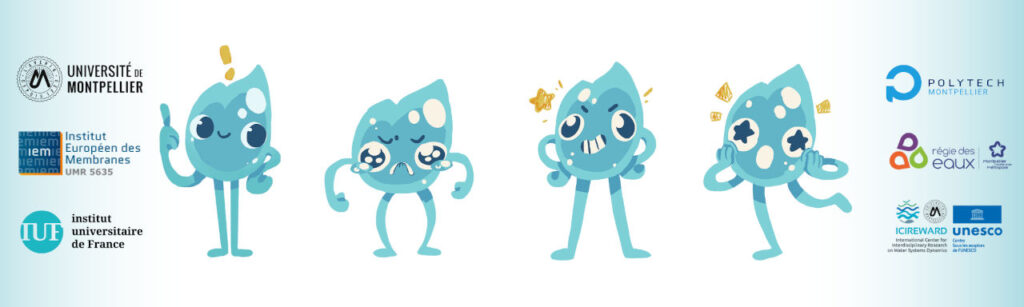
“Drop Odyssey” features Lézia, an adventurous water droplet who guides players through the different stages of water treatment. In two fun modules, each lasting about 15 minutes, the game lets players discover:
- The water treatment process: from water collection to treatment (clarification, disinfection, storage, and distribution) to make it safe to drink.
- The wastewater treatment sector: the path water takes from domestic use through various treatment stages (primary, secondary, tertiary, and quaternary) until it is discharged into the natural environment or reused.
Accessible to everyone, this game combines scientific rigor with a fun approach to help us better understand the invisible journey that every drop of water takes before reaching the tap and after it has been used.
Understanding and Taking Action: Water, a Major Issue for the University of Montpellier
Beyond its entertaining nature, “Drop Odyssey” addresses a fundamental issue: raising awareness about water conservation and innovative solutions for a sustainable future. This serious game is part of the University of Montpellier’s long tradition of excellence in water research, driven by its internationally renowned institutes and laboratories, includingIEM the EPUM (École Pratique des Hautes Études de l’Eau et de l’Environnement).
The game's educational objectives are clear:
- Identify the various sources of water pollution.
- Learn how water is collected, treated, purified, and reused.
- Raise awareness about emerging pollutants (PFAS, pharmaceutical residues).
- Highlight the importance of reusing treated water (REUT) within a circular economy framework.
By placing research and education at the heart of this project, the University of Montpellier reaffirms its central role in training and raising awareness about major environmental and societal challenges.
Practical information:
- Date: Tuesday, September 23, 2025, from 9 a.m. to 12 p.m.
- Location: European Institute of Membranes – University of Montpellier
- Registration
- More information about the European Membrane Institute
- For any questions or requests: email.