[LUM#15] Ebola: Is It Still Around?
Patients who continue to suffer more than four years after their recovery, and a virus that plays hide-and-seek with our immune system. This is the focus of the research conducted by Alpha Keita and Eric Delaporte, along with teams from TransVIHMI and CERFIG, who have uncovered a true paradigm shift in Ebola virus transmission.
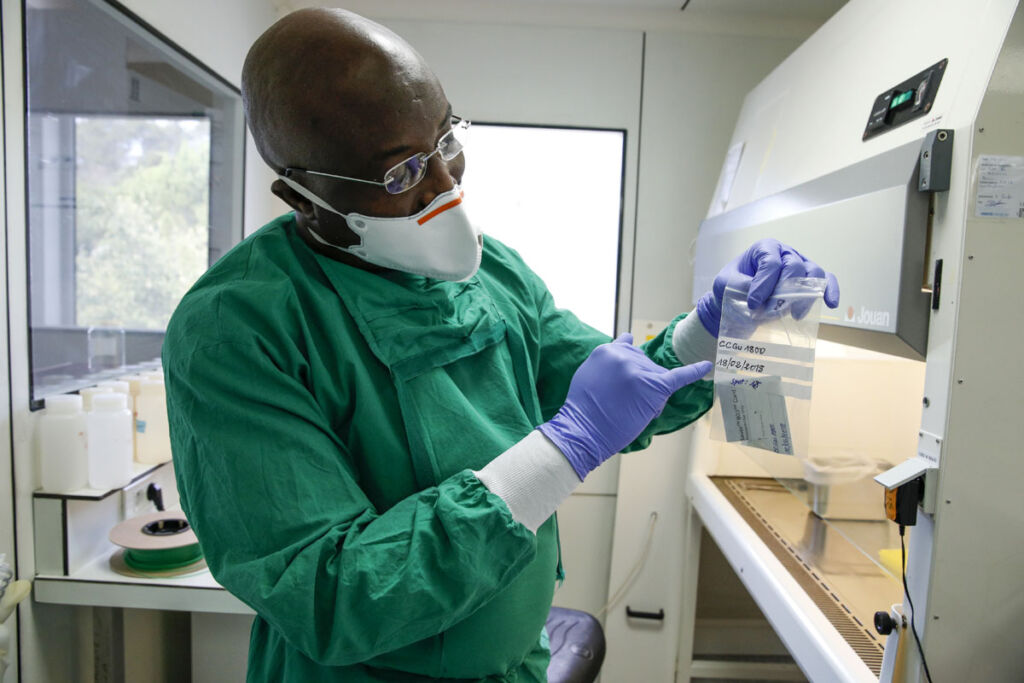
It’s a word that sounds like the title of a B-movie disaster film: Ebola. A disease that sparks the imagination of screenwriters, but weighs heavily on the daily lives of thousands of people—and one that can affect them for much longer than previously thought. This is what Dr. Eric Delaporte and virologist Alpha Keita, researchers at the TransVIHMI laboratory, have highlighted. For more than four years, they have been monitoring 722 survivors of the major Ebola epidemic that occurred in West Africa between 2013 and 2016. Although they were declared cured —“meaning no virus was found in their blood, ” as Alpha Keita explains—some of them still suffer from aftereffects more than four years after their recovery.
Long-term Ebola
This patient cohort, known as PostEboGui, was closely monitored by researchers from IRD, Inserm, the University of Montpellier, the University of Conakry, and Cerfig (Center for Research and Training in Infectious Diseases in Guinea), who observed symptoms in 1 out of every 3 patients. Headaches, dizziness, fever, fatigue, loss of appetite, abdominal or musculoskeletal pain, anxiety, depression… the list of symptoms for what researchers now consider “long Ebola”—by analogy with “long COVID”—is just as extensive.
“There are several types of these symptoms,” explains Eric Delaporte. “They may be related to post-traumatic stress disorder or directly to the virus’s attack and the damage it has caused to the body.” But they can also be caused by the virus settling in specific parts of the body—such as the eye, the joints, or the brain—where it persists long after recovery, causing chronic inflammation that leads to long-term pain. “These are called ‘immunoprivileaged sites’ because they are areas where antibodies do not act, ” explains Eric Delaporte.
Immune Hide-and-Seek
Well hidden, the Ebola virus can therefore persist in the body for years… And emerge from its hiding place whenever it pleases? That, at any rate, may be what led to the new Ebola outbreak that occurred in February 2021 in Guinea. To determine the origin of this new outbreak, researchers analyzed the virus’s genome—isolated from patients—and obtained surprising results. “We realized that it was very similar to the one that caused the outbreak that ended in 2016, which means that the 2021 outbreak was caused by the resurgence of a persistent source—most likely a human host in whom the virus had remained hidden all this time, ” adds Alpha Keita.
This represents a true paradigm shift for researchers, because “for a long time, it was thought that with each new outbreak, the virus was introduced into the population through contact with wildlife, thus spreading from animals to humans, ” explains Eric Delaporte.
The virus, safely hidden in these viral reservoirs, could thus cause a relapse years later in a patient considered cured. It could even be transmitted by these “healthy carriers” to other individuals, who would then develop the disease. “The testicles are another site with privileged immunity, so Ebola can be transmitted sexually. “A case has already been documented in which, by all evidence, a survivor transmitted the virus to his partner via semen, months after he had been declared cured, ” adds Eric Delaporte.
Stigmatization
These findings—while shedding new light on these outbreaks—must nevertheless be treated with great caution, according to the researchers. “None of this allows us to conclude that it was specifically an Ebola survivor who triggered this new outbreak,” they caution. “It may very well have been sparked by an asymptomatic patient as well.” This is a crucial point, given that Ebola survivors already face stigmatization: “They can lose their jobs and their homes; they are sometimes even rejected by their communities—a stigma that risks being further exacerbated if this issue is not communicated properly, ” emphasizes Eric Delaporte. “In Guinea, 16% of people have antibodies against Ebola. As far as we know, anyone could be considered the source of this outbreak, ” concludes Alpha Keita.
These unprecedented findings certainly underscore the need to support Ebola patients long after their recovery. “Long-term sequelae can have a major negative impact on survivors’ health, quality of life, and ability to work. It is important to continue monitoring them over the long term, not only to improve their care but also to prevent possible resurgences of the virus, ” concludes Eric Delaporte.
International Response
What is the prognosis for a patient with Ebola? “For a long time, it was thought that an Ebola infection was always fatal, ” recalls Dr. Eric Delaporte. This disease, which begins with simple feverish diarrhea, can indeed progress to a hemorrhagic syndrome and multi-organ failure, which is fatal. “But that was before the major outbreak of 2013,” explains the researcher from the TransVIHMI laboratory. “The fear of the virus spreading across the globe sparked an international response. Resources were finally allocated, and research has made significant progress. We now have a vaccine, as well as effective treatments based on anti-Ebola monoclonal antibodies.”
Check out theUM podcasts, now available on your favorite platform (Spotify, Deezer, Apple Podcasts, Amazon Music, etc.).