School: Should Yoga Be Part of the Curriculum?
Yoga has taken the world by storm. The crane, crow, and half-grasshopper poses are just a few examples of an activity that has become a global phenomenon in a matter of decades. Whether viewed as a sport, a path to spiritual awakening, or a way of life, yoga has become a “global activity.” How can one of the world’s most widespread physical practices be integrated into the school setting? How might yoga help transform education?
Sylvain Wagnon, University of Montpellier and Sihame Chkair, University of Montpellier
Global “soft power”
Marie Kock showed how the global spread of this ancient practice had transformed it into a “New Age” activity—a form of relaxation for people seeking personal growth and happiness. Caught up in a fad and reinvented by the West, yoga has become a business.
It is also a political weapon. Narendra Modi’s Indian government has turned it into a tool for nationalist political glorification and seeks to maintain its global leadership in yoga. Celebrated with an international day on June 21, yoga thus transcends the mere status of a form of physical expression.
The activity is also recognized as part of the Intangible Cultural Heritage of Humanity and is practiced worldwide by nearly three million French people and hundreds of millions of people around the globe. As a sport, it has national, regional, and local organizations, as well as a multitude of associations that promote these various practices.
Stress Management
During the lockdown, “yoga” was one of the most searched-for terms on search engines. We saw a dramatic increase in yoga mat purchases during the first month of the lockdown in France! Similarly, during this unprecedented health crisis, there was an exponential increase in blog posts and videos offering introductions to yoga—both live and on-demand.
As a form of exercise and relaxation, yoga aims to foster spiritual awakening through awareness of the body and breath. Studies have shown the benefits of combining yoga with meditation. Regular practice improves attention, concentration, and the management of stress and emotions by reducing levels of cortisol, a stress-related hormone. The positive effects of yoga on cognitive learning are beginning to be recognized, as are its contributions to the well-being of students and teachers.
School Adaptations
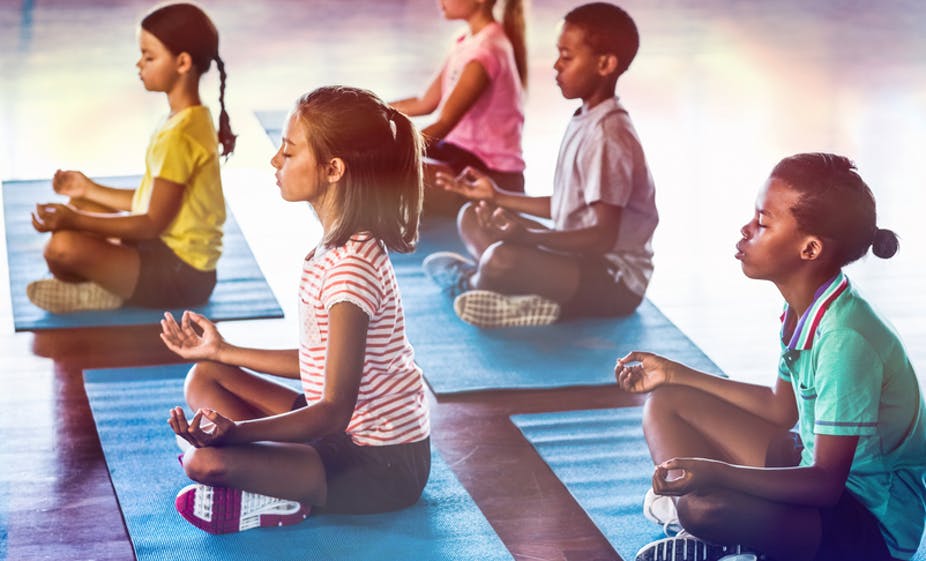
Yoga is already being taught in French schools—in preschool, elementary school, and high school. This trend appears to be growing, and we are currently conducting a study to quantify this boom, which is still not well understood in France. Many teachers are expressing a growing interest in introducing yoga into the classroom.
The first initiatives to introduce yoga in schools were led by teachers who practiced yoga themselves. For them, yoga was defined as a set of physical and breathing exercises that did not exclude a spiritual dimension. Today, more and more teachers are emphasizing the benefits of yoga for coordinated work on breathing and body awareness. The spiritual dimension is becoming less prominent, giving way to a focus on physical and mental well-being, as well as the creation of a positive school environment conducive to learning through active relaxation.
Accredited organizations, such as the RYE Association, support the many initiatives within the French Ministry of Education, which, for its part, offers yoga training and workshops.
Yoga in Schools (A Thousand and One Lives, 2016).
Schools are becoming less and less reluctant to incorporate this form of physical expression into their curricula. Teachers who practice it with their classes note that it has been well received by both parents and children.
The question that remains is that of yoga’s place in schools. Such alternative activities highlight the need for an education that addresses children and adolescents holistically, encompassing not only cognitive learning but also physical and emotional development. Will yoga in schools remain the domain of activist teachers, will it be integrated into existing subjects, or will it become a tool for developing cross-curricular activities and creating a truly holistic education?
Sylvain Wagnon, Full Professor of Education, School of Education, University of Montpellier and Sihame Chkair, Ph.D. in Health Economics and Ph.D. candidate in Education, University of Montpellier
This article is republished from The Conversation under a Creative Commons license. Readthe original article.