Assessing the Structural Integrity of Notre-Dame’s Vaults After the Fire
A cultural disaster, the 2019 Notre-Dame fire has also expanded our knowledge: the debris from the world-famous cathedral serves as a valuable record of the past! This series follows the scientific investigation at Notre-Dame, where charred wood and metal parts reveal their secrets. After the first episodes focused on the roof structure and the origin of the wood, we turn our attention to the cathedral’s structure and, in thisfourth installment, to its masonry.
Stéphane Morel, University of Bordeaux; Frédéric Dubois, University of Montpellier; Jean-Christophe Mindeguia, University of Bordeaux; Paul Nougayrede, National School of Architecture (ENSA) Paris-Malaquais – PSL; Pierre Morenon, INSA Toulouse and Thomas Parent, University of Bordeaux
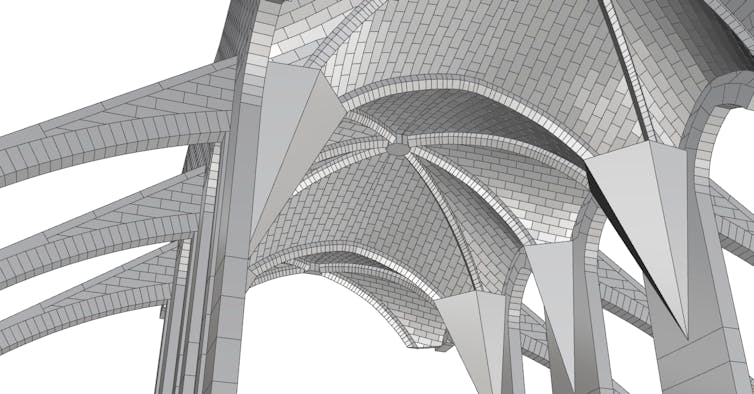
Maurizio Brocato and Paul Nougayrede, GSA Paris-Malaquais, Provided by the author
In April 2019, in the aftermath of the fire that struck Notre-Dame Cathedral, the CNRS and the Ministry of Culture launched the “Notre-Dame Scientific Project” to bring together and organize initiatives from the French scientific community.
Our “Structures” working group focuses on the structural assessment of the cathedral’s load-bearing elements—particularly the masonry and timber framing. We were quickly contacted by the project management team overseeing the restoration work to assess the current stability of the cathedral’s high vaults, which were damaged by the fire.
Although some parts of the vaults collapsed during the fire—primarily due to impacts from parts of the spire or the roof structure—the vast majority of the vaults remained in place. This is not surprising, since the vaults were originally designed as a fire protection system to prevent burning debris from falling! They fulfilled their role effectively, but their stability is critical to the site’s safety.
Furthermore, the vaults are today a true architectural masterpiece of the Gothic style—and, of course, they are being preserved to the fullest extent possible.
Unfortunately, no modern calculation method is currently available in engineering firms to accurately model the mechanical behavior of such structures in order to assess the safety of the site and the effectiveness of the shoring measures implemented by the project management team.
That is why scientific expertise is necessary here… and, faced with highly complex mechanisms, our working group had to develop new approaches.
A gem of masonry, a challenge for modelers
Inthe 20th century, the construction of large buildings gradually shifted away from masonry toward steel and reinforced concrete; the focus of structural analysis and modeling then turned to these modern materials.
[Nearly 70,000 readers rely on The Conversation's newsletter to better understand the world's major issues. Subscribe today]
Furthermore, the mechanical behavior of a masonry structure is extremely complex to understand: masonry made of dressed stones set in course, such as that of Notre-Dame Cathedral, is similar to a composite material— anisotropic (a material whose mechanical properties vary depending on the direction within the material) and heterogeneous, consisting of blocks of cut stone joined by thin joints of lime mortar, with the stone-mortar interface constituting a zone of mechanical weakness.
Thus, damage to masonry made of dressed stone will occur primarily at the stone-mortar interfaces, and, as a result, cracking in the masonry will follow clearly identifiable patterns.
Stability and flexibility of the structure
Thanks to this construction method, Notre-Dame possesses high mechanical stability combined with great flexibility: relative movement between blocks is allowed by cracking at the stone-mortar interfaces, which results in a significant capacity to dissipate mechanical energy through friction along these crack planes.
It is the cracking at the stone-mortar interfaces that gives masonry the full range of its mechanical behavior and, at the same time, makes it difficult to model its mechanical behavior accurately.
Although the modeling of the mechanical behavior of masonry is currently the subject of extensive research, none of the methods developed to date can claim to provide a comprehensive description of the behavior of this heterogeneous material.
The studies conducted by our scientific consortium therefore relied on a comparison of various complementary mechanical modeling methods in order to obtain a reliable estimate of the post-fire mechanical behavior of Notre-Dame’s high vaults.
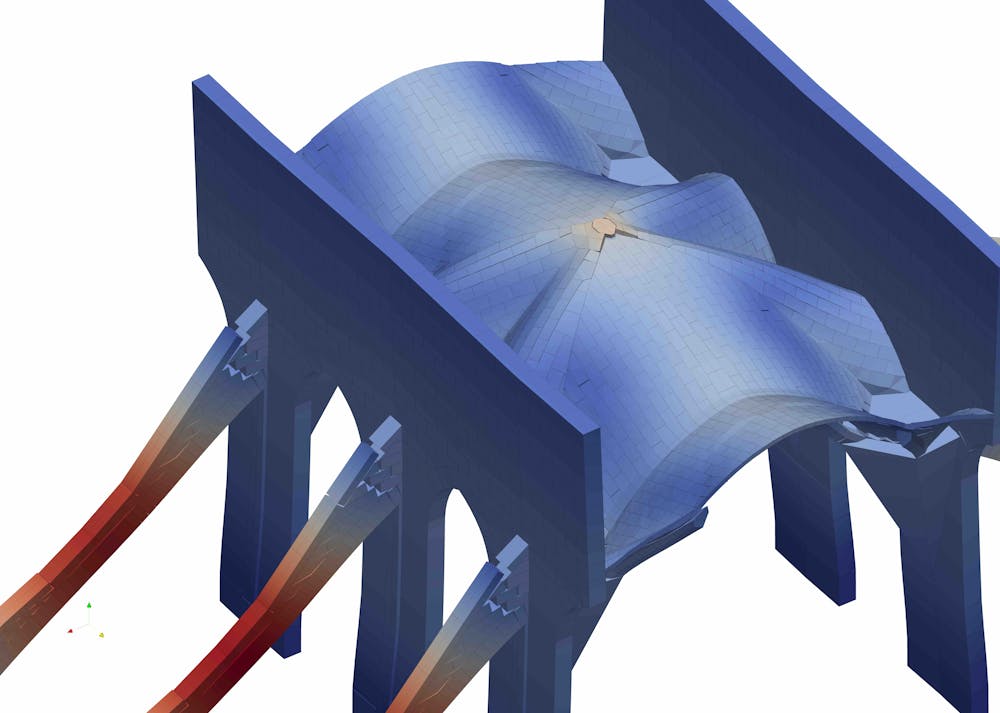
Maurizio Brocato and Paul Nougayrede, GSA Paris-Malaquais, Provided by the author
These methods are based on:
- either using a “continuous” approach: the masonry is modeled as a single continuous material with elastic properties and failure modes equivalent to those of the masonry composite material;
- or using a block-by-block or “discrete” approach: the interactions between blocks describe the mechanical behavior resulting from the mortar joints and their interfaces.
The complex nature of masonry behavior—resulting from the assembly of blocks and the morphological influence of the bond pattern—will be understood more naturally and rigorously using the discrete approach compared to the continuous approach, but at the cost of longer mesh generation and model calculation times. On the other hand, the discrete approach will fail to describe the failure of the blocks, whereas the continuous approach will describe it accurately.
These two examples illustrate how the discrete and continuous approaches complement each other; comparing these approaches ultimately allows for a more precise understanding of the simulated mechanical responses of the modeled structures.
What are the differences before and after the fire?
A pre-fire assessment was first conducted to quantify how the stability of the vaults would change after the fire.
This initial study shed light on the construction phases of the vaults and flying buttresses. Pre-fire modeling also revealed that the morphological differences observed between the slender vaults of the choir (12 to 15 centimeters thick) and the thicker vaults of the nave (19 to 25 centimeters thick) result in the vaults exerting less thrust than the flying buttresses in the choir, and vice versa in the nave.
Fire modeling, meanwhile, has led to the identification of the physical phenomenon responsible for most of the post-fire damage observed at the cathedral: thermal expansion.
In fact, the “swelling” of materials due to the rise in their temperature during a fire appears to be a more significant factor than the decrease in the materials’ mechanical properties per se (this decrease is linked to the rise in temperature and to the saturation of the materials with water used to extinguish the fire).
Simulate shoring techniques
On this basis, the solution for reinforcing the fire-damaged arches selected by the project management team was simulated in order to evaluate the risk-benefit ratio of this solution and identify possible modifications to increase its effectiveness (for example, regarding the modulus of elasticity and the thickness of the screed, or the behavior of the vault-screed assembly under mechanical loads).
The work of the “Structures” working group is set to continue through 2024, when the cathedral’s restoration is expected to be completed. At the same time, the group’s members are developing a hybrid modeling tool for masonry, which combines discrete and continuous approaches.
Frédéric Dubois (LMGC-Montpellier), Paul Taforel (MiMeTICS Engineering, an LMGC spin-off), Pierre Morenon (LMDC-Toulouse TTT platform), Maurizio Brocato and Paul Nougayrede (GSA-Paris), Jean-Christophe Mindeguia, Thomas Parent, and Stéphane Morel (I2M-Bordeaux, study coordinators) are co-authors of this article.
Stéphane Morel, University Professor, University of Bordeaux; Frédéric Dubois, Research Engineer at the CNRS, University of Montpellier; Jean-Christophe Mindeguia, Associate Professor of Civil Engineering, University of Bordeaux; Paul Nougayrede, Ph.D. candidate in architecture, École Nationale Supérieure d’Architecture (ENSA) Paris-Malaquais – PSL; Pierre Morenon, Engineer and researcher in civil engineering within the LMDC’s technology transfer division. Specialist in numerical structural analysis methods., INSA Toulouse and Thomas Parent, Associate Professor of Civil Engineering, University of Bordeaux
This article is republished from The Conversation under a Creative Commons license. Readthe original article.