International Students: Can Artificial Intelligence Tools Help Overcome the Language Barrier?
In higher education, international students continue to face a key challenge: understanding, keeping up with, and participating in a language they do not fully master. Recent advances in artificial intelligence for translation and interpretation are opening up new possibilities, while also raising sensitive issues regarding data protection. A potential solution is emerging: developing alternative tools hosted directly by the institutions themselves. Researchers at the University of Montpellier have developed such a prototype.
Vincent Berry, University of Montpellier; Chouki Tibermacine, University of Southern Brittany (UBS); Chrysta Pelissier, University of Montpellier; Éric Anglaret, University of Montpellier and Vanessa Vigano, University of Montpellier
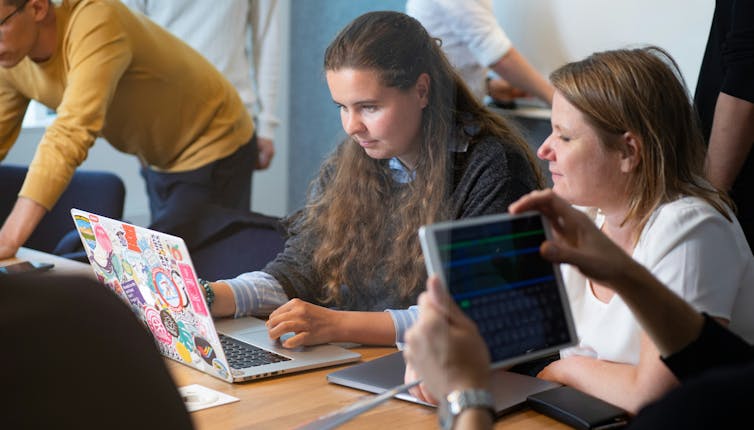
French higher education attracted nearly 450,000 international students in 2024–2025, ranking France7thin the world. They account for nearly 15% of the student body at French universities.
Student mobility is constantly on the rise. In Europe, there have been more organized mobility programs in the past ten years than in the previous twenty-seven years, with demand in 2025 expected to rise by 9% compared to 2024. This acceleration is linked to an increase in bilateral agreements between countries and the expansion of Erasmus+, the European program supporting international mobility.
Globally, the most attractive countries are, unsurprisingly, English-speaking nations—notably the United States, the United Kingdom, and Australia—since English is the language of international communication. But for those who choose France and the French language, what kind of adventure are they embarking on?
The Challenges Faced by International Students
For these students, the language barrier makes it difficultto absorb technical knowledge, hinders active participation in class, and limitstheir immersion in student life—despite French as a Foreign Language (FLE) courses. The complexity of the French language compounds this challenge, even for French-speaking international students who have had little exposure to academic French.
The European Union is aware of this obstacle to mobility and encourages its member states to provide both academic and non-academic support.
In 2024 and 2025, we conducted a survey of a sample of the 9,000 international students enrolled at the University of Montpellier each year. The survey revealed clear needs for support:
- during classes and lectures, to understand what the teachers are saying and to have a transcript of the content so they can better grasp the material;
- after class, to help students memorize, review, and check their understanding of the course material.
Recent advances in artificial intelligence (AI) make it possible to meet some of these needs.
A comparative analysis of AI-based simultaneous translation solutions was conducted based on three main criteria: the ability to automatically recognize spoken language (enabling dynamic adaptation when the speaker switches languages or when a question is asked in another language), ease of use (minimizing installation and configuration requirements for students and teachers), and the quality of the translation produced. This analysis identifies two types of solutions: commercial tools accessible via the cloud and open-source tools that can be installed locally on the institution’s own servers.
Sales tools: effective, but expensive and risky in terms of intellectual property
In terms of commercial tools, our technology watch indicates that eventCat is the tool best suited to the identified needs. This tool provides a turnkey service that requires minimal IT and audiovisual resources to deploy. It was tested in 2024 and again in 2025 during a medical conference co-hosted by two universities. The speakers had diverse language backgrounds: researchers with a high level of English, doctors accustomed to speaking in French, and patient representatives with limited knowledge of English. The audience consisted of French and Dutch students, with the Dutch students having a good command of English but not understanding French.
The tool allowed speakers to present in their preferred language, while English-speaking students followed along via simultaneous translation through a dedicated link. Feedback from the speakers was very positive. Displaying the translations on a large screen set up next to the speakers rather than on the students’ smartphones or laptops helped reduce their cognitive load, as they were already required to simultaneously follow the spoken words and read the transcript. The quality of the translation was generally satisfactory, though field-specific acronyms and the speakers’ accents posed some challenges. This underscores the need for more nuanced contextual adaptation for highly specialized content.
The drawbacks of such a solution include an annual cost of tens of thousands of euros per training program and uncertainty regarding the data. For example, as of the date of this article, the GDPR policy of the identified tool is not to store received audio streams and their transcripts for more than seven days and not to use this data to train its AI models, which would expose this data to attacks via malicious prompts.
However, the company operating this service is based in the United States, so it is subject to the Cloud Act, which requires it to disclose the data it stores if ordered to do so by a U.S. government agency. Concerns about data protection came up repeatedly in our discussions with teachers and students during our survey. It is important to note that teachers and Professors higher education hold the copyright to the courses they offer; therefore, it is their intellectual property that may be exposed by an automatic transcription and translation tool.
An open-source prototype tool for data protection
It is therefore preferable for teaching teams to have alternative solutions hosted within their institutions. Open-source software is the natural choice in this context; unfortunately, as of 2025, no such solution existed to meet the needs expressed by international students in our analyses.
We have therefore laid the groundwork for such a tool and proposed an initial prototype. This prototype already translates text content locally using an open-source AI model that can run on a standard server. However, the transcription of audio streams still relies on AI services offered by various cloud providers (the most effective models for this step are either more resource-intensive or simply proprietary), although it is not tied to any specific provider. This prototype uses RAG (Retrieval-Augmented Generation) technology to adapt to technical vocabulary and has been used in classes of 20 to 30 students. Students have expressed strong interest in this type of tool, which they also use for social interactions.
However, they all note difficulties with technical courses in French that contain numerous Anglicisms. These issues still need to be corrected, but the next major step is to transcribe the audio into text locally, without relying on a cloud service. Given the current state of the models, this requires the use of specialized processors (GPUs), representing an equipment investment of several thousand euros per site. This is the price that must be paid to preserve the data.
Learning the language of the host country is a central goal of international mobility. The digital tools mentioned above facilitate this learning and the academic success of international students, but they are not a substitute for French as a Foreign Language (FLE) instruction. AI tools promote the acquisition of subject-specific knowledge and, to a certain extent, the acculturation of international students. However, they are not sufficient for successful integration. In this regard, the measures implemented by the home country to prepare students for their study abroad experience remain paramount.
Vincent Berry, Professor, University of Montpellier; Chouki Tibermacine, Professor of Software Science, University of Southern Brittany (UBS); Chrysta Pelissier, Associate Professor of Language Sciences and Education Sciences, University of Montpellier; Éric Anglaret, Professor of Materials Physics, Deputy Director for International Relations at Polytech Montpellier, University of Montpellier and Vanessa Vigano, Educational Engineer, University of Montpellier
This article is republished from The Conversation under a Creative Commons license. Readthe original article.