Windows on the Courtyard: Living and Thinking Under a Dome
With the outbreak of the novel coronavirus, the possibility of the end of the world as we know it—that is, the demise of our civilization—has moved beyond the realm of eschatology and alarmist rhetoric to take center stage in the media, politics, and science.
Abdel Aouacheria, University of Montpellier
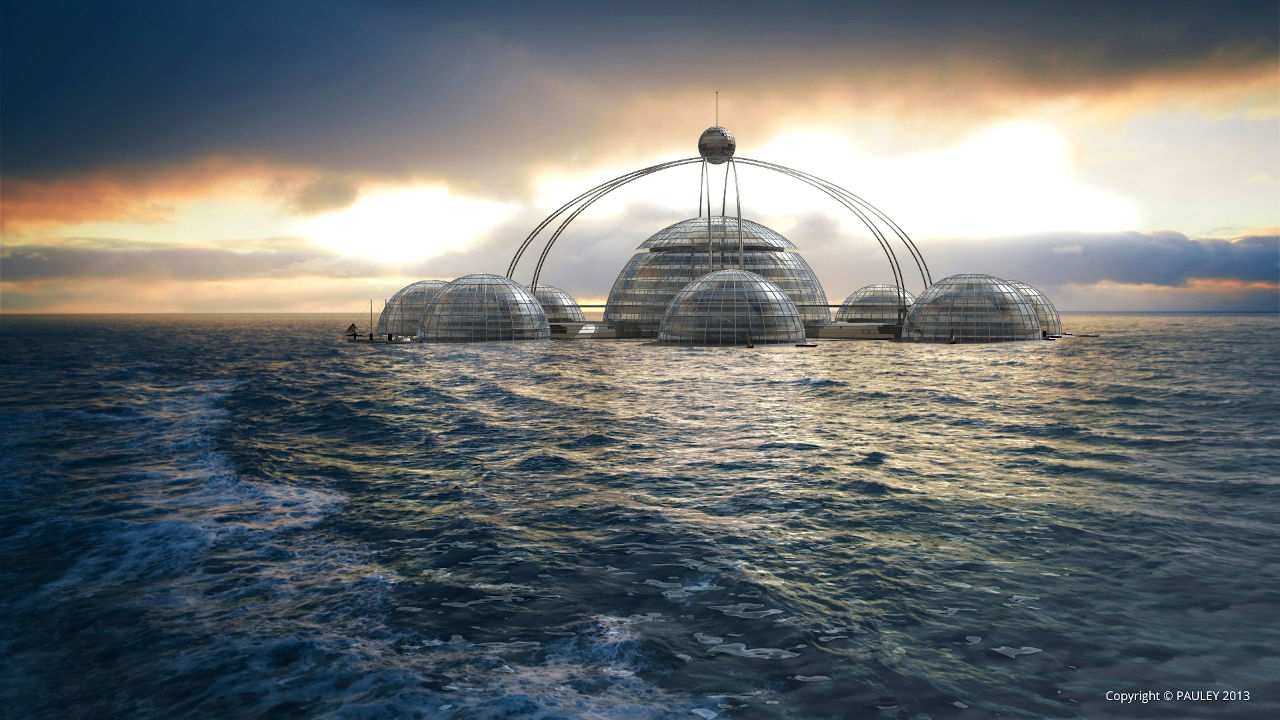
From now on, any discussion of COVID-19 is inseparable from an analysis not only of the threat (viral infection) but also of our reactions to it and the measures taken to protect ourselves from it. What are the real limits of the defenses meant to protect us from collective collapse? Might preventive measures be just the tip of the iceberg—the visible part of a broader trend toward widespread isolation that stands in contrast to the concepts of globalization and the “open society”?
The Emergence of a Dystopia
For weeks now, part of humanity has been confined to their homes (just like the photographer Jefferies inside his New York apartment in *Rear Window* by Alfred Hitchcock), on probation, oscillating between two impulses: withdrawal into oneself, justified by the fear of being infected, and the search for refuge. But might these two impulses not stem from the same process, with deeper roots? From a sort of “dome syndrome”? Throughout human evolution, the dome was both the house (domus) that protects and the roof (doma), the rampart placed above one, which obscures the sky. Now, it is a true “amputecture ”: the dome protects but cuts off its resident’s entire horizon, confining them spatially and depriving them of points of reference. The dome functions as a biological membrane, according to Simondon’s definition: polarized (serving as an interface between an interior and an exterior) and selective (ensuring that “the living is alive at every moment”).
When the Dome Turns Against Humans
Admittedly, even before SARS-CoV-2, this syndrome was already evident, but it had only the characteristics of an endemic disease. Consider the International School of Beijing and its shelters designed to protect children from suffocation, the survivalists’ bunkers, or the plant and seed vaults ofthe Eden Project and the Svalbard Seed Vault. Or consider the construction of walls that isolate countries from one another (Israel from Palestine, the United States from Mexico, etc.).
Seeking to isolate oneself from others, on whatever scale, was still merely a “nimbie” mindset—that is, a defensive stance taken by property owners seeking to protect their interests, as described by Mike Davis in *City of Quartz*. But what can be done against an invisible enemy that can affect everyone?
What's at stake with the dome
In the face of the virus, the dome functions—as a second characteristic—like an immune system. With COVID-19, the defense of interests has transformed into a defense of society at all costs. As in the post-apocalyptic film Logan’s Run(1976), which depicts a society isolated within bubble cities, protection under the dome comes at a high price.
https://www.dailymotion.com/video/x9cajc
The price to pay is a logic of isolation: the dome must become as hermetically sealed as possible. Its purpose is to control the masses in order to ensure the system’s long-term survival. In Europe, we quickly witnessed the closure of the Schengen Area and the implementation of controls on the movement of goods and people.
To limit the spread of the pathogen, symbolic or miniature “domes” have been deployed, ranging from the virus to the clan (parents, children, friends), including the establishment of hospital wards with high and low viral densities, triage areas, and social distancing (considered synonymous with physical distancing). The tailored reopening plan is itself a “dome” program, based on statistical management of deaths and compliance with standards (including in green zones).
A disconcerting cacophony
By influencing behavior and living environments, the health crisis serves as a prime example of Foucault’s theory of biopolitics, bringing to life the dystopia depicted in *The Age of Crystal*. In this film, a computer controls the life and death of humans, who have become oblivious to the outside world (which they themselves had rendered uninhabitable) and to the very reasons for their confinement within domes.
However, governance through the dome is struggling to take hold under the current circumstances: confusion reigns regarding the availability and usefulness of masks and tests, the legitimacy of treatments (e.g., chloroquine), political decisions (scientific advice, the role of experts, the media), and due to the existence of contradictory directives that place citizens in a paradoxical predicament (e.g., sending their children to school but not going to a restaurant; promoting remote work while being wary of videoconferencing tools like Zoom).
These blunders—which affect both public statements (sometimes reassuring, sometimes alarming) and therapeutic practices (with suspicions of collusion with private interests) as well as preventive measures (with the disregard for the precautionary principle embodied in public health precautions)—undermine the effects of the government’s attempts to standardize behavior. The government is seeking salvation in technology, through the tracking of patients and their contacts. In *The Crystal Age*, citizens wear a connected crystal in the palm of their hand their entire lives, like a kind of electronic ankle monitor.
The government is thus opening a Pandora’s box that threatens civil liberties—likely under the control of GAFAM—while simultaneously encroaching on both physical space (through the use of drones) and cyberspace (with the ubiquitous #StayHome hashtag, reminiscent of the propaganda described in the novel *1984* or the film *THX 1138*).
Architectural domes: Reflections of cognitive and sociocultural domes
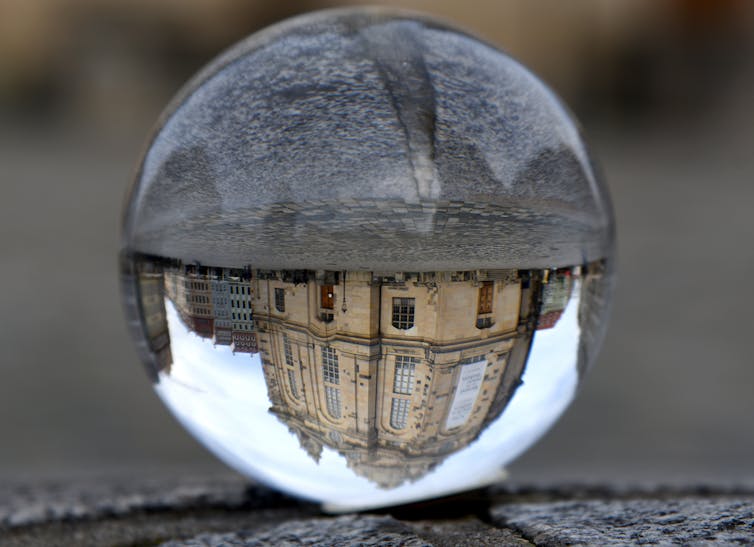
Mistakes in the management of the COVID-19 pandemic have the effect of undermining public trust and fostering mistrust, denunciation (in Eugène Zamyatin ’s *We*, the glass buildings allow for the spying on and subjugation of those who resist), and conspiracy theories on social media. Here again, the metaphor of the dome helps illustrate digital echo chambers, whose filter bubbles isolate internet users from ideas that differ from their own, thereby reinforcing their own beliefs.
AdobeStock, Author provided
The thing is, domes aren’t just on the outside—they’re also on the inside. It’s risky to crack them. By undermining our certainties and our conditioning, the crisis intensifies our anxiety about the limitations of a (neoliberal) model that is incapable of compensating for the decline of grand ideologies, but which is already looking toward the day after—or even the day after that (seethe hearing with military historian Pierre Razoux).
Toward a More United Humanity?
The pandemic, because it represents the occurrence of an unforeseen event, accelerates the construction of citadels—both within ourselves and in the outside world—revealing the scars of civilizational apoptosis (apoptosis being the process by which a cell, isolated from the rest, destroys itself).
See also:
What is a “crisis”?
To this risk of collective suicide must be added that of hikikomori: the “apoptosis” of individuals induced by social withdrawal. This crisis will, however, have had beneficial effects on our cities and the environment, which have been temporarily cleansed of pollution and allowed to return to a wild state. Projects are getting underway, and dynamic forces are mobilizing to co-create change, just as Edgar Morin had envisioned in The Way.
This virus reminds us that the outcome of the human adventure on this planet—that pale blue dot (immortalized by the Voyager 1 spacecraft), whose limitations and finite resources we know—is not predetermined. Just as with the DeepDream dream machine—to which we might say , “Whatever you see, we want more of it!”—humans today must foster the emergence of a future human who is qualitatively more human, rather than sowing the seeds of their own zombification.
While there is no definitive end to confinement outside the domes, the goal is to better define their boundaries as part of an ongoing quest to explore what lies beyond them.
This article was co-authored with Joachim Daniel Dupuis, a Ph.D. in philosophy, historian, and specialist in genre cinema. The co-authors published “Biopolitics as Seen Through Cinema: The Crystal Age” (L’Harmattan, 2018).
Abdel Aouacheria, biologist, research fellow at the CNRS, specialist in cell life and death, University of Montpellier
This article is republished from The Conversation under a Creative Commons license. Readthe original article.