Festivals: After the Earthquake
Arabesques Festival, Montpellier, September 2019: Sofiane Saïdi, followed by Marcel & Rami Khalife Feat, set the event ablaze; audiences from neighborhoods, urban centers, and social and geographic outskirts are jubilant.
Emmanuel Négrier, University of Montpellier
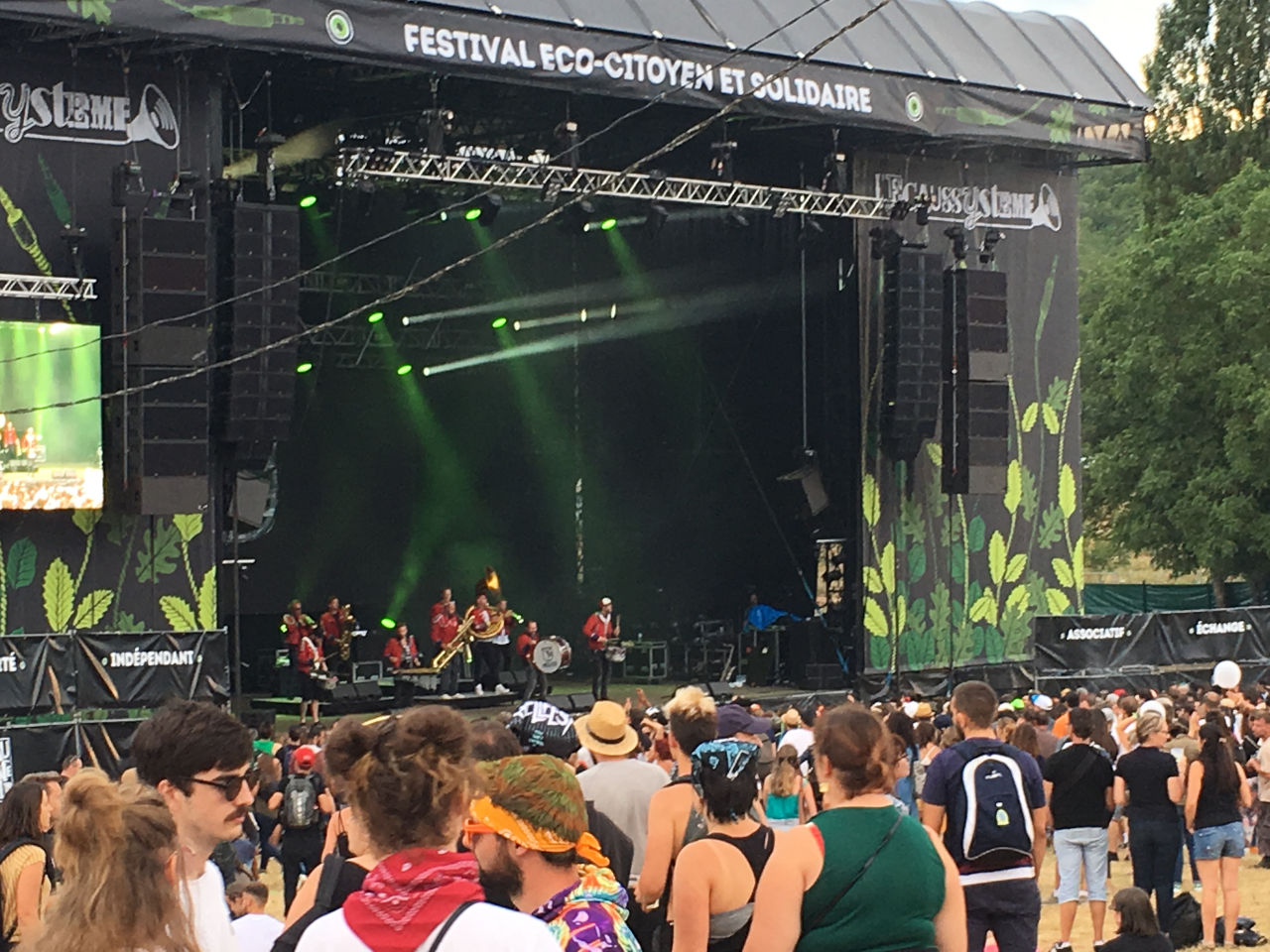
Arabesques Festival, Montpellier, September 2020. To the surprise of many, the festival is going ahead, though it has been radically revamped given the circumstances. By the organizers’ own admission, the goal is less about surviving as a business and more about achieving two objectives that most festivals set for themselves.
The first: to support artists working within a particular genre or aesthetic; in this case, world music, which has been particularly hard hit by the pandemic and its impact on travel. The second: to preserve the annual gathering that the festival and its team have provided for partners, volunteers, and audiences, even if the numbers are inevitably more limited.
These two key aspects of the festival industry were fundamental to the survival of a few events. For most others, however, they were not enough. A third dimension of the festival industry led many public stakeholders to change their perspective—and for some, quite abruptly: the economy. It thus became clear that the cancellation of more than 2,000 events (the number of events affected by COVID-19—those taking place between April and August 2020—can be estimated at around 4,000) had a very real and dire economic, social, and artistic impact.
Economic and Social Impact
The total of unspent funds by festivals and festivalgoers, along with their ripple effects, exceeded two billion euros over the course of these six months. Those who thought that the inherently fleeting nature of an event made it a frivolous or secondary economic player are in for a surprise: behind the festivities lies a distinct yet significant economic sector that has developed as a result of what might be called the “festivalization” of culture.
In terms of employment, of course, the contrast is more striking between the few permanent employees and the wide variety of professionals working for a week, a month, or on a one-time assignment. But here, too, this ultimately affects thousands of jobs, the impact of which has been mitigated by government decisions regarding unemployment benefits and the postponement of the anniversary dates for intermittent workers (to avoid requiring artists who are unable to perform to prove their hours of work!).
On a social level, we must mention the work of volunteers, who, on average in France, account for two-thirds of the workforce mobilized for events. This is therefore an entire community—not necessarily made up of professionals or salaried employees, but people who are genuinely committed to the festival experience—that has found itself at a standstill. Finally, the artistic engagements wiped out by these cancellations represent, for some, a crucial part of their professional year—and even their future commitments.
A gathering place and business hub
A festival is not an event closed off from the outside world, nor is it an operator focused solely on its own business. A festival is a milestone on a journey, a gathering place, and sometimes almost a “market.” Avignon embodies this for theater, Auch for the circus, and Cannes for cinema. A festival is a hub of businesses: talent agents, chefs, the brilliant inventor of the world’s fastest machine for cleaning returnable glasses, technical service providers, security firms, and so on.
So the fate of a festival is also the fate of this entire little world—an economy that is sometimes only modestly profitable, often not-for-profit, but one that cannot afford to run a deficit and cannot tolerate silence.
A festival is, in the end, a small, ephemeral republic that brings together participants with often diverse backgrounds—some more knowledgeable than others, some enthusiasts of certain parts of the program—but who all embrace tolerance toward the tastes and behaviors of others, often promising themselves they’ll give them a try. At a festival, the risk involved in discovering a new style or an unknown artist is tempered by the jubilation, the collective experience, and the outpouring of enthusiasm.
In fact, the health crisis only forced organizers into silence with a heavy heart—and only after they had tried everything with prefects, health authorities, and local governments. Often, despite the cancellation, they wanted to keep the tiny flame of life burning—or to already look forward to next year! Les Moments Musicaux du Tarn had to call it off, but they welcomed François-René Duchâble for a concert that, for one evening, gave music a touch of a “vaccine” against gloom. The Festival des Suds (Arles) did the same. In Corrèze and Creuse, the Kind of Belou and Musique à la Source festivals kept their dates on the schedule, even if they couldn’t fully recreate that unique blend of artistic expression, camaraderie, and celebration.
An anthropological phenomenon
The growing importance of festivals in social life is evident from two recent trends. First, of all cultural activities, festivals have shown the highest growth rate over the past twenty years, while attendance at concerts, museums, and movie theaters has tended to stagnate.
The recent study by the Department of Research, Forecasting, and Statistics of the Ministry of Culture is very clear on this point.
Further evidence is the proliferation of festivals—centered on a wide variety of artistic expressions—that took place despite the crisis. This indicates that the rise of festivals is far from being merely a “live” response to the crisis in the music industry, as is sometimes claimed. On the contrary, it is an anthropological phenomenon, and it is in this sense that it is painfully grappling with the health crisis, just as it had previously grappled with the rise of security-related issues.
But festivals are a deceptively homogeneous world. In economic terms, in the face of the crisis, we can already identify two main types that are experiencing it differently because their strategic uncertainty is not of the same nature.
On the one hand, there are festivals that are highly dependent on subsidies—often in classical music, theater, and dance, and to a lesser extent in jazz and world music. Here, the uncertainty centers on the future of cultural policies for the 2021–25 period. The fact that most of the promised grants were maintained in 2020 cannot be considered a guarantee of survival, even though it is an important resource that many foreign festivals do not have at their disposal. On the other hand, there are festivals that depend primarily on ticket sales. These are frequently found in the contemporary music sector (notably rock, pop, and electronic music). They are heavily dependent on audience behavior, in a context where the attendance rates needed to break even have risen considerably in recent years. Even though many attendees accepted the option to postpone their reservations (to 2021) rather than receive a refund, this merely creates an unusual cash flow situation and says nothing about the short-term economic sustainability of these events. And this applies not only to the festivals themselves but also to all the businesses that are more or less connected to them.
Two Approaches
In light of these uncertainties, two different approaches warrant consideration: public action and collective action. Public action raises questions about the role the state and local governments intend to play in this area. Curiously, while local governments are among the most interventionist in Europe, they have few explicit policy priorities in this area. Furthermore, there is a lack of genuine, systematic monitoring of the field, despite recent efforts—which have not been fully followed through—within the Ministry of Culture.
The government can, even outside the ministry responsible for the sector, address two sensitive issues. The first is combating potential abuses of dominant market position—specifically those linked to the market concentration that has been affecting the sector for several years. The second is the overhaul of the—to put it mildly—chaotic policy regarding security costs, which place an undue and highly uneven burden on festival budgets depending on the region. The Collomb circular of May 15, 2018, was intended to reassess the compensation paid by festivals to law enforcement agencies (police or gendarmerie) for services provided in the vicinity of events. Its implementation has led to enormous disparities across departments and resulted in the Council of State overturning part of the measure on the grounds of abuse of power.
Collective action is the other path, one that respects the unique nature of the festival ecosystem, where revenue streams (refreshment stands, food service, merchandise) and expenses (technical costs, security, performance fees) are higher than in the world of “permanent cultural institutions” (francefestivals.com/media/francefestival/6-sofestindicateurs.pdf). This unique nature compels festivals to organize their own world by forging cooperative ties; by exploring the possibilities of active audience participation; and by examining what the lockdown has sparked in the digital realm: the idea of remote expressions of enthusiasm. Cooperation among stakeholders is an old idea, often undermined by the opportunism of a few.
Yet the festival world is changing right before our eyes. In the past, founders had a highly individualized—even heroic and traditional—vision of “their” festival. They were, in a way, like gods on earth. The new generation of organizers lacks both the same resources and the same values to assert themselves majestically over their territory. And while God has always been somewhat uncooperative, the apostles of today’s festival world are more eager—and compelled—to cooperate than ever before.
Emmanuel Négrier will attend the États Généraux des festivals on October 2 and 3 in Avignon. He will speak on the topic of changing economic models for festivals.
Emmanuel Négrier, CNRS Research Director in Political Science at CEPEL, University of Montpellier, University of Montpellier
This article is republished from The Conversation under a Creative Commons license. Readthe original article.