A Guide for Library Explorers: An Adventure in Discovering Biodiversity
After more than three years of work on the LitterNaturepublishing project, theUniversity of Montpellier’sscientific outreach departmenthas published its book *Guide for Library Explorers*. This book is the latest addition to the department’s range of scientific outreach initiatives, which aim to explore—in creative ways, together with young readers and families—the biodiversity hidden within children’s literature.
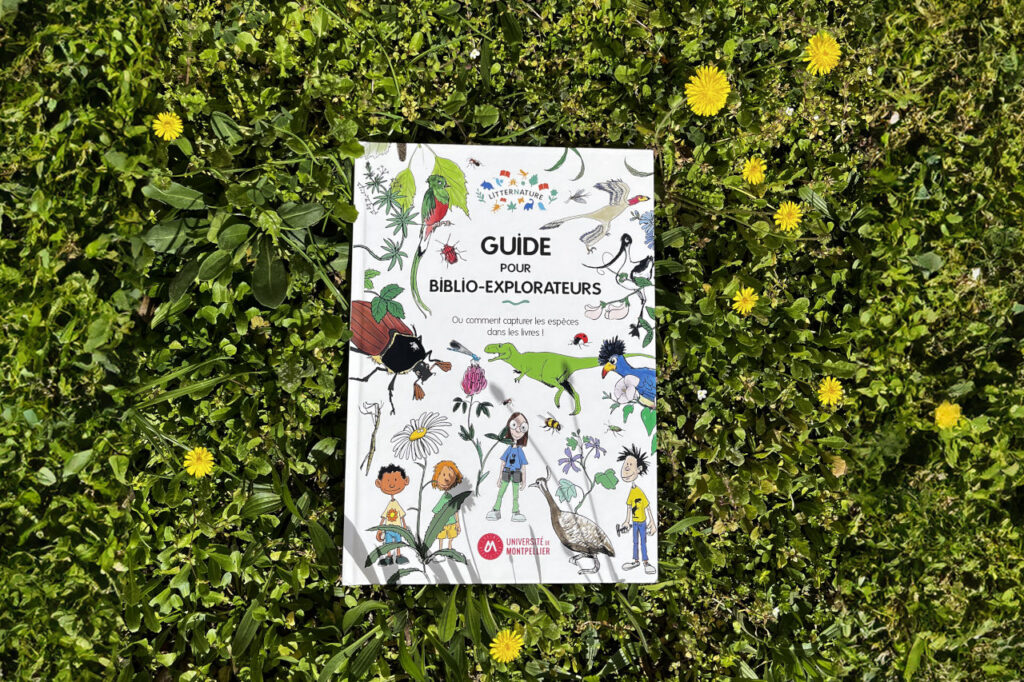
Inspired by the LitterNature project’s traveling exhibits on the natural sciences for curious non-specialists, this book introduces us to species of plants, insects, and birds, as well as extinct species: dinosaurs. Throughout the book, characters passionate about biodiversity explain the principles of evolution, species classification, and the survival strategies of certain species using entertaining examples such as: “Why do some flowers smell like a dead body?” All of this is presented in an accessible, popular science style. This book builds on the work the University of Montpellier’s Science Outreach Department has been doing since 2019, reaching out to young audiences at literary festivals and collaborating with 35 public libraries.
Enriching the Imagination
Beyond the book itself, LitterNature offers a true ecosystem for science outreach through its website. The site invites young readers to identify the living species found in children’s literature. All they have to do is upload a photo of the animal in question and answer the questionnaire. Nearly 1,300 submissions have been made by more than 440 budding “library naturalists.”
In addition to offering educational activities, the website also serves as a database for several research projects exploring the connections between children’s literature, biodiversity, and behavior. This research aims to understand the sense of connection to nature, as well as how social and ecological transitions enrich the imagination.
Reach as many people as possible
LitterNature now also offers exhibits available for rent nationwide, which are free for young visitors and allow them to learn about biodiversity through activities and shared experiences. These exhibits were designed to be easily adaptable and modular so they can be hosted in science education venues and tailored to their specific requirements (space, flexibility). Since the start of the 2023 school year, LitterNature has been reaching out to new partners by offering biodiversity training to library staff, groups of elementary school teachers, and organizations involved in science education. These training sessions aim to make the exhibits—and, more broadly, the LitterNature ecosystem—increasingly self-sufficient and accessible. The goal is to share knowledge as effectively as possible with as many people as possible—an ambition that the science outreach department makes no secret of.
A nationwide expansion
The current focus of the project is to expand nationwide. Training sessions and traveling exhibitions, which were initially held at the regional level, are now taking place on a larger scale throughout the country. This expansion brings new challenges related to making these exhibitions and the tools provided by the University of Montpellier’s Science Communication Department more self-sufficient. The idea behind this drive toward greater autonomy and ease of use for participants is to foster a wider range of contributions and greater knowledge sharing. A greater number of contributions also means higher-quality scientific results for ongoing research related to the LitterNature project.
This project is supported by the region and the European Union (ERDF).