Science Images: New Materials for Trapping or Filtering Molecules
This image was taken during the formation of a membrane made of an ultraporous material, which can “sift” molecules or trap them. These materials are developed, in particular, for separating gas mixtures, purifying air or water, and delivering active pharmaceutical ingredients more effectively.
Martin Drobek, University of Montpellier; Anne JULBE, University of Montpellier and Didier Cot, University of Montpellier
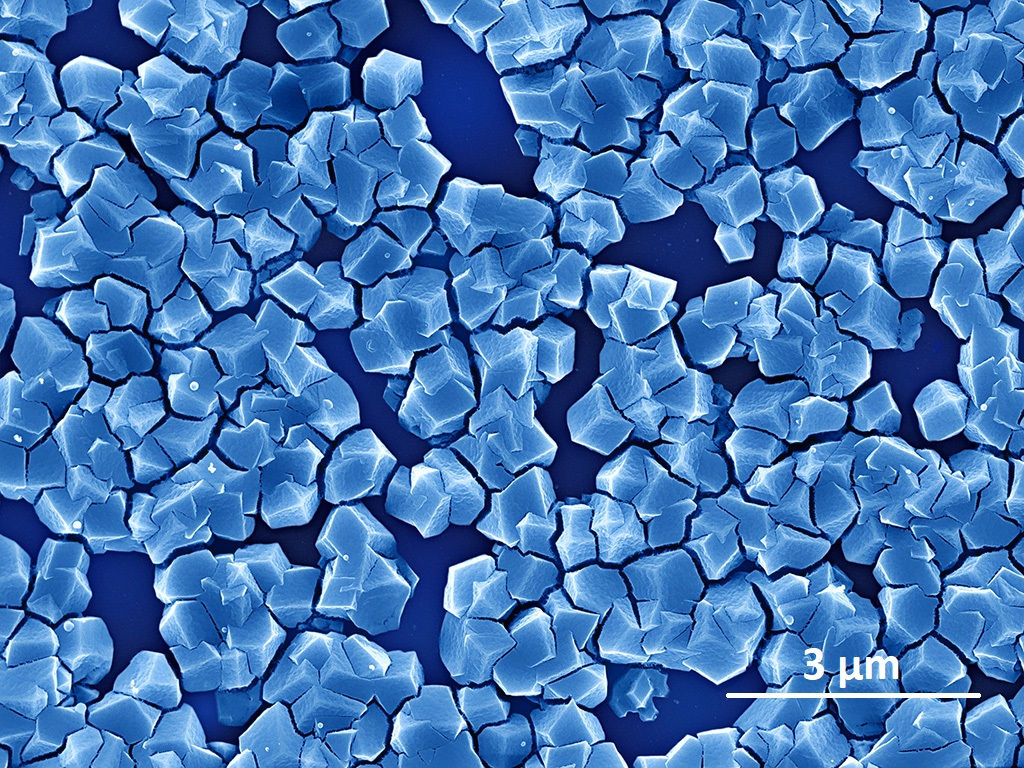
These materials are composed of basic building blocks that form networks of impressive diversity. The building blocks can be assembled in any configuration, much like a “Lego set” on the nanoscale.
They consist of metal ions linked together by organic molecules that act as both a binder and a spacer. These networks, known as “ metal-organic frameworks ” (or “MOFs”), allow for the formation of a virtually unlimited number of molecular structures with tunable physical and chemical properties. Some “MOFs” can accommodate and transport small gas molecules, such as hydrogen, while others can trap and release large molecules, such as the active ingredients in medications.
Their hybrid nature—both organic and inorganic—gives “MOFs” a highly flexible structure. Their extremely high porosity, with a network of small, regular, and well-ordered pores, explains their low density and large accessible internal surface area—the size of a soccer field for just one gram of material! Such a surface area—several thousand square meters—far exceeds that of standard porous materials, such as zeolites or activated carbons.
Most “MOFs” are, by default, prepared and used in powder form, but to fully exploit their potential for large-scale and industrial applications, “processing”—for example, into granules or thin films—is generally required, and production costs must be competitive.
Sieve molecules through a highly selective porous network
At the European Membrane Institute in Montpellier, we are studying these materials to develop membranes capable of separating gas mixtures through a “molecular sieving” effect. When deposited on the surface of gas sensors, such membranes can, in particular, improve the selectivity of detection for toxic or explosive gases, thanks to their preferential transport through the pores.
By varying the length of the organic molecules that link the metal centers, the pore size can be adjusted. Most “MOFs” are microporous (with pores less than 2 nanometers in diameter), and their pores can accommodate and transport not only hydrogen but also other small gas molecules or vapors such as water, oxygen, or carbon dioxide.
Currently, we are focusing particularly on hydrogen detectors in relation to the safety issues posed by the production, transport, storage, and use of this gas. The strategy involves coating the sensor’s sensitive material with a layer of a specific type of “MOF.” The separation effect of this molecular sieve allows hydrogen to diffuse easily to the sensor while rejecting the other gases in the mixture.
Trapping molecules as if in cages
However, given the wide variety of possible structures and functions, the scope of application for “MOFs” is much broader. In fact, their pores are sized to accommodate a wide variety of common molecules, and they can be used as nanocage sponges for the selective adsorption of these molecules.
For these applications, researchers are also interested in mesoporous “MOFs” (with a diameter greater than 2 nanometers). Their main advantage lies in their ability to encapsulate large molecular systems, such as proteins, drugs, nanoparticles, or “macromolecular” assemblies (groups of giant molecules).
We can therefore consider developing complex architectures such as "MOFs" to store and generate energy, clean up the air or water through the selective adsorption of harmful compounds; or in the field of health, for example, for the controlled delivery of active ingredients.
Martin Drobek, CNRS Research Fellow, University of Montpellier; Anne JULBE, Director of the CNRS- Research , specialist in ceramic and hybrid membranes, University of Montpellier and Didier Cot, Engineer, Head of the Electron Microscopy and Photonics Division, European Institute of Membranes, University of Montpellier
This article is republished from The Conversation under a Creative Commons license. Readthe original article.