[LUM#17] Innovation from Head to Toe
At the Saint-Priest campus, robotics engineers, computer scientists, and electronics engineers are applying their expertise to the field of surgery. Whether they’re working on smart prosthetics, like the RFEF team at the Institute of Electronics and Systems (IES)*, or on surgical robots, like the Dexter team at the Montpellier Laboratory of Computer Science, Robotics, and Microelectronics (Lirmm)**, their motivation is the same: to ensure that innovation has a strong social impact.
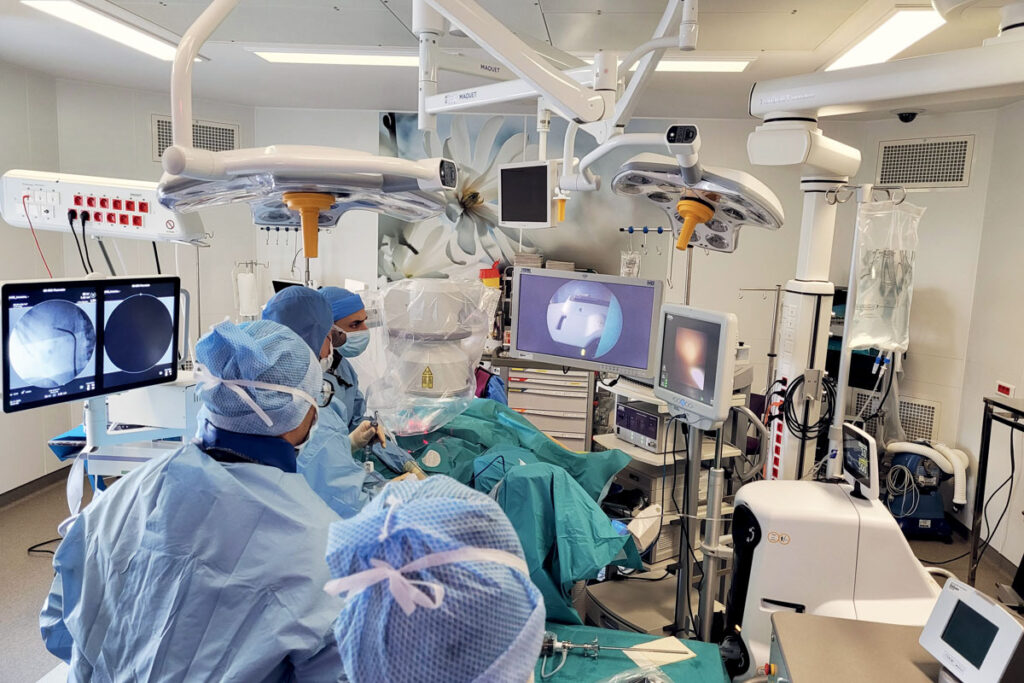
In France, 100,000 people undergo knee replacement surgery each year. To improve patient follow-up, orthopedic surgeon Stéphane Naudi, founder of the startup Bonetag, has designed a smart prosthesis equipped with a friction sensor to predict loosening from the bone and a tracking system to ensure continuity of care.
Techno to the Core
“Stéphane Naudi came to see us back in 2013 because he had heard about our expertise in sensors and RFID tags,” recall Brice Sorli and Arnaud Vena, researchers atthe IES and scientific collaborators with Bonetag. An RFID tag is a radio-frequency identification technology used to track clothing, packaging, and even our dogs and cats. “It’s a device that contains a microprocessor, memory, and an antenna but doesn’t require a battery, ” explains Arnaud Vena. “For Bonetag, we needed a technology that would work for the entire lifespan of the prosthesis without having to perform another surgery on the patient to replace a battery.” ” The inactive tag in the knee emits a radio-frequency signal when it is activated by a reader during the medical appointment.
The challenge of this innovation lay in miniaturizing the implant. “Existing electronic prosthesis projects have not gained traction due to their complexity,” explains Brice Sorli, “whereas the Bonetag implant is easy to integrate into any prosthesis thanks to a notch system for which the company has, in fact, filed a patent. ” The electronics engineers succeeded in developing a microdevice containing the RFID tag, equipped with a miniature antenna—also patented—and a sensor that measures the bond between the bone and the prosthesis. They even went so far as to add a temperature sensor “to detect a possible tissue infection,” explains Arnaud Vena. With four patents already to its credit, the Bonetag microimplant may be small… but it’s powerful!
Compass in the Eye
Surgical robots are quite powerful, too. First used in the operating room in 1985 in California, their precision has continued to improve ever since, as confirmed by Philippe Poignet, director of Lirmm: “We perform operations with a precision of less than 10 microns. That’s ten times more precise than a surgeon’s hand.” In 2020, this robotics expert founded the startup AcuSurgical with his colleague Yassine Haddab and Zurich-based engineer Christophe Spuhler. Their mission? Robotics applied to retinal surgery— “a form of microsurgery so precise that it remains the preserve of an elite group of surgeons.” In partnership with two surgeons from Saint-Étienne, they launched the Retinoct project, which combines imaging and robotics. Instead of a scalpel, the surgeon holds a joystick integrated into a console and connected to a robotic arm that instantly replicates the surgeon’s movements on the patient. The first human trials are scheduled for 2023…
In the Skin
Another example: the Astrid Blockprint project, which is breathing new life into the Dermarob robot—developed in the 2000s by the LIRMM—to collect skin samples during reconstructive surgery for burn victims. Its updated version is back in service as part of a project with the Lyon-based startup LabSkinCreations, a manufacturer of liquid artificial dermis.“Its mission,” explains Philippe Poignet, “will be to perform robotic in-situ bioprinting of skin while precisely controlling the geometry and thickness of the print.”
Strong Kidneys
Ergonomics is also a key area for improvement in surgical practice. Since 2015, Philippe Poignet, Nabil Zemiti (LIRMM), and Stéphane Droupy of the Nîmes University Hospital have been collaborating with the company STERLAB to develop a robotic assistant for the laser treatment of kidney stones. This is a long and delicate procedure that involves inserting a flexible camera equipped with a laser into the patient’s urethra and guiding it all the way to the kidney.
“To remove a 1-centimeter stone,it takes about an hour during which the surgeon remains in an uncomfortable position, standing between the patient’s legs,” explains Philippe Poignet. With the ILY robot, which will replicate all of his movements remotely, he will now be able to sit in front of a console and benefit from an imaging system and an augmented environment. Thanks to extremely sophisticated algorithms, ILY will be able to compensate for the natural physiological movements of both the patient and the surgeon, thereby providing even greater precision. To date, 80 surgeries have already been performed, and two more are scheduled for this year.
Check out theUM podcasts, now available on your favorite platform (Spotify, Deezer, Apple Podcasts, Amazon Music, etc.).