Inria and the University of Montpellier announce the signing of a strategic partnership agreement and the creation of the “Inria Branch at the University of Montpellier”
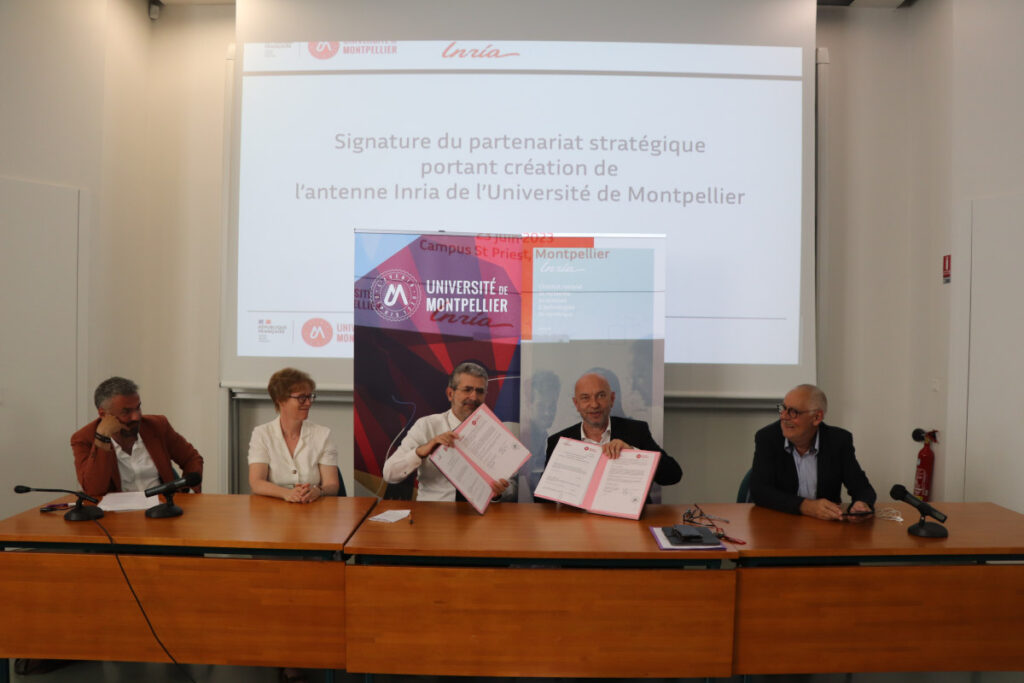
On June 23, 2023, to mark the 20th anniversary of Inria’s presence in Montpellier, Bruno Sportisse, Inria’s President and CEO, and Philippe Augé, President of the University of Montpellier, signed a strategic partnership framework agreement in Montpellier, thereby underscoring their commitment to strengthening their collaboration in digital sciences and technologies.
This partnership will take shape, in particular, through the creation of the “Inria Branch at the University of Montpellier,” a precursor to a future Inria center in Montpellier, which is part of Inria’s national strategy to contribute to the development of major, world-class research universities.
The University of Montpellier (UM) and Inria have been collaborating on research for 20 years through joint project teams in the fields of data science, simulation, and control, with applications in the environment, agriculture, and health. Their collaboration has been strengthened through key initiatives such as the#DigitAg convergence institute, the LabeX NUMEV, and the I-SITE MUSE “Montpellier University of Excellence.” The Pl@ntNet platform and the startup Neurinnov were created and developed in Montpellier thanks to this collaboration, which also included other academic partners, such as national research organizations like INRAE and the CNRS.
Convinced that their missions, scientific strengths, and research organization are complementary, the University of Montpellier and Inria wish to enter into a strong strategic partnership by building on their existing organizations and structures—specifically, Inria’s joint project-team model and the University of Montpellier’s system of laboratories, support units, and research federations. Inria and theUM will continue to coordinate their strategies and resources to address the challenges facing France and Europe in the field of digital science and technology.
Through the “Inria Branch at the University of Montpellier,” Inria and theUM have established a joint strategy for the site and mechanisms to implement it in collaboration with public partners in education, research, and innovation, as well as with private partners—whether French, European, or international.
This policy is intended to facilitate interactions between the University of Montpellier and Inria by opening up new areas of cooperation or expanding existing ones to maximize their impact. It also aims to enhance the site’s international appeal for the benefit of education, research, and innovation, as well as job creation in the region. It further promotes the dissemination of scientific and technical culture.
A common HR policy will be developed to attract top talent and strengthen existing or future joint project teams in areas such as numerical simulation of environmental risks, remote sensing, statistical analysis of health data, assistive robotics, automatic knowledge extraction, data science for diversity and the agro-environment, and citizen science. Among the priorities for collaboration are the launch of the University Innovation Hub (PUI) and the expansion of the Montpellier Institute of Data Science (ISDM).

“It is a source of great pride and a major step forward to officially announce the signing and establishment of the INRIA branch at the University of Montpellier, which will enable us to continue—and, above all, to strengthen—our collaboration and our shared commitment in the field of digital science and technology. Research and innovation at the University of Montpellier never stop, and this new agreement is yet another testament to that.”
Philippe Augé, President of the University of Montpellier
“Our approach is based on consistency and synergies between national policy and campus-specific policy. By establishing the Inria branch at the University of Montpellier, Inria reaffirms its commitment to strengthening world-class research universities at the heart of entrepreneurial and industrial ecosystems driven by digital technology, with a single requirement: the impact of our joint actions—including those with other national organizations—regardless of the form that impact takes.”
Bruno Sportisse, CEO of Inria

ABOUT
The University of Montpellier
With its 17 faculties, schools, and institutes and 74 research centers, the University of Montpellier brings together a vast community of knowledge spanning the sciences, technology, physical education and sports, medicine, pharmacy, law, political science, economics, and business administration. With more than 50,000 students and 4,800 staff members, the University of Montpellier is now one of France’s largest universities.UM is internationally recognized for the excellence of its education, research, and capacity for innovation across a wide range of scientific fields related to major societal challenges, foremost among which are food security, environmental protection, and human health. It holds a leading position in international rankings, placing among the world’s top three in ecology in the Shanghai Thematic Ranking, within the top 200 in the Shanghai General Ranking, and as the top French university among the most innovative universities in the Reuters ranking. As a socially responsible university, theUM is particularly committed to issues of gender equality and the fight against all forms of discrimination, as well as environmental challenges, scientific integrity, and the relationship between science and society.
Inria
Inria is the national research institute for digital sciences and technologies. World-class research, technological innovation, and entrepreneurial risk-taking are at its core. Across 220 project teams—most of which are joint ventures with leading research universities—more than 3,500 researchers and engineers explore new avenues, often through interdisciplinary approaches and in collaboration with industrial partners, to tackle ambitious challenges.
As a technology institute, Inria supports a diverse range of innovation pathways: from open-source software development to the creation of technology startups (Deeptech).
www.inria.fr