ExposUM Institute: “Building a Strong Sense of Community”
The goal of the ExposUM Institute, launched on Tuesday, March 14, is to better identify and analyze external environmental factors that can affect human health. One year after securing 46.4 million in funding from the national government and the region over eight years, the team is presenting an ambitious program: to bring together the entire scientific community in Montpellier around a common theme by funding research programs and new training initiatives.
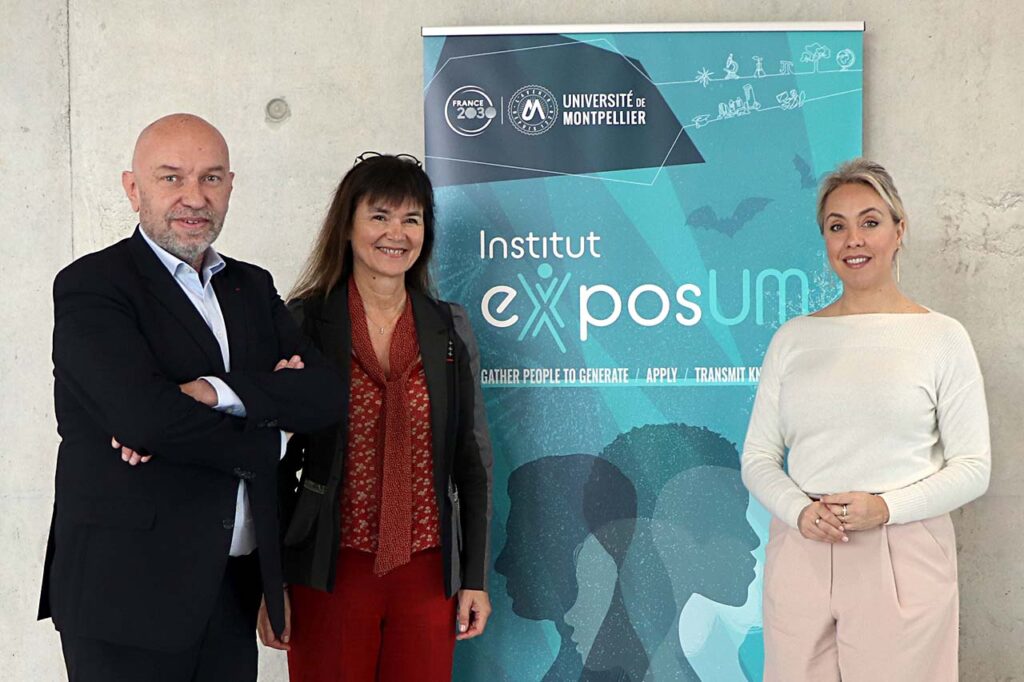
“With this launch, our goal is first and foremost to announce our plans for the coming months and years, but above all, we want to foster a strong sense of community around the ExposUM Institute by communicating the values that underpin it,” explains Charlotte Boullé, a researcher on the TransVIHMI team and a member of ExposUM’s executive committee, or “codir.” The name was chosen in reference to the concept of the exposome, which refersto “the totality of exposures to external and environmental factors (diet, pollution, infectious agents, etc.)capable of affecting human health,” explains Eric Delaporte, a professor of infectious diseases and also a member of the “codir,” which has a total of four members: Charlotte Boullé, Eric Delaporte, as well as Mircea Sofonea, an epidemiologist atthe PCCEI’ , and Aurélie Binot, an anthropologist and agronomist at Astre.
A unifying theme
Let’s go back a few months. In November 2021, the University of Montpellier and its partners* learned that they had been selected, along with ExposUM, as winners of the “Excellence in All Its Forms” call for projects under the Investments for the Future program (PIA4). The prize: 23.2 million euros in government funding, matched by the Occitanie Region—for a total of 46.4 million euros over eight years—for a project designed to mobilize all of the University’s key players. “ This is an extremely unifying theme in Montpellier, ” continues Eric Delaporte. “It will allow us to bring together a wide range of topics as well as multiple disciplines such as oncology, nutrition, ecology, chemistry, and the social sciences…”
A year later, after countless meetings, video conferences, messages on various collaborative platforms, and more, the founders of the ExposUM Institute are presenting an ambitious program. Research, science-society interaction, and education—as Charlotte Boullé points out, each pillar of the project is guided by a set of values. “ Interdisciplinarity, a strong focus on the Global South, an integrated ‘One Health’ approach, and interactions with societal stakeholders” are among the features that form the framework of the Institute. A joint, multidisciplinary Scientific and Strategic Advisory Board (COSS), chaired by Jacques Mercier, Vice President for Research at the University of Montpellier, guides its implementation.
First Call for Proposals
Following this, on December 9, ExposUM launched its very first call for projects (AAP). With a budget of 2 million euros, its first theme is the emerging exposome. Winners will receive funding ranging from 100 to 300,000 euros to develop their projects over a period of 1 to 3 years. “A new call for proposals will be launched every year,” continues Charlotte Boullé. “We have chosen to operate through calls for proposals to ensure transparency with the research community and have established a selection process designed to be as clear as possible.” ” Applicants have until April 7 to submit their applications before the COER (Research Guidance and Evaluation Council, also a joint and multidisciplinary body established for this purpose) and then the COSS , render their decisions next July, with the program set to launch in September.
Another important initiative in the research component is the creation of “ExposUM fellowships,”which offer highly attractive research conditions. “These will be two-year contracts, renewable once, for fully funded positions—meaning that the researcher will have a budget for operating expenses and to cover payroll costs for up to three people,” explains the researcher. Six such positions are expected to be created.
Doctoral Nexus
Training is also central to ExposUM’s mission, with the announcement that 60 doctoral dissertations will be funded over eight years as part of the doctoral nexus program. “The reality today is that we still do not place enough value on interdisciplinarity. We want to encourage future generations of researchers to embrace this approach by familiarizing them with it starting at the doctoral level through the creation of these Doctoral Nexus programs,” explains Charlotte Boullé. Here again, calls for proposals will be issued. To apply, researchers will need to form teams to lead networks of three or four doctoral researchers in different disciplines but linked by a common theme. “We are taking into account the additional workload involved in this interdisciplinary approach by providing each doctoral student with funding for four years instead of the usual three. Each student will also receive 20,000 euros over four years to cover the practical costs of this collaborative work.”
Over the course of the year, ExposUM is also expected to help doctoral and postdoctoral students secure funding for internship and operating stipends so they can work with master’s students and guide them in becoming familiar withresearch supervision—“an important aspect of a research career for which we are not always well prepared,” the researchernotes . Finally, because the project aims not only to focus on the Global South but also to be open to international opportunities, ExposUM seeks to promote study abroad. “Many researchers engage in informal teaching abroad during their travels,” Charlotte Boullé points out . “The UM program aims to recognize these efforts as part of the University of Montpellier’s outreach initiatives, providing small grants ranging from 10,000 to 15,000 euros.”
Science Activities
To strengthen this interdisciplinary vision, cross-disciplinary scientific events will be offered to members of the ExposUM research community to support them in their thinking at the intersection of disciplines with very different theoretical and methodological frameworks.“This initiative will lead to the emergence of new interdisciplinary themes, bringing together perspectives from the medical, environmental, and social sciences, particularly in future calls for proposals and doctoral nexus programs,” says Aurélie Binot, the coordinator for the “Interaction” research track within the co-directorship.
A focus on science communication lies at the heart of the Institute’s approach, which aims to tackle another challenge: gaining a better understanding of the exposure issues faced by stakeholders in the nonprofit, private, and political sectors in orderto “convey these issues to researchers and foster ‘transdisciplinary’ initiatives that bring together scientists and members of society to address shared challenges,” concludes Aurélie Binot.
* CIRAD, CNRS, Ifremer, INRAe, Inria, Inserm, IRD, ENSCM, Institut Agro, Montpellier University Hospital, ICM, Occitanie Region.