The Disaster That’s a Long Time Coming: Understanding the “Environmentalist’s Paradox”
Climates are becoming unstable, ecosystems are deteriorating, and yet, on a global scale, average per capita income, life expectancy, and education levels continue to rise. This discrepancy is one of the most troubling paradoxes in the contemporary environmental debate. Exploring all the factors behind this phenomenon is essential to thinking about how to act and communicate in the era of climate change.
Jean-Michel Salles, University of Montpellier; Guy Richard, INRAE and Michel Colombier, IDDRI

Since the 1960s, warnings about the environmental consequences of economic growth and industrialization have become increasingly frequent. Ecosystem degradation, resource depletion, pollution, climate change, and the crossing of planetary boundaries: numerous scientific studies describe trends that could permanently alter human living conditions.
And yet: global life expectancy is rising, extreme poverty has declined—at least until the recent crises—education levels are improving, and average per capita income continues its long-term upward trend worldwide.
This discrepancy corresponds to what researchers referred to, around the turn of the 2010s, as the “environmentalist paradox”: how can we explain that human well-being, as measured by mainstream indicators, is improving even as ecosystems are deteriorating?
This paradox obviously does not deny the existence of the ecological crisis. But it complicates its interpretation.

A Disturbing Finding
In 2005, the UN published the Millennium Ecosystem Assessment. This report, prompted by the observation of widespread degradation of ecosystems and the services that human societies derive from them, confirmed that a large portion of the world’s ecosystems and the benefits humans derive from them were in decline.
Building on this, in 2010, researchers formalized the puzzle: if the ecosystem services that support human societies are deteriorating, why do human development indicators continue to rise?
This question is not purely academic. It strikes at the heart of the contemporary political debate. If environmental warnings do not result in visible and widespread deterioration of living conditions, their credibility may be undermined. Conversely, if current prosperity is based on cumulative degradation whose effects are delayed, inaction is the greater risk.
First line of inquiry: the problem with indicators
One initial attempt to explain the environmentalist’s paradox focused on the indicators used.
The primary indicators of well-being—gross domestic product (GDP) per capita, life expectancy, school enrollment, or a combination of these in the Human Development Index (HDI)—primarily capture material and health-related dimensions.
But they do a poor job—or fail entirely—to capture the quality of community relationships, the resilience of regions, future ecological security, and intergenerational vulnerabilities.
Part of the paradox stems from a disconnect between flows and stocks: well-being indicators measure flows (income, production, consumption), whereas environmental degradation affects stocks (climate, biodiversity, soil), the depletion of which may remain invisible in standard indicators for a long time.
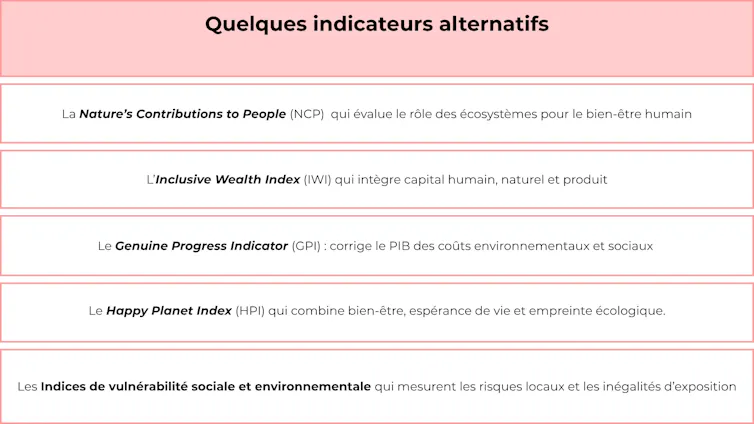
The paradox could therefore be linked to what is—or is not—measured, and part of the recent debate has thus focused on broadening the frameworks for assessment to take into accountnature’s contributions to people, natural capital accounting, and multidimensional well-being indicators. However, even with these expanded indicators, the overall conclusion remains the same: socioeconomic performance indicators have not yet shifted.
Second approach: the great energy and technology transition
The most widely accepted hypothesis today is that fossil fuels and technological innovation have enabled the large-scale substitution of nature’s services. Industrial agriculture has thus increased yields.
Water infrastructure, for its part, mitigates local disruptions to precipitation patterns. Finally, health care systems reduce mortality regardless of immediate ecological quality. In other words, modern societies have developed a capacity for resilience and adaptation. But this capacity itself relies on unprecedented material and energy intensification.
Recent research on material flows shows that global extraction continues to grow: on a global scale, economic growth and environmental pressures are still very often correlated.
The paradox does not refute ecological limits; rather, it demonstrates the temporary ability of industrial societies to postpone their effects through a massive mobilization of energy and resources.
Resilience or the illusion of stability?
Another interpretation of the paradox draws on the concept of resilience: socio-ecological systems can absorb significant disturbances without collapsing immediately. They possess inertia, redundancies, and adaptive capacities. But this resilience can be misleading.
Research ontipping points suggests that seemingly stable systems can suddenly cross critical thresholds. The climate, forest ecosystems, and ice caps all exhibit nonlinear dynamics. A troubling example is deforestation in the Amazon, which could alter rainfall patterns and transform the rainforest into savanna, with consequences for the global climate.
From this perspective, the absence of any observable collapse today is not proof of safety, but possibly a latent phase. The environmentalist paradox would then be the expression of an apparent robustness preceding a more profound transformation.
A Matter of Scale and Inequality
Overall averages also mask contrasting realities. For some populations, climate-related floods, droughts, or mega-fires are already synonymous with food insecurity, loss of livelihoods, or forced migration. The paradox is particularly evident at the aggregate level. At the local level or in terms of the distribution of impacts, the correlation between ecological degradation and vulnerability is often much clearer.
Consequently, the debate has shifted toward the concept ofa “safe and fair space,” a concept proposed in 2012 by British economist Kate Raworth. It aims to emphasize that, in order to move toward a livable world, the eradication of poverty was a necessary step. But how can we now reconcile respect for planetary boundaries with the reduction of social inequalities, given that average prosperity coexists with ecological overshoot and social injustices?
The Political Risk of the Paradox
One thing is certain: the environmentalist paradox is politically ambiguous. It could be interpreted either as:
- evidence that doomsday scenarios were exaggerated; environmental degradation has limited effects on human well-being because it is less severe than predicted or because human societies have sufficient capacity to adapt;
- or as evidence that societies have so far managed to defer these costs, but not to eliminate them. It is therefore the tools for observation and forecasting that are inadequate for capturing the reality of the situation.
In the first case, the paradox fuels skepticism and the temptation to maintain the status quo. In the second, it strengthens the case for preventive and prudent policies. The tension between these two interpretations is at the heart of public debates today.
Systemic Resilience and Dependence on Inventories
A central theme in recent literature concerns dependence on accumulated stocks: fossil fuels, natural capital, and legacy infrastructure. Contemporary prosperity is based on growth in the consumption of these stocks, which is unprecedented in human history.
The question then becomes: Is this situation sustainable in the long term? The paradox could be that of a modernity sustained by transitory biophysical conditions, the maintenance of which would require either limiting the number of beneficiaries —which is what neo-Malthusianism suggests by calling for birth control—or to hope that human ingenuity and technological progress will make it possible to prolong them—which is what technosolutionists or Cornucopians claim.
Collapse or Transformation?
The term “collapse” implies a sudden and widespread breakdown. However, the dynamics observed could be more gradual, varied, and transformative rather than destructive.
Recent scientific literature places greater emphasis on system trajectories, socio-ecological transitions, institutional adaptive capacities, and systemic risks.
The debate has thus shifted from a simple question—“Are we going to collapse?”—or even “When are we going to collapse?”—to a more complex one: Under what conditions and in what forms will ecological degradation ultimately affect human well-being, and in what ways and over what time frames?
What the Paradox Really Reveals
The environmentalist paradox does not invalidate either scientific warnings or advances in human development. It calls on us to move beyond the simplistic dichotomy between doomsday scenarios and technological optimism, and reminds us that the effects of environmental degradation are often delayed, unevenly distributed, and masked by the material power of industrial societies.
The catastrophe may be a long time coming, or it may already be here, but in forms that are less visible, more diffuse, and different from those we had imagined. In any case, the paradox does not settle the ecological question. It forces us to frame it differently—and more rigorously.
Jean-Michel Salles, Research Director in Environmental Economics, University of Montpellier; Guy Richard, Director of Collective Scientific Expertise, Foresight, and Studies at the National Institute for Research in Agriculture, Food, and the Environment (INRAE), INRAE and Michel Colombier, Scientific Director, IDDRI
This article is republished from The Conversation under a Creative Commons license. Readthe original article.