[LUM#18] “Coastal risk management will be interregional—or it won’t be at all”
In the Gulf of Lion, 25% of the coastline is eroding. This widespread phenomenon, which is accompanied by the risk of coastal flooding, raises questions about inter-territorial relations, particularly in Montpellier, where spatial restructuring cannot take place without dialogue between the metropolitan area and coastal municipalities. Political science researchers Sylvain Barone (G-Eau) and Laura Michel (Cepel), authors of the book *Metropolis and Coastal Risks*, provide insights.
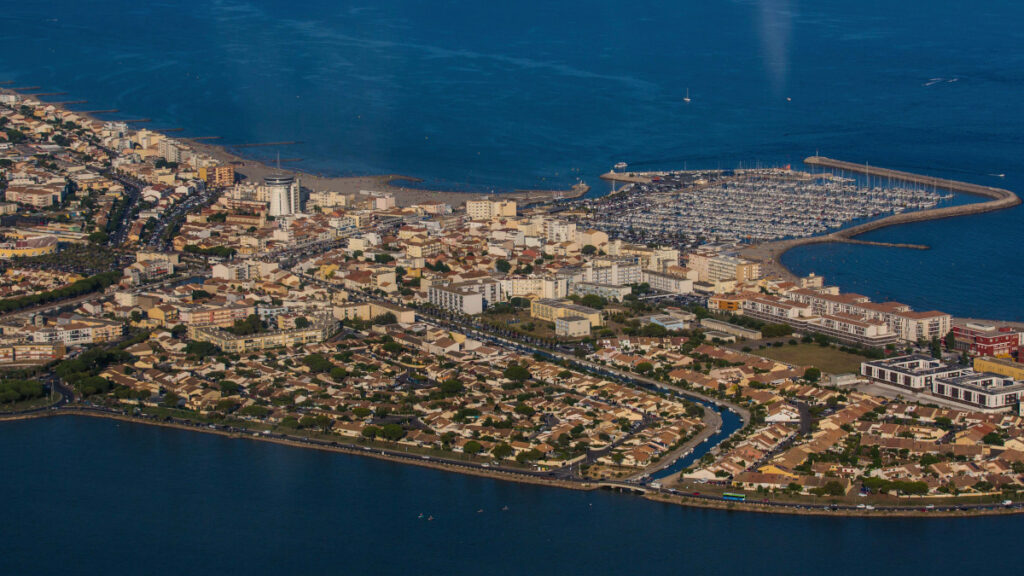
This “Popsu” study (a platform for observing urban projects and strategies) was conducted in collaboration with the Montpellier metropolitan area. What are the specific policy characteristics of this region?
S.B.: Coastal risk management policies emphasize the importance of planning on a scale broader than just the beach. Montpellier, as a metropolitan area, plays a central role in this equation, but from an institutional standpoint, it comprises only one municipality directly on the coast: Villeneuve-lès-Maguelone. The other coastal municipalities in the urban area are part of the Pays de l’Or Urban Community (POA). Coastal risks have long been an overlooked political issue for Montpellier. That is no longer the case.
Which jurisdictions are responsible for these risks?
L.M.: The risk of flooding remains a matter for the national government. Erosion, on the other hand, is considered a gradual natural hazard that can be anticipated through local land-use policies. It is therefore largely the responsibility of local stakeholders. Under the Climate and Resilience Act, municipalities affected by coastal retreat will be required to incorporate maps of eroding areas into their urban planning documents, with implications for building regulations.
Is there no dialogue between the metropolitan area and the coastal municipalities on these issues?
S.B.: There has been a history of conflict between Montpellier and these municipalities, but it is beginning to subside. A major study was conducted on the future of governance in the Gulf of Aigues-Mortes (GAM). It provided an opportunity for dialogue not only between Montpellier and neighboring intermunicipal associations but also with various public agencies, such as the Water Agency and the French Office for Biodiversity… Coastal risk management will be inter-territorial or it won’t be at all (Midi Libre, April 28, 2023).
Has the government completely withdrawn from the issue of coastal erosion?
L.M.: No, as part of the “Plan Littoral 21,” the Region, the government, and the Banque des Territoires are supporting six regions in implementing local strategies for coastal management and spatial restructuring. The aim is to build on existing forms of cooperation. For the Gulf of Aigues-Mortes, the study serves as a stepping stone for developing this strategy.
Could it take the form of shared governance?
S.B.: Based on the GAM study, the local governments opted for a system of agreements that relies on the consent of all parties and allows for greater flexibility. Another option would have been a joint agency-type structure, but that would have entailed decision-making by majority vote. Local governments in the minority might have been forced to implement measures with which they did not agree.
L.M.: At the regional level, one possible form of governance was the public interest group, but the stakeholders did not want to add another layer to the already complex web of existing structures. But it’s clear that progress is being made; the stakeholders are participating in the workshops and are actively involved.
The metropolitan area is sometimes criticized for being a tool that pits regions against each other in economic competition. Is it effective in addressing environmental challenges?
S.B.: That’s a legitimate question, but at the local level, no other local government has as many resources and areas of expertise to support this spatial restructuring. Should the metropolitan area decide and manage everything on its own? No, of course not. In fact, we’re moving toward forms of governance that promote more symmetrical relationships among public actors. Beyond simply including citizens and organizations, it will be interesting to foster a vibrant public discourse around these issues.
Isn’t there also a disconnect between the electoral timeline and the ecological timeline?
L.M.: Issues of risk adaptation require looking ahead several decades and adopting an integrated approach that goes beyond short-term, operational urban planning. The metropolitan area does not necessarily have the tools to involve citizens in issues that are often presented as technical but are in fact eminently political, because they involve choices that will have a profound impact on people’s lives. It is not easy for an elected official to tell constituents that they will have to relocate; they should not have to bear that burden alone.
How much leeway do we have to address these coastal risks?
L.M.: Climate change will lead to rising sea levels—that is irreversible. But the problems we face today are mainly due to large-scale coastal development and the exploitation of rivers upstream. We need to reevaluate the model of urbanization.
S.B.: We also need to reexamine the tourism model, but talking about spatial restructuring at campgrounds or beachfront hotels is complicated.
Is this a lack of political will on the part of municipalities?
L.M.: They are subject to conflicting demands. They are told they need to reduce land use, move toward zero net land take, take risks into account, and so on. But they are also asked to build housing, and their revenue is largely based on urban development and tourism.
S.B.: This region faces not only extremely significant challenges related to population density, public facilities, major infrastructure, agriculture, and biodiversity, but also very serious constraints, including the risks of coastal flooding, as well as runoff, river overflows, and wildfires… Montpellier is almost an extreme case, which makes it a fascinating area for research.
Check out theUM podcasts, now available on your favorite platform (Spotify, Deezer, Apple Podcasts, Amazon Music, etc.).