Digital Education for Student Success
Enhancing in-person classes, adopting hybrid teaching models, introducing new assessment methods… Since 2016, theUM has been developing a policy to support digital pedagogy, as evidenced by the organization of training sessions for faculty and the rollout of new tools. All of this is aimed at a single goal: promoting the success of its 50,000 students.
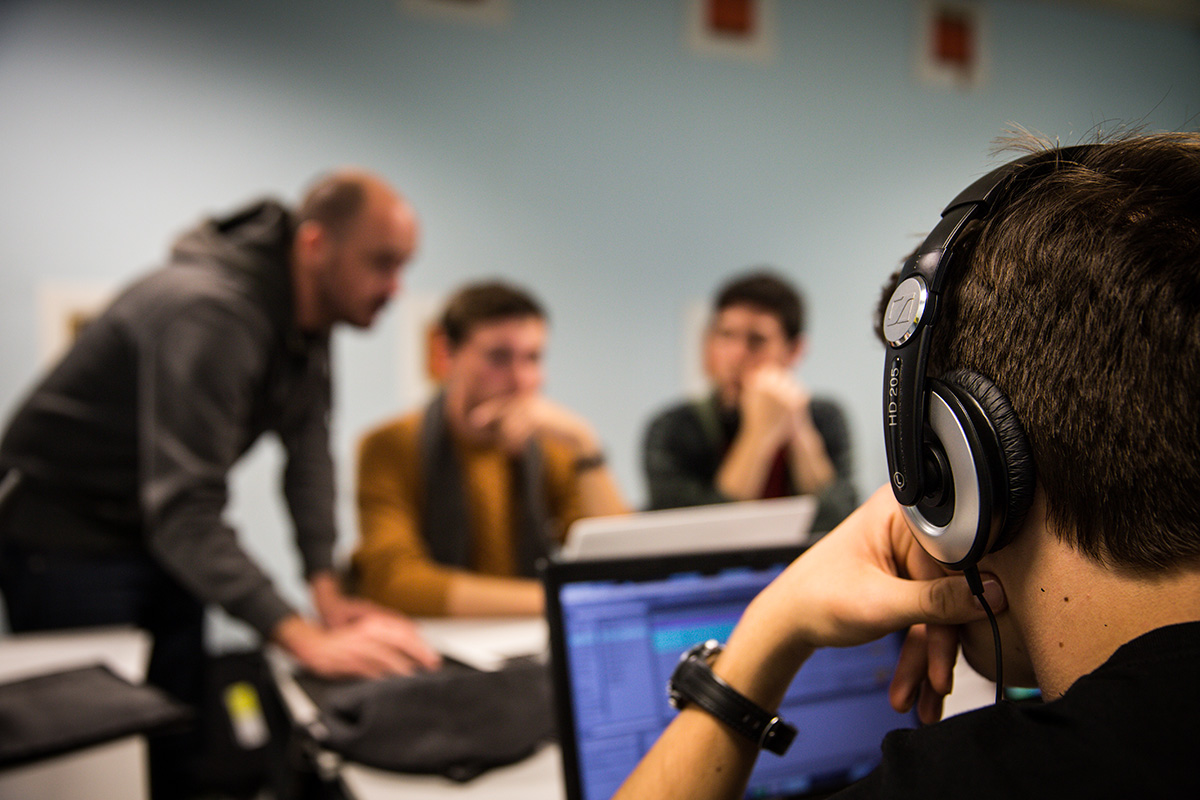
On March 22, more than a hundred people—157, to be exact—gathered to learn and exchange ideas at the PédagoN’UM event organized by theUM.“For the first time, participants from other universities joined us to discuss and make progress on these topics,” says Yohann Pottier, head of the Digital Usage Department (SUN/DSIN). The focus of the 2022 event was the assessment of knowledge and skills, featuring a presentation of new tools developed for this purpose—in particular, theKaruta e-portfolios, currently in the pilot phase at theUM. “This tool allows us to assess not only knowledge but also skills, placing real emphasis on what we call students’ practical skills and incorporating a self-assessment approach, ”emphasizes David Cassagne, Vice President for Digital Initiatives in Education.
FlexiEval for Better Assessment
This initiative builds on the work launched in 2019 by theUM as part of the FlexiEval project, which aims to build a digital ecosystem for assessing knowledge and skills—a project whose results, at the end of its planned three-year term, have proven to be very positive. Among the project’s successes is the partnership established between the University of Montpellier and Wooclap, an app designed to address two challenges well known to educators: the difficulty of capturing students’ attention and measuring their knowledge. In practice, the app functions as an interactive platform that allows instructors to design quizzes or interactive exercises that students access during class using their smartphones. It’s a quick and direct way to automate the assessment of students’ knowledge while actively involving them in the class.
“This type of practice is part of what we call ‘enriched in-person learning,’ explains David Cassagne. Here, digital technology becomes a tool for improving interactions between professors and students, bringing the professors’ content to life and stimulating the students’ attention. ” More recently, theUM was once again named a winner in a national call for proposals with its Pair’sEval project. Developed in partnership with the Montpellier-based startup Challenge Me, this project aims to foster collaborative learning and evaluative judgment through a platform dedicated to peer assessment.
Enriched in-person learning is intended to be a benefit for both students and teachers—some of whom are already engaged in the so-called “flipped classroom” approach, which emphasizes a more interactive and hands-on approach to learning in the classroom. The Moodle platform, which allows for the sharing of course materials and/or supplemental content, is a prime example of this.“The idea is not at all to shift teaching to 100% distance learning, as some may have feared, but rather to take advantage of in-person classes to prioritize interaction with students,” adds Yohann Pottier.
AgilHybrid: Even More Freedom
AgilHybrid’s goal is to avoid a complete shift to remote learning while also embracing the benefits of a hybrid model that combines in-person and remote learning. This other flagship project in digital education at theUM has been supported since 2020 by the MESRI as part of the France Relance program, as well as by Muse and the Occitanie Region, for a total funding of 2.3 million euros.“Seventy-one classrooms are now equipped to deliver co-modal instruction, allowing students to choose between in-person and distance learning,” explains David Cassagne. “In addition, 125 course units are currently being adapted to a hybrid format incorporating asynchronous distance learning.”
The so-called“asynchronous”training program consists of online learning modules that learners can complete at their own pace. Audio files, videos, multiple-choice quizzes, and interactive content are all educational resources that students can access freely and at their own pace.“One of the advantages of asynchronous learning is that it also allows for a greater diversity of students—including working students, those pursuing dual degrees, continuing education students, and international students—since this content can be more easily adapted for an international audience. Here again, digital pedagogy is a powerful tool for student success,” continues the vice president.
29 courses offered
A message that is increasingly being heard within the teaching community, whose members no longer hesitate to embark on this new adventure thanks to the numerous training programs offered by SUN/DSIN and the support provided by instructional designers (video Rouage: Supporting Teachers in Pedagogical and Digital Transformation). From lesson planning and gamification to student interactions and new assessment methods,“29 training courses were offered this year to faculty members at theUM, and the École nationale supérieure de chimie de Montpellier (ENSCM), and Institut Agro, and the CIHEAM IAMM, 19 of which are open to participants from all over France as part of AgilHybrid,” says Yohann Pottier. This program has continued to grow in popularity over the past two years. In 2022, more than 300 students at theUM benefited from these training courses.