The Class Photo: Another Side of School Life?
Dating back to the invention of photography, the class photo has, since themid-19th century, become a ritual that—even in the digital age—remains an indispensable tradition from kindergarten through high school. As a testament to its time, the class photo reflects—sometimes unwittingly—the political, cultural, and social history of the school.
Sylvain Wagnon, University of Montpellier

"It's 'a memory you'll cherish,'" the teacher tells her students in the first chapter of Little Nicholas, presenting the class photo as a future image of a lost world—that of childhood. This is just one of many signs, in literature and film, that these snapshots are indeed part of our history and our imagination.
The first class photos were taken inthe mid-19th century at the most prestigious secondary schools, which displayed them. As photography became more widely accessible, beginning in the last quarter ofthe 19th century, these “souvenir” photos were made available to families. The funds raised by school cooperatives were used to purchase supplies or help pay for field trips.
Between the Public and Private Sectors
Delphine Campagnolle, director of the National Museum of Education (MUNAÉ), points out that “it’s a highly symbolic object, straddling the line between school and private life, because these photos are very often kept—or even passed down—within a family.” This nostalgic approach is evident on websites where people hope to reconnect with a classmate they’ve lost touch with by looking at their class photos. This is the case with Copains d’avant, which claims to have over 15 million members.
Starting in the late19th century, photographers began to specialize in portrait photography or school photography, such as Pierre Petit (1831–1909). School photography companies were established, including David et Vallois, founded in 1867, and Tourte et Petitin, founded in 1882.
The growing popularity and proliferation of class photos prompted schools to establish guidelines for taking such photos as early as 1927. The most recent French circular on school photography dates from 2003. It aims to prevent abuses by establishing a “code of conduct” for class photography that respects the rights of everyone in the photo, including the photographer, the school, and minors (who require parental consent).
The Master in the Center
In 2017, the wonderful exhibition at the National Museum of Education clearly demonstrated that class photos were not merely cultural artifacts but tools for understanding the history of educational institutions. For example, they help dispel the myth that uniforms were worn in19th-century public schools; in fact, this was a phenomenon specific to religious schools.
With the introduction of Jules Ferry’s system of free, compulsory, and secular education beginning in the 1881–1882 school year, the class photo became an essential reflection of a “school order” and a school culture, embodying the values of discipline, seriousness, and obedience among students. The 1906 class photo from the school in Buigny-les-Gamaches clearly illustrates a staging intended by the school administration.
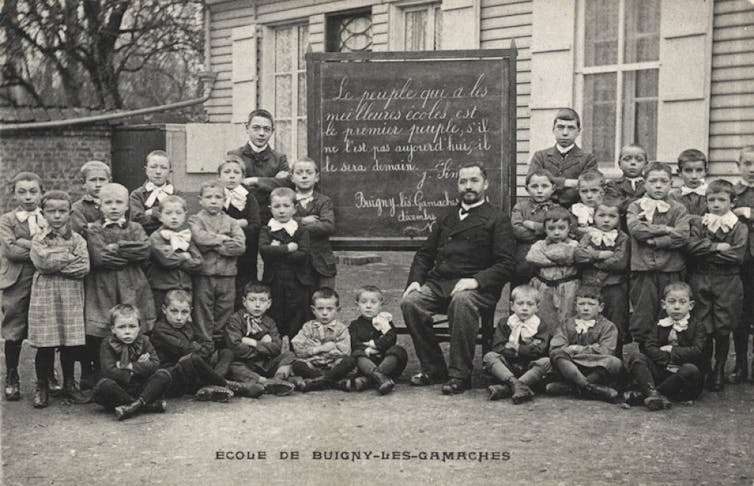
It depicts a teacher standing in the center of his classroom and the blackboard, on which is written a quote from Minister Jules Simon: “The people who have the best schools are the greatest people; if they are not so today, they will be so tomorrow”—a quote that explicitly reflects this desire for redemption following the defeat in the Franco-Prussian War of 1870–1871.
More natural
In themid-20th century, thanks to technological advances that reduced exposure times and the institution’s own efforts, photography began to take on a more “natural” look. Faces appear more cheerful, whether they belong to students or teachers. Nevertheless, do class photos serve as an illustration of change or stagnation in the “school environment”?
For this portrayal of the class photo changed little until the mid-1960s. Is this evidence of a society where the status quo prevails? Or does this unchanging ritual reflect the enduring nature of this republican school? But since the 1970s, a “relaxing of the norm” has been evident in the students’ positioning, their clothing, the teacher’s place in the photo, and also in the presence of both boys and girls—a belated but powerful sign of the school’s evolution.
A nostalgic symbol of childhood, the class photo is thus slowly evolving. Isn’t it a sign of an educational institution that, while undergoing fundamental modernization, remains true to the same educational model?
Sylvain Wagnon, Full Professor of Education, School of Education, University of Montpellier
This article is republished from The Conversation under a Creative Commons license. Readthe original article.