The Reform Explained to Future Teachers
On November 20, the Faculty of Education hosted the rector of the Occitanie academic region for a meeting focused on careers in teaching. Third-year undergraduate students majoring in economics, science, sports science (STAPS), or education came to learn about career opportunities in the field and the new teacher-training reform.
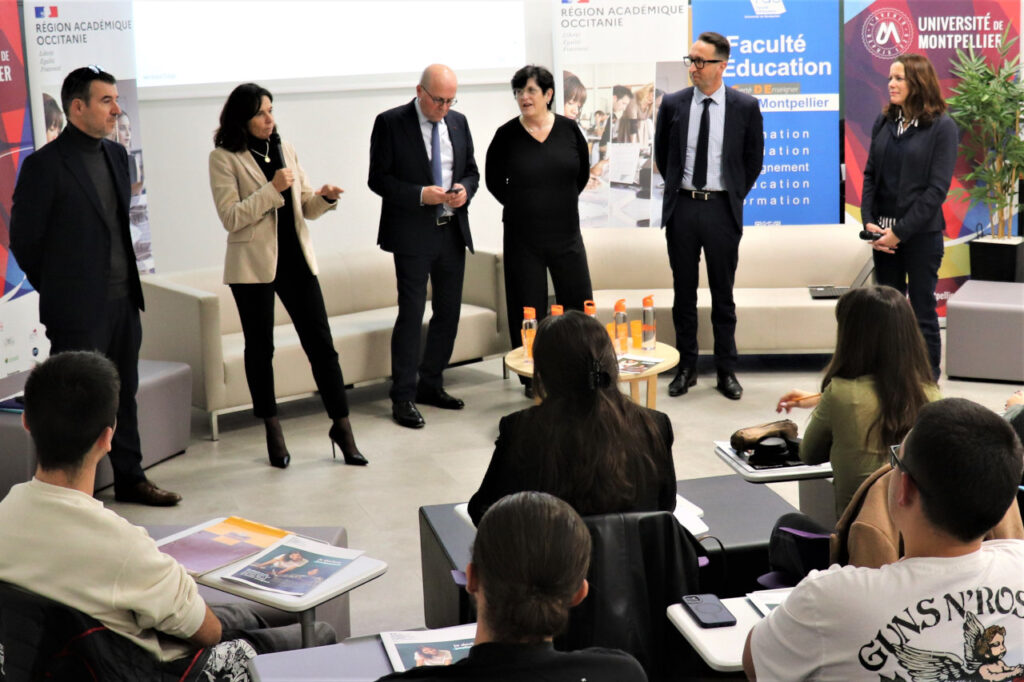
Agnès Perrin Doucey, dean of the Faculty of Education, opened the event by emphasizing the importance of bridging the gap between future college graduates and the world of education in which they will go on to work. This sector is undergoing rapid transformation and has seen numerous successive reforms in recent years.
A Better Start to a Career
It was precisely the latest of these reforms—concerning initial teacher training—that Carole Drucker-Godard, the rector of the Occitanie academic region and the Montpellier school district, came to present and explain. Joining her were Mathieu Ruffenach, academic inspector and regional educational inspector in charge of initial teacher training; Christophe Mauny, academic director of the National Education Services for the Gard department in charge of elementary education; and Laurent Gouze, director of human resources for the academy.
The reform introduces several major changes designed to facilitate a more immersive and clear transition into the profession. Future teachers are now out in the field from the very beginning of their training. New skills reinforce the practical and career-oriented aspects of the program to better meet the profession’s current demands. Another change is that students now receive compensation starting in their first year of the master’s program—a recognition of their professional commitment during their training. As the university president emphasizes, “This reform is designed to provide a better transition into the profession.”
Continue the dialogue
The students then had the opportunity to ask the speakers questions. Many topics were discussed, such as: assignment criteria, details about expectations for the final exam and the status of student civil servants, as well as class sizes. One concern that appears to be a major one for future teachers was addressed clearly by Carole Drucker-Godard:
“The reform will not affect class sizes. It is the declining birth rate that is currently leading to a decrease in enrollment, with a national average of 21 students per class.”
Finally, an interactive quiz led by Agnès Vrinat, the senior inspector, gave students the opportunity to test their understanding of the profession, its realities, and how it is evolving. The event concluded with a period of informal discussion. The stated goal? To encourage young people to become ambassadors for teaching professions and to help them better envision themselves in this meaningful career path, which, as Rector Carole Drucker-Godard reminded everyone, remains “the best job in the world, because it’s a job where you feel useful.”