[LUM#19] What Drives the Yellow Vests
For over a year, every day at roundabouts and almost every Saturday in the streets, Yellow Vests gathered to voice their demand for social justice. Beneath the vests were men and women from all walks of life, galvanized by the spark of a carbon tax they denounced as unfair.
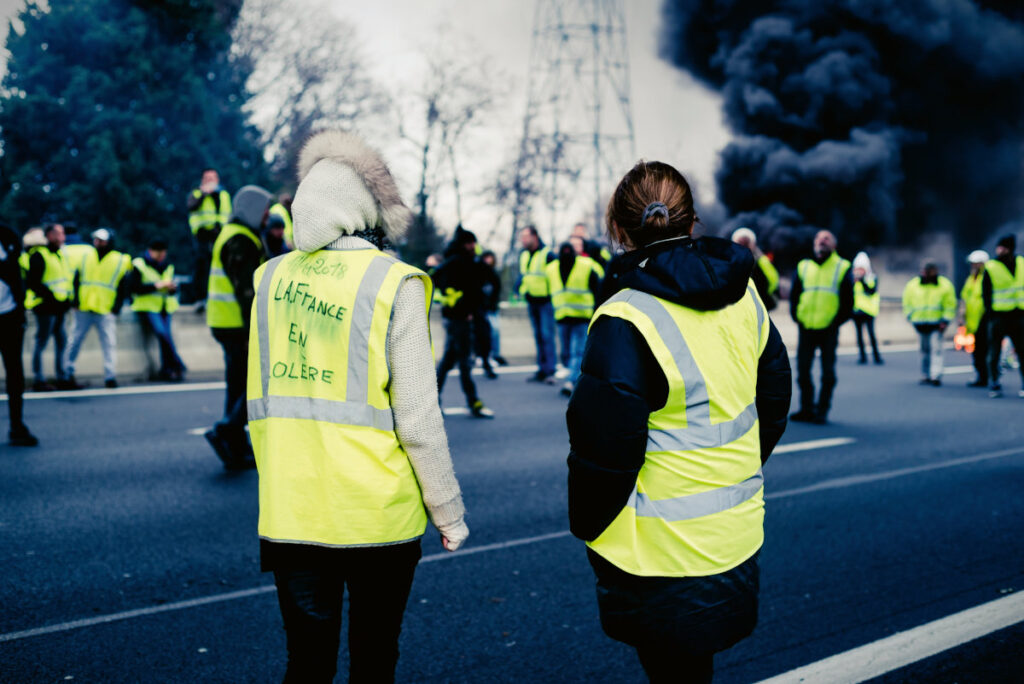
On November 17, 2018, to everyone’s astonishment, the first act of a social conflict—which would eventually number 65—erupted, destabilizing the government for many months (Le Monde 11/17/2018). In the streets and at roundabouts, thousands of protesters wearing yellow vests voiced their anger following the announcement of the carbon tax, as evidenced by the slogans chanted during the demonstrations: “Stop the taxes”; “The drop of gas that makes the cup run over”; “Stop bleeding us dry”; “Jo the Taxed One”…
Based on the “polluter pays” principle, the carbon tax —which aims to reduce greenhouse gas emissions—is viewed by a significant portion of the population as an unfair tax, especially at a time when the rising cost of living is already weighing heavily on the middle and working classes. “Movements related to energy issues always challenge societal models, ” explains Emmanuelle Reungoat, a political science researcher at the Center for Political and Social Studies (Cepel)*. “The Yellow Vests initially mobilized over the issue of fuel prices, but within a few weeks the movement began to denounce tax injustice, social inequalities, and then the institutions themselves, because energy issues affect mobility, purchasing power, and political and social organization.”
Mobility Under Scrutiny
The spontaneity of this uprising surprised observers: “It was a movement that was difficult to interpret—one that didn’t fit the profile of the public or the usual forms of protest,” recalls the researcher, who then worked urgently to develop a questionnaire that would serve as the basis for a major national study— the only one conducted on-site regarding the Yellow Vests. Despite a high degree of heterogeneity— “talking about the Yellow Vests is almost a misnomer,” as Emmanuelle Reungoat points out —it is possible to identify a few key characteristics: people often drawn from certain segments of the working class and middle class, frequently living in suburban areas, small towns, or rural communities; they exhibit diverse and sometimes conflicting electoral preferences, tending toward the most polarized positions on the political spectrum, and are fairly distant from labor unions and political parties—hence their open distrust of these institutions.
Certain professions, such as those in the healthcare sector, are also overrepresented—home health aides, nursing assistants, and nurses who have seen the public sector deteriorate… “People who rely heavily on their cars for work and whose commuting costs aren’t factored into their pay but take a heavy toll on their wallets.” The least protected categories of workers—temporary workers and those on fixed-term contracts—and, more broadly, blue-collar and white-collar workers are also overrepresented in the protests. So they gather at these all-too-familiar and accessible roundabouts—at the intersections of major thoroughfares—to voice their concerns about the mobility they feel is under threat. “The carbon tax was seen as an obstacle to their mobility, so they blocked everyone else’s mobility. In all major strike movements, people block mobility and the energy supply,” the researcher notes.
The End of the World or the End of the Month
Another distinctive feature of the movement is that many first-time protesters in the ranks of the demonstrators—mobilized through social media—are voicing their anger for the first time in the streets and at general assemblies. They are becoming politically engaged, discussing issues, and sharing their life experiences. “Many of them are, for the first time, framing a life journey marked by failure and guilt within the context of collective trajectories and a system that produces inequality. We’re moving from shame to injustice,” summarizes Emmanuelle Reungoat.
An awareness of class identity—which, beyond social issues, will shape a “classist” discourse among some of the Yellow Vests on environmental and energy issues—by denouncing “a policy that penalizes the little guys by taxing gasoline rather than jet fuel.” There is the emergence of a “we,” but it is the “we” of the little people against the big players who pollute far more—the powerful, the political elites who fail to take responsibility for climate change. ” While it is well established that the environmental footprint of the wealthiest classes is greater than that of working-class communities, the researcher also sees this as a challenge to public policies that are most often modeled on the practices of the urban middle class: “Riding a bike is all well and good, but you still have to be able to afford an electric bike, live close enough to work, and have suitable bike lanes…”
"Rednecks who drive diesel cars"?
This rhetoric is often suspected in the media of masking, at best, a lack of interest in environmental issues and, at worst, climate skepticism—all fueled by the common perception that the working class is not environmentally conscious. Emmanuelle Reungoat and her colleagues at CEPEL—Jean-Yves Dormagen and Laura Michel—set out to explore this idea by launching a study on the Yellow Vests’ relationship to environmental issues in Occitanie. “We had to see if, as was often claimed, we were dealing with climate skeptics or rednecks who drive diesel cars,” the researcher jokes. Unsurprisingly, what stands out most from this study is the group’s great heterogeneity, with widely divided views on environmental issues and many other topics. Nevertheless, 88% of the Yellow Vests surveyed acknowledge the reality of climate change, and 75% said they were aware of the impact of human activities on the climate—figures equivalent to those of the rest of the French population surveyed. Similarly, their carbon footprint, sometimes constrained by their standard of living, remains limited.
Without necessarily identifying as “green,” many of them have a vegetable garden, a compost bin, and an appreciation for nature… Reading the study, we learn above all that the Yellow Vests are ultimately neither more nor less environmentally conscious than the rest of the population, “Even though there are individuals with more assertive positions—with more ‘for’ and ‘against’ stances,” confirms Emmanuelle Reungoat, before concluding: “The management of resources—whether water or energy—will continue to be a major source of mobilization, raising issues of conflict, divergent interests, and the obligation for a democracy to learn how to manage these disagreements. And, to put it mildly, there is still progress to be made.”
* CEPEL (UM, CNRS)
Check out theUM podcasts, now available on your favorite platform (Spotify, Deezer, Apple Podcasts, Amazon Music, etc.).