The new Balard Chemistry Building brings a new dimension to research
The new Chimie Balard building, now considered the largest real estate project dedicated to chemical research in France, was inaugurated on June 13, 2023, at the CNRS in Montpellier. The inauguration provided an opportunity to highlight the CNRS/Michelin HydrogenLab joint laboratory, whose far-reaching partnership is primarily based on ambitious basic research aimed at addressing a wide range of major industrial challenges in the hydrogen sector.
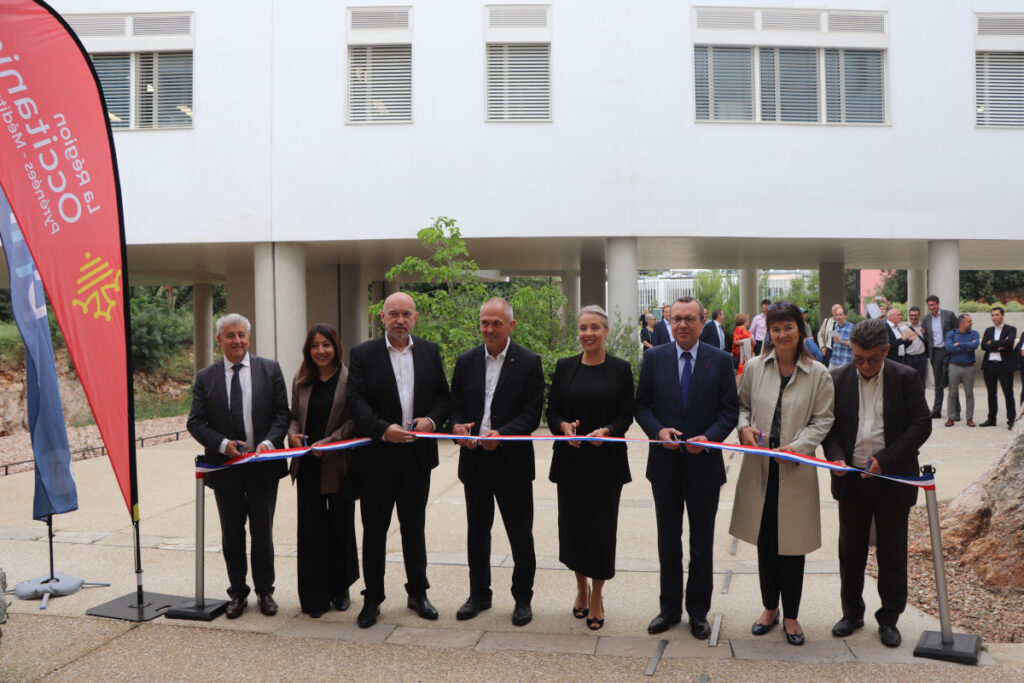
With its 25,500 m² of space capable of accommodating 800 people and its 2.5 kilometers of lab benches, the new Balard Chemistry Building, located on the CNRS campus on Route de Mende, is the largest chemistry research center in France. It was inaugurated on Tuesday, June 13, by Pierre-André Durand, Prefect of the Occitanie region and Prefect of Haute-Garonne; Nadia Pellefigue, Vice President of the Occitanie Region in charge of Higher Education, the “ Research,” Europe, and International Relations, representing President Carole Delga; and Antoine Petit, President and CEO of the CNRS.
This building, funded to the tune of 62 M€ by the Occitanie / Pyrénées-Méditerranée and €1 million by the CNRS, houses the research teams of the Max Mousseron Institute of Biomolecules (IBMM) and the Charles Gerhardt Institute of Montpellier (ICGM), as well as the joint research units of the CNRS, the University of Montpellier, andthe ENSCM.
The largest chemistry research center
With this new building, Montpellier is now home to the largest chemistry research center in France, both in terms of floor space and staff. The center is designed to meet the high technical standards required by the research activities conducted there, notably featuring 244 research modules capable of accommodating nearly 800 people, an analysis and characterization platform housing heavy and medium-duty equipment dedicated to research teams and industrial partners, as well as an innovation and technology transfer center designed to host startups in the field of green chemistry.
The Balard building is at the heart of an integrated campus of exceptional scale that covers all disciplines of chemistry and its applications, particularly in the fields of energy (hydrogen and batteries), health (active ingredients, medications, biomaterials, biomolecules), the environment (air and water quality, seawater desalination), and green chemistry (biomass conversion).
Spotlight on Hydrogen
This new building houses, among other things, the joint CNRS/ Michelin HydrogenLab, which aims to bring together the expertise of the Charles Gerhardt Institute of Montpellier (ICGM)—a joint research unit of the CNRS, the University of Montpellier, and the ENSCM—and that of Michelin’s Research & Development Operations Division (DORD) in the study of hydrogen to develop sustainable and innovative materials.
This joint laboratory thus aims to develop new materials for fuel cell stacks and electrolyzers through innovative approaches to the fabrication and shaping of these materials in order to enhance the sustainability of the hydrogen sector. The collaboration will involve the development of six projects, including doctoral theses, postdoctoral research, and master’s internships, focused on improving catalysts for water electrolysis as well as developing new membranes and nanofiber networks to significantly enhance durability.
The Montpellier Chemistry Community: A Community in Synergy
The Balard Chemistry Cluster was created in 2007, at the initiative of the Region and the State, to organize the chemistry sector by giving it real visibility and strong governance, thereby formalizing the commitment of the universities, schools, and governing bodies of the chemistry laboratories: the University of Montpellier (UM), the École Nationale Supérieure de Chimie de Montpellier (ENSCM), the French Alternative Energies and Atomic Energy Commission (CEA), and the National Center for Scientific R Research (CNRS).
Geographically located near the University of Montpellier’s Triolet Campus and on a portion of the CNRS campus, the two buildings—Chimie Balard Formation and Research —thus form the beating heart of Montpellier’s chemistry community. This clustering of the two largest laboratories in the immediate vicinity of the European Institute of Membranes has led to the emergence of an exceptional scientific campus—one of the very best in Europe—competing with the chemistry departments of prestigious European universities such as ETH (Zurich, Switzerland), Oxford and Bristol (United Kingdom), and the German center of excellence at the Max Planck Institute for Coal Research (Mülheim).
The Balard Chemistry Cluster, which also includesthe Marcoule Institute of Separative Chemistry in the Gard department, aims to pursue an ambitious project to advance the field of chemistry by pooling expertise and resources to promote sustainable development centered on three key areas: energy and materials; resource conservation and environmental protection; and chemistry in the service of human health and well-being.
Some facts and figures about the Balard Chemistry Building:
- 250,000 m³ of air extracted per hour, 2.5 km of lab benches.
- The shared analysis and characterization platform (PAC), which spans more than 1,600 m² and is open to both research teams and companies, houses heavy and medium-weight equipment (NMR spectrometers, diffractometers, etc.).
- The building was designed by the architectural firm Reichen and Robert & Associates, and the CNRS served as the project owner.
- The building also received special government funding through the DSIL fund (€1 million), allocated to cover the relocation of all equipment and devices from 15 buildings spread across four separate sites.