UM 's Heritage, as Told by Thierry Lavabre-Bertrand
Due to the health crisis, the 37th edition of Heritage Days, which was scheduled to take place on September 19 and 20, has ultimately been canceled at all state-owned buildings, including those at the University. To make up for this missed event, Thierry Lavabre-Bertrand, vice president in charge of Heritage, takes you on a virtual tour in this article.
“I love everything about it here,” Thierry Lavabre-Bertrand replies simply when asked what he likes best about this historic medical building, which is more than six centuries old. “ Do you see that wall [the one in the inner courtyard to the left of the Atrium]? It alone sums up the entire history of this fascinating place.” Indeed, remnants of medieval walls stand alongside the remains of the old cloister, where ancient pointed-arch windows seem to open onto the scars of the Wars of Religion etched into the stone.
While the Faculty of Medicine as an institution is celebrating its 800th anniversary this year, the historic building is a little less than a century younger. “It was built in the 14th century to house a Benedictine monastery; in 1536, it became the episcopal see before being plundered and ransacked during the Wars of Religion and abandoned for more than a century. ” Renovated and expanded under Louis XIV, the building began to take on the form we recognize today. The grand vestibule, the staircase, and the ceremonial halls, among other features, date from this period.
From the Clergy to Science
It would take a revolution, however—and not just any revolution—to transform this place of worship into a medical school under the leadership of Jean-Antoine Chaptal in 1795. “That was the era of the Theatrum anatomicum, the prestigious library, and the Hall of Acts, which was built on the site of the former bishops’ chapel. I, of course, defended my dissertation there, just as our students still do today,” recalls the vice president, an alumnus of the Faculty of Medicine.
From his student days, he also recalls the Dugès Room, where the busts now on display in the main hall once stood. “It was a lab, but also the foyer to the anatomy lecture hall. It had been decorated in the 19th century with large frescoes intended to encourage students to meditate while waiting for class to begin. ” Too damaged to be preserved, the frescoes were removed in the 1980s during the renovation of the room initiated by Dean Solassol. “ At that time, the building wasn’t yet a historic landmark [it would be designated one in 2001], so we didn’t have the reverence we have today for traces of the past.”
Medicine in the winter, botany in the summer
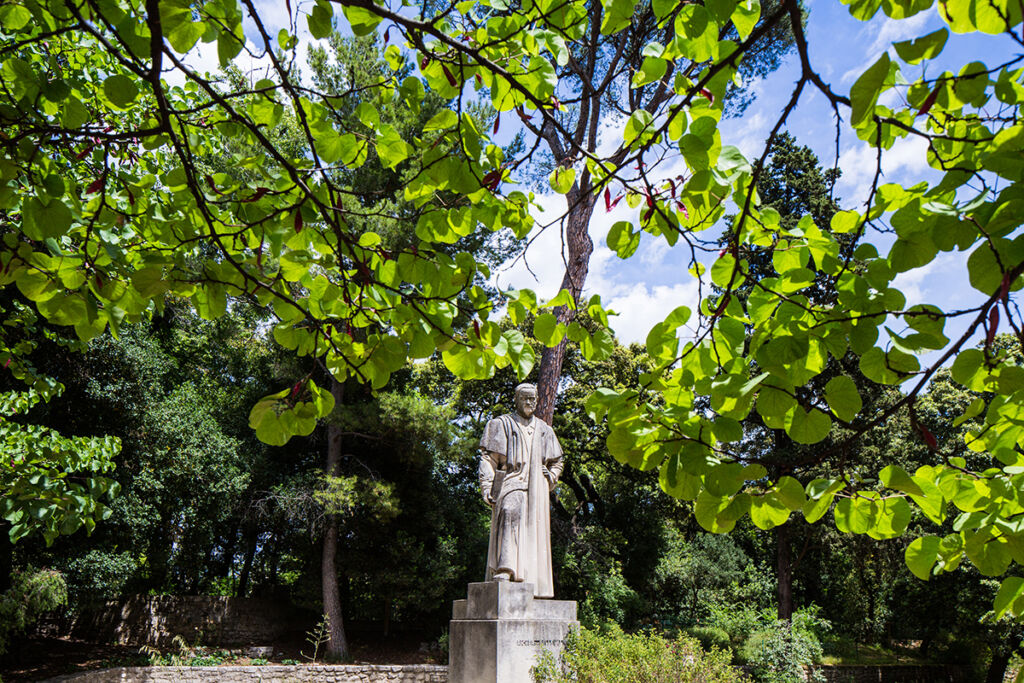
Let’s now cross Boulevard Henri IV to head to the Jardin des Plantes, another landmark of theUM ’s heritage. Founded in 1593, during the reign of Henry IV, by Pierre Richer de Belleval—then chair of anatomy and botany at the Faculty of Medicine— “the two disciplines were, in fact, linked. Anatomy in the winter because cadavers were better preserved, and botany in the summer when the trees are in bloom. That said, Richer de Belleval didn’t like anatomy and, in fact, never practiced it,” Thierry Lavabre-Bertrand notes with a smile.
As France’s oldest botanical garden, it was originally called the “King’s Garden in Montpellier” (the Queen’s Garden, which still exists today, is an extension of it) and served several purposes: “The medicinal garden was used to teach future doctors and apothecaries; the nursery allowed for the acclimatization and propagation of plants; and a natural history collection housed remarkable specimens,” continues the vice president. It still serves this educational purpose today for students in the School of Pharmacy. “The garden currently hosts more than 3,000 species across 4.5 hectares. Its maintenance and operation are managed by a team of ten gardeners working under the director, the head gardener, and the botanist.”
Serre Martins, Orangery, Stewardship, and Hidden Maze
The garden is made up of several areas, starting with the Martins Greenhouse— “named after the botanist who had it built in 1860.” Renovated in 2011 with support from the Languedoc-Roussillon region, it now houses an impressive collection of succulents. The Orangery, meanwhile, provides shelter for the plants during the winter. “Built in the early 19th century, it perfectly embodies the style of the Versailles orangeries but in a revolutionary, simpler, and more harmonious version. There are no coats of arms or crests to be found here; only the signs of the zodiac, referring to the cycle of the seasons, appear on the pediment,” notes the heritage specialist. Its renovation, made possible by the support of a corporate foundation, was completed in 2018.
Now it is the turn of the Intendance building—which served as the Rector’s Office from 1815 to 1980—to undergo renovation. “We are looking forward to this project with great interest, as it could reveal remarkable archaeological remains.” Foremost among these is the mysterious labyrinth of Richer de Belleval, which is said to lead down to the water table beneath the Jardin des Plantes and where the famous botanist is said to have cultivated ferns and other plants that thrive in shade and moisture.
A Living Museum of "Drugs"
Closely linked to the Jardin des Plantes, the apothecary, located within the School of Pharmacy, “is another iconic site in our history that bears witness to the city’s long medical and pharmaceutical tradition.” Established in the late 16th century, it houses the second-largest collection—after Paris’s— "with more than 10,000 samples of plant, mineral, or animal origin from around the world, whose ethnopharmacological value remains inestimable," explains the vice president. A living museum of the history of “drugs” and medicines, “it continues to grow regularly thanks to donations and bequests and remains a very active center for education and research.”
This concludes our tour with Thierry Lavabre-Bertrand through the treasures and anecdotes that make up the University’s heritage. Its walls will continue to be enriched for another year before welcoming the public once again for the next Heritage Days.