Plastic: It's Getting Complicated—An Innovation Marathon in Support of the Ecological Transition at the University of Montpellier
The Pol’Innov Challenge 2024 awards ceremony, organized by Polytech Montpellier (University of Montpellier), marked the end of an intense week dedicated to innovation and the ecological transition, focusing on the theme of single-use plastic packaging. On this occasion, ten “favorite” awards were presented to the most outstanding projects among the 49 submitted by the school’s engineering students.
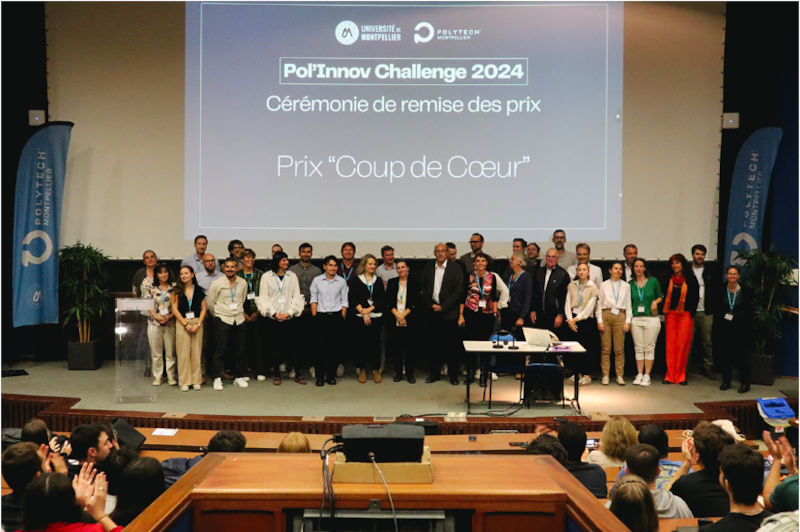
The 2024 edition focused on single-use plastic packaging
This year, the challenge focused on the issue of single-use plastics, an environmental emergency. Student teams were encouraged to develop solutions to reduce the impact of these plastics, whether by changing behaviors regarding waste and recycling or by innovating in the areas of reuse and recycling, thereby addressing the technological and industrial challenges of our time.
Indeed, the figures are alarming. Plastic is ubiquitous in our daily lives, with more than 6.9 billion metric tons of plastic waste generated since 2015, of which less than 10% has been recycled. By 2060, projections indicate that greenhouse gas emissions linked to this material could reach 4.3 billion metric tons—a major challenge that the projects in this edition have sought to address.
A week marked by two highlights
On October 22, the issue of plastic packaging was addressed by three experts who gathered for the Pol’Innov Challenge conference, brilliantly moderated by Géraldine Karbouch of innovation4impact, an expert in CSR and innovation. Quentin Passet, founder of Eio—which collects plastic waste from rivers and transforms it into eyeglass frames made from 100% recycled plastic—came to share his experience with innovative and sustainable entrepreneurship. Valérie Guillard, winner of the special jury prize at the “Stars of Europe” competition, is a researcher at the Agropolymers and Emerging Technologies Laboratory, and she detailed her project “GLOPACK, the packaging of tomorrow: bio-based, biodegradable, active, and smart.”
These exchanges allowed our students to gather key information on both technical and scientific aspects, as well as on the management of such projects.
As for the closing ceremony, it provided an opportunity to screen the short film “Plastic Symphony” in the presence of its production team—Elisabete Silva, Nicolas Brobecker, and Franck Molina. The film offered an artistic and socially conscious perspective on the challenges of plastic pollution, a topic close to the hearts of the organizers and participants of the Pol’Innov Challenge.
Projects at the Heart of the Green Transition
The teams of male and female students stood out for their commitment and creativity in addressing these environmental challenges. Among the winning projects were innovative solutions for plastic sorting in the medical sector, the reuse of plastic for home insulation, and initiatives promoting sustainable food systems. The winners also received a Reus’eat cutlery set, a practical and sustainable alternative to single-use plastic and a powerful symbol of Polytech Montpellier’s commitment to reducing waste.
By placing innovation and sustainability at the heart of its educational approach, Polytech Montpellier reaffirms its mission to train engineers committed to the ecological transition. The Pol’Innov Challenge is a prime example of this: an inspiring and unifying event for its students, partners, and the entire university community.
A team effort with the support of our partners
Throughout the week, 245 students benefited from the support of numerous institutional and private partners, including the Montpellier Metropolitan Area, SUEZ, the U Cooperative, the University of Montpellier, Aglo Pôle de Sète, business incubators, and many others. These partners shared their expertise and helped enrich the participants’ ideas and projects; their support for this initiative is essential.
Inter-school collaborations have also emerged: for the first time, business administration students from the Montpellier-Sète University Institute of Technology (GEA track) and the MTEEC master’s program at Montpellier Management joined the challenge. Their contribution enabled the Polytech teams to incorporate management and strategic skills, which are essential for structuring their projects from a professional perspective.
The list of 49 projects is available to anyone interested, and several companies have already decided to continue certain projects by offering internships to engineering students.