“The PUI… an invisible force that supports all projects”
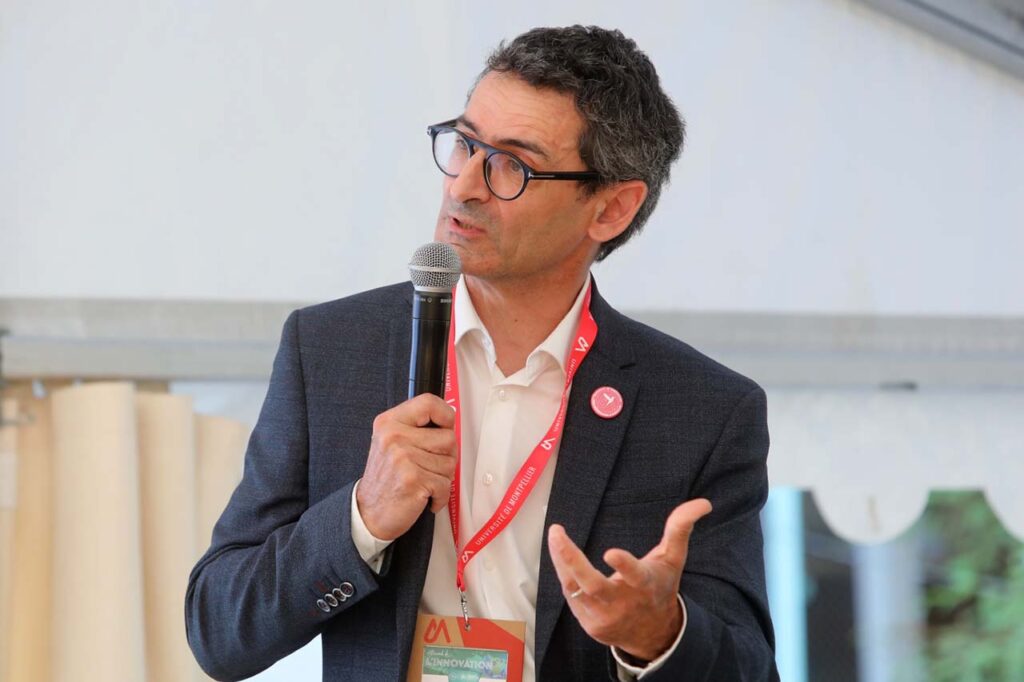
Philippe Combette, Vice President of the University of Montpellier in charge of partnerships and innovation, heads the PUI (University Innovation Hub). After two years of pilot testing and one year of accreditation, he offers a very compelling assessment…
A pilot site since 2021, the University of Montpellier was designated a university innovation hub in September 2023. Why was it obvious that the University would embark on this journey?
It all started with the I-site label of excellence, whose acronym already referred to the terms “innovation,” “regions,” and “economy.” In this regard, the first initiatives were launched as early as 2017. In 2021, the Ministry of Higher Education and Research ( Research ) approached us prior to the PUI pilot program, because it considered that the Montpellier region already possessed quite a few strengths. This was true both in terms of our research-intensive university, which is highly successful, and in terms of the local socio-economic ecosystem. Startup creation is one of this city’s strengths, and it also has a BIC (Business Innovation Center) recognized as one of the best internationally… It was therefore entirely appropriate for us to submit an application for the PUI pilot phase…
In a few words, how would you summarize the role and responsibilities of the PUI?
We didn’t want to turn the PUI into some kind of totem that all initiatives must pass through… But rather as an invisible force that supports all projects. The PUI is a collective that works to build a network across a well-defined territory—in this case, the metropolitan area and its surrounding region. The goal is to ensure that all innovation stakeholders know one another, work together, and ultimately create jobs and advance research. An additional mission of this hub is to enable the various research laboratories—which often have a national perspective on innovation—to promote research at the local sites where they are represented. Ultimately, the PUI aims to increase the competitiveness of businesses and reindustrialize the regions.
The academic and business worlds faced some challenges before they were able to work together. Overall, how has the PUI succeeded in creating a new dynamic?
Every year, we are measured against key performance indicators that show us whether our efforts are paying off. In the 2023–2024 fiscal year alone, we signed more than 300 research contracts with companies, totaling 15 million euros, even though our goal for 2025 was 393. We recorded 175 invention disclosures, whereas the target is 210 by 2025. We have created 7 spin-offs and 25 startups, while the goal is to create 8 and 25, respectively, by 2025… In short, we have already achieved approximately 75% of our goals.
What does this mean in terms of resources and budget?
Today, between the pilot phase and the consolidation phase, we have an initial budget of 9 million euros, and we have used about one-third of that amount. This allows us to fund a collective effort—one that local governments have recognized and embraced—which is organizing itself to be as effective as possible.
Several initiatives have been put in place to promote research projects. Could you briefly tell us about the most effective tools?
We have three main tools. First,“Companies and Campus,”which we launched in 2018. This initiative involves bringing companies onto our campuses so they can benefit from our scientists’ facilities and expertise, while also sharing their own know-how with us. We allocate grants ranging from 40,000 to 50,000 euros per project. In total, 1.8 million euros have been invested since 2018—including 500,000 in 2023—for approximately 40 projects.
There's the Montpellier Innovation Booster (BIM) as well?
Yes, BIM has been holding four sessions a year since 2020 to support and coach project leaders as they bring their projects to fruition. In total, we offer 20,000 to 30,000 euros per project, and about fifteen coaches per BIM session, drawn from the business world, the Montpellier BIC, the regional agency Ad’Occ, and Satt AxLR… Here again, our strength lies in having a network that extends beyond the academic world. Finally, we have the “Pre-incubate to Co-incubate” program. A sort of launchpad designed to identify and support business creation, it brings together several academic incubators (such as Initium and AgroVallée) and public incubators (such as the BIC in Montpellier). In total, we have supported the creation of 23 startups.
You have garnered the support of many local partners, both institutional and private. In your opinion, what are the final obstacles that need to be overcome?
Overall, it’s a bit like a honeymoon… But at some point, to take things to the next level, we need to raise funds, and that’s a little more complicated. We need to bring investors to the table so they can make their decisions calmly and with full knowledge of the facts.
In 2023, 12 deep tech startups were launched within the PUI. And since 2021, these innovative young companies—all based in Montpellier—have managed to raise more than 360 million euros. Which projects have made the biggest impression on you or really impressed you?
Two wonderful examples come to mind. The founding of Terratis, which supported us during our oral presentation for the ANR (National Research Agency). Clélia Oliva had devised a technique to eradicate the tiger mosquito through irradiation, and she thought to herself: why not start a company? She went to see the director of the Initium incubator, pitched her idea, and participated in the “Pre-incubation for Co-incubation” program. She also participated in the BIM program and received support from Satt AxLR, the BIC, and BPI France… And Terratis was born. Today, this remarkable technology has already been deployed in certain areas of the Montpellier metropolitan area.
This year, our doctoral student Sarah Colombani has also had a remarkable journey. As a BIM award winner, she founded her company, OcciCal Therapeutics, which aims to develop a drug to treat respiratory dysfunction. Sarah is amazing—she has boundless energy. She has received support from BPI France and the BIC. She was awarded the Innovation Prize last July. And she perfectly exemplifies what can be achieved through the PUI program.
Do you plan to focus on or promote specific issues in the coming years?
We are a collective, and we have collectively defined thematic roadmaps. Our rule is that if more than two founding members think it’s a good idea, we should move in that direction. So together, we’ve decided to focus more specifically on water issues, digital health, oncology, the energy transition… We’re also considering creating a roadmap centered on vineyards and wine.
As early as 2019, the University of Montpellier was considered, according to the Reuters ranking, one of the most innovative universities in France (2ndin France and17th in Europe). What are your ambitions today?
This year, we’re going to create a new status for innovative student entrepreneurs. We decided we needed to open our doors to the student community and give them access to all the initiatives offered to researchers through the PUI. Today, it’s important to note that 90% of innovation comes from just 10 to 12% of the academic community, which means that many researchers are not on the path to innovation for a variety of reasons…
And on a European scale?
In the coming months, we will also strengthen our engagement with Europe through the EIC (European Innovation Council), via several calls for projects and through the creation of alliances. We would also like to secure more European funding for research and innovation. More broadly, within the PUI, our strategic planning teams are constantly reevaluating how we coordinate our efforts. This is what enables us to continually improve and make gains in technology transfer, research, collaboration, and more. We have a single goal in mind: to increase our capacity for innovation.
Key Figures
- 360 partnership agreements per year;
- 175 invention disclosures per year;
- 33 operating licenses;
- 12 deep tech startups founded in 2023;
- 360 million euros raised since 2021;
- 62 startup and spin-off projects supported;
- 60 companies based on the campuses.