The National Rally in Isolation: The Failure of Le Penism at the Local Level
For the National Rally, this municipal election was shaping up to be one in which the party would establish a firm foothold.
Emmanuel Négrier, University of Montpellier

It promised to be very different from the 1995 election, when symbolic victories in cities such as Toulon, Marignane, and Orange had turned out to be exceptional and fragile: short-lived in electoral terms for Toulon and Vitrolles, and complicated for the party apparatus elsewhere, with well-established elected officials—such as Jacques Bompart in Orange and Daniel Simonpieri in Marignane—breaking ranks.
This election also promised to be different from the one in 2014, which was marked by significant gains, particularly in the far right’s two main areas of influence: a vast region in the northeast, stretching from Hénin-Beaumont to Villers-Cotterêts via Hayange; and the Mediterranean coast, notably including Béziers, Fréjus, and Beaucaire.
However, nothing went as planned, and it is clear that, on the eve of this second round, the RN finds itself in a very difficult situation.
A Two-Pronged Challenge
This time, there were two challenges. The first was to retain the mayoral seats won in the last municipal elections—under circumstances that were at times unusual, particularly given the high degree of fragmentation among the opposition—without being able to rely on a significant pool of votes.
The second was to translate the successes the party had achieved in the 2015 regional elections, the 2017 presidential election, and the 2019 European elections—in which the party had come out on top—to this very specific scale.
To this end, the National Rally had adopted a three-pronged strategy: establishing a local presence; expanding into and co-opting the right; and softening its rhetoric. These three pillars of the far right’s rise to prominence constituted Bruno Mégret’s “posthumous” victory over Jean-Marie Le Pen, who had always been resistant to even the slightest degree of political autonomy for his local elected officials.
They were intended to enable the party to increase its number of representatives at the local level, and while victory was not always guaranteed, this pool of candidates at least made it possible to envision certain favorable outcomes in the upcoming Senate elections.
This strategy was particularly evident in Perpignan, where Louis Aliot had strengthened an already substantial presence by winning the seat for the2nd constituency of the Pyrénées-Orientales in 2017. Above all, the tone of his campaign revealed a good-natured leader whose moderate rhetoric stood in stark contrast to the radically right-wing rhetoric of the outgoing LR mayor.
She has found an almost troublesome supporter in Robert Ménard, who, from Béziers, is thinking more and more clearly about the world after Marine Le Pen. Having previously attempted—and failed—to unite the radical right ideologically through the “Ose ta droite” event, has shifted his strategy toward electoral expansion, advocating for a unification of the right in Sète (where he endorsed the departmental secretary of Les Républicains) and Frontignan (where, on behalf of the same coalition, he supported Front National candidate Gérard Prato), while Thierry Mariani, a former minister under François Fillon, did the same in Lunel.
A resounding failure and a setback in the first round
The result of this strategy to raise the party’s profile has been a resounding failure riddled with paradoxes. To attribute it to the health crisis would be a gross exaggeration. The failure predates March 15, 2020: in fact, it is clear that the RN did not even manage to field as many slates in cities with more than 10,000 residents as it did in 2014. Far from it: only 262 slates, compared to 369 in 2014!
The Jean Jaurès Foundation kept a detailed tally of the results for these slates—which were fewer in number but, as was promised, of higher quality and with greater electoral appeal—during the first round.
The result is indisputable. The RN is losing ground in all regions, even those where it had a substantial electoral base, as evidenced by its results in 2017 (presidential election) and 2019 (European elections), when it exceeded 50% of the vote in a large number of municipalities (Occitanie, PACA, Hauts-de-France, Grand Est).
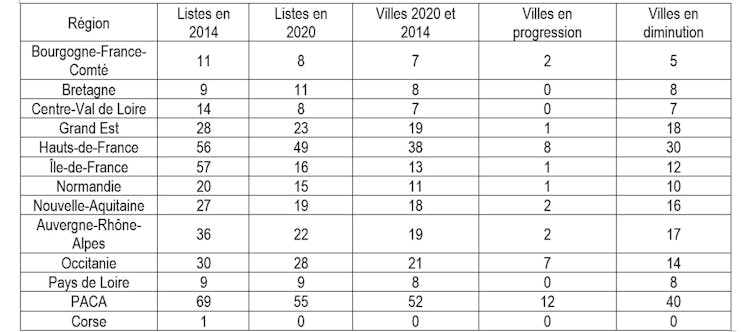
The first paradox, then, is that the RN failed to expand its influence even though it was riding an extremely favorable wave. In southern cities, where its prospects seemed all the stronger given its pool of candidates who had been running in the same districts for several years, its decline has been striking.
He lost a third of his support in Nîmes and more than half in Saint-Gilles, his main stronghold in the late 1980s—a town he had nearly recaptured with Gilbert Collard in 2014. In addition to the towns where he failed to field a slate of candidates, his results are down sharply in Frontignan (28%, or 2 percentage points and 800 fewer votes than in 2014). In Montpellier and Toulouse, the two major cities, he even fell below the 5% threshold, meaning his campaign expenses will not be reimbursed.
In Sète, a hotbed of the Ménard-style merger of right-wing parties, the prominent figure Sébastien Pacull—an outgoing deputy mayor who rose through the ranks and was endorsed by the RN—garnered… 14.4% of the vote, exactly the same percentage as in 2014, but with 900 fewer votes due to voter abstention. The goal was to break through the barriers, but they seemed to have grown even stronger in these towns where victory was expected.
Victories for Incumbents
The second paradox is that, while it is losing ground in areas where its most reasonable hopes had been pinned—with the exception of a few cases, such as Moissac in the Tarn, where it doubled its vote total and is very well positioned to win in the second round—the RN is scoring resounding victories in areas where it was the incumbent.
Beaucaire, Béziers, Fréjus, and many others had been won under specific circumstances marked by pathological divisions among the opposition, and in three-way races in the second round without reaching 50 percent of the vote. Here, the re-elections are resounding, as in Hénin-Beaumont, Hayange, Villers-Cotterêts, and Le Pontet.
But they only serve to confirm the exceptional nature of the RN’s municipal leadership, both at the national level and in the local areas where it is established. It is thus remarkable that these successes do not, in most cases, lead to an expansion at the intermunicipal level, where an increasing number of resources are available to influence public policy.
Julien Sanchez triumphed in Beaucaire, but will not be able to lead the Terres d’Argence Community of Municipalities. Steve Briois faces the same problem in Hénin-Beaumont.
Political Singularity
Ultimately, the RN, which sought to establish itself as a mainstream party through these elections, has only served to reinforce its political distinctiveness and, as a result, its isolation. Why?
To put this election in perspective, we’ll have to wait for the results of the second round, in which the party is still in a position to retain its seats in 136 municipalities (compared to 317 in 2014). But we can already identify the following three trends.
- If the RN fails to gain a foothold at the municipal level, it is because neither voters nor potential candidates view it as a party like any other. Even as it puts forward a moderate message, it still gives off a whiff of sulfur. The best evidence of this comes from surveys: RN voters, like those of the FN in the past, are the only ones who feel the need to justify themselves when asked who they are voting for. To overcome this, voters cannot be satisfied with mere promises of representation. They need to experience being in power. And the leaders of the 2014 cohort, unlike most of their predecessors, have skillfully leveraged communication, symbolic gestures, and a high-profile presence on the ground.
- The health crisis clearly played a role among voters who, in the past, had turned to the National Rally’s European lists or its legislative and presidential candidates. Much has been made of the sense of shock that gripped voters on March 15, strengthening the advantage of incumbents and sidelining the most “disruptive” opposition candidates. There is undoubtedly some truth to the idea that episodes of sudden and severe crisis have a negative impact on parties that thrive on negative emotions: hostility toward others, feelings of social decline, loss of collective reference points, and so on. The prevailing sentiment on March 15 leaned more toward the “joyful” passions of mutual aid, solidarity, and the need for the common good. But the problem for the RN goes far beyond that. If there is a structural disconnect between its success at the European level and its disappointment at the municipal level, it is because even to its own supporters, the RN remains undesirable “back home.” This is the paradox of the National Front’s illegitimacy. To ward off this ill omen, the disintegration of the local right (and left) would need to be accompanied by the rise of a providential figure who knows how to make this fertile ground bear fruit. By definition, this remains an exceptional occurrence.
- It would therefore be wrong to view this setback as a more widespread setback for the RN. If the far right continues to perform differently at the municipal level, it is because it is partially disconnected from the causes and dynamics that drive its success at other levels, as researchers Jean-Yves Camus and Nicolas Lebourg recently demonstrated with regard to Europe.
The turmoil of dark emotions, the prevalence of simplistic solutions, and the lack of investment in culture and education have, in post-COVID-19 Europe and France, provided ample fuel to reignite the narrative of the radical right.
Emmanuel Négrier, CNRS Research Director in Political Science at CEPEL, University of Montpellier, University of Montpellier
This article is republished from The Conversation under a Creative Commons license. Readthe original article.