A New Dawn for U.S.- UM-Japan Partnerships
As part of Japan Week in Occitanie, the University of Montpellier and the Japan Society for the Promotion of Science organized a day of discussions on international academic cooperation between France and Japan on November 30.
It was an opportunity to discuss and strengthen the various collaborative efforts between our university and our Japanese partners.
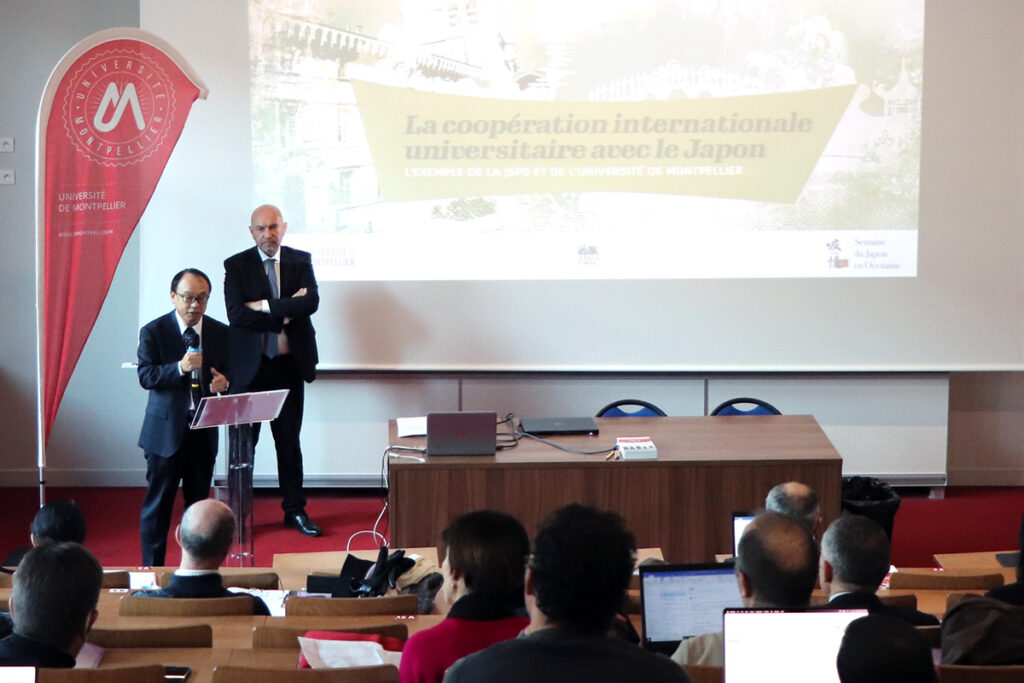
"The Japan Society for the Promotion of Science (JSPS) reports directly to Japan's Ministry of Education, Culture, Sports, Science and Technology (Monbukagakusho). It is somewhat equivalent to Campus France,”explains Jean-Marie Pincemin, head of the Cooperation Division (Scoop) in the International Relations Department. Thus, Director Kazuhiko Saigo and his colleagues Junko Fujimoto and Chika Koda traveled from Strasbourg—home to the JSPS office for Southern Europe—to participate in this day of discussions, attended by, among others, Japan’s Consul General in Marseille, Yukuo Murata; President Philippe Augé; and Patrick Caron, Vice President in charge of international relations.“Not all countries have this type of representation, but Japan recognizes France as a major scientific partner,” the department head continued.
Human Adventures
The goal of this event is to promote scientific cooperation by highlighting cooperation programs—and in particular funding opportunities—for researchers seeking to strengthen or establish cooperation with Japan.“Every year, the JSPS issues a call forapplications open to all Professors , and female faculty members. “We took advantage of this event to invite the three current recipients of the ‘UM ’ grant to share their experiences by presenting their projects,” continues Jean-Marie Pincemin. Nicolas Louvain and Werner Paulus, researchers at the Charles Gerhardt Institute in Montpellier, and Marc Willinger from the Montpellier Center for Environmental Economics, came to share their experiences.
“One of the DRI’s missions is to inform the scientific community at theUM that these opportunities exist and that we are here to support them if they are interested in pursuing this path,” explains Jean-Marie Pincemin. The testimonials from Julien Audemard, Bruno Clair, and Sandrine Bardet—all three alumni—also helped highlight the human dimension of international cooperation by sharing stories about their daily lives and those of their families in Japan.
Institutional and Industrial Partnerships
Other funding sources can also enable French researchers to form partnerships and participate in exchange programs in Japan.“Campus France has an office in every embassy through which the Ministry for Europe and Foreign Affairs funds cooperation programs,” explains Scoop, the department director. This is particularly true of the Hubert Curien Partnerships (PHC), which operate on the principle of reciprocal funding:“Each country funds the travel expenses of its own teams.”In the case of Japan, the Sakura PHC enables doctoral students, faculty members, and researchers to undertake scientific stays as part of two-year projects.
Japanese companies are also excellent partners for university research. In his opening remarks, Philippe Augé highlighted the strong ties established between theUM and Horiba Medical, a company based in Montpellier: This was illustrated by the company’s Deputy CEO, Mr. Sylvain Jacquemin, who highlighted research projects, the hosting of student interns, and funding for CIFRE doctoral contracts, in partnership with the Pathogenesis & Control of Chronic Infections Laboratoryled by Philippe Van de Perre.
A wide variety of shared research topics
Renowned for being a world leader in the field of technology, Japan also has some lesser-known characteristics.“Consul Yukuo Murata noted in his presentation that 70 percent of Japan is covered by forests,” says Jean-Marie Pincemin; “it is in this context that interesting connections have been forged with the master’s program in wood engineering, for example.”
“Like Europe, Japan faces challenges related to its aging population and is developing numerous projects in the fields of medicine and technology, as well as in ethics, law, sociology, and economics. It is also a highly agricultural country… The avenues for collaboration between our two countries are potentially rich and very diverse,” concluded the head of the Scoop.