The Winning Trio for Energy-Efficient Renovations
Environment, economy, and comfort. That could be the motto of the large-scale energy-efficiency renovation project launched by the University of Montpellier. This unprecedented initiative, which began last April with the renovation of the largest building on the Triolet campus, puts the university’s strategy for reducing its carbon footprint into action.
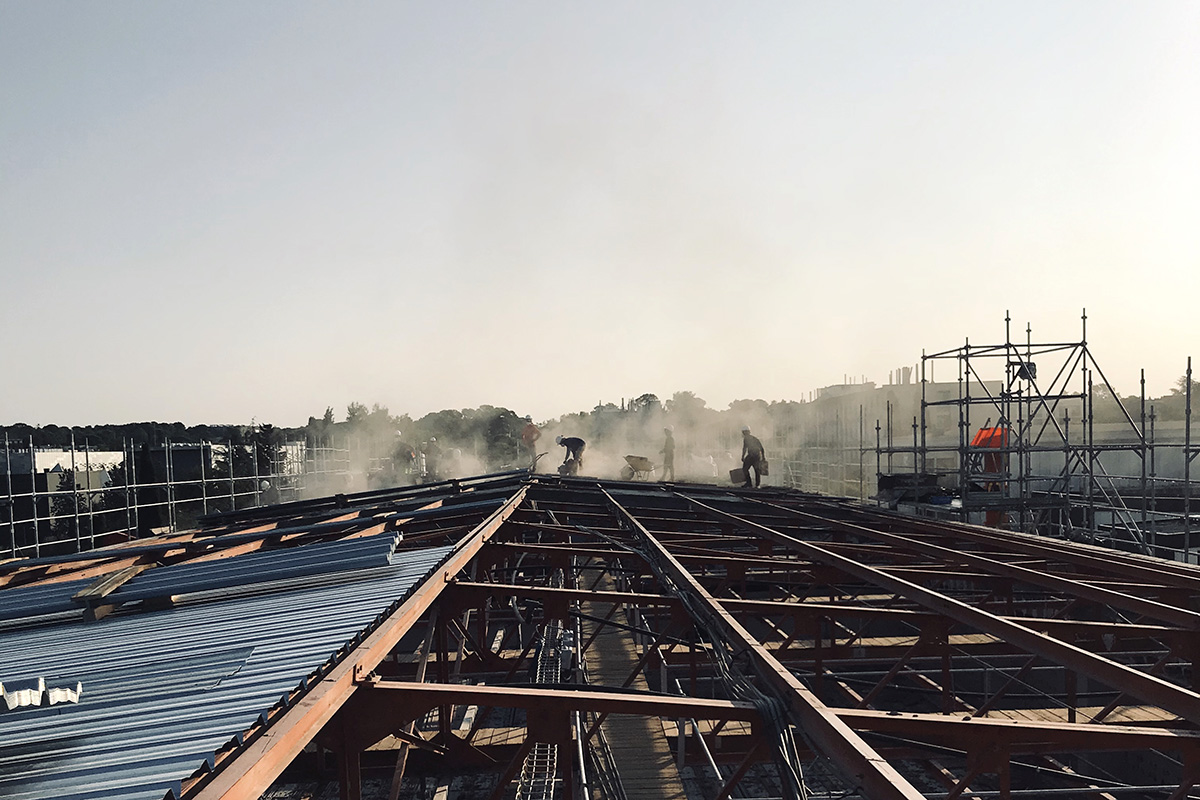
It is one of the largest buildings atUM undoubtedly the most imposing on the Triolet campus. Housing six lecture halls, 43 tutorial rooms, and the Department of Languages, Building 5—with a capacity of 2,000 students—is thus the first phase of this energy-efficiency renovation project, which is unprecedented in the University’s history. This holds even greater symbolic significance given that “it was within these walls that the very first class in the history of this campus was held in 1964,” says Bernard Maurin, Vice President for Real Estate and Sustainable Development.
Everyone Wins
The work, which began last April and is being overseen by the Real Estate Management Department, focuses primarily on the building’s envelope: insulating the walls and roof, and replacing the windows.“We have three goals for this first phase of construction,” announced the vice president. A 50% reduction in energy consumption, leading to lower greenhouse gas emissions, as well as reduced operating costs—achieved, for example, through the installation of LED lighting equipped with motion sensors.
“What we also hope to achieve, beyond the environmental and economic benefits, is an improvement in comfort and in working and learning conditions, particularly in the summer and winter. This is a project where we come out ahead on all fronts. ” These renovations also provide an opportunity to address other issues, such as accessibility for people with limited mobility through the installation of elevators, as well as compliance with the latest safety standards. As for the cost, it amountsto “approximately 8.5 million euros, funded under the State-Region planning contract with a contribution from the University,” explains Bernard Maurin.
A Gradual Rehabilitation
The renovation of Building 5 is thus taking place just a few months after the opening of Science Village A—a low-energy building constructed in accordance with the latest environmental standards, which is also part of this real estate transition strategy. One of the goals of this strategy—whether through the renovation of existing buildings or the construction of new ones—remains the reduction of our carbon footprint.
A second major energy-efficiency renovation project will thus begin at the IUTs in Nîmes and Montpellier-Sète. Similar projects will then follow at other campuses: the School of Pharmacy, the Institute of Botany in the city center, the Physics Laboratories, and Science Village B in Triolet.
The Choice of Energy Transition
This real estate investment aligns with the University of Montpellier’s energy supply, which, for example, consists of 50% electricity from renewable sources.“The contract with our supplier guarantees that for every kilowatt-hour consumed, the supplier feeds half a kilowatt-hour of wind- or solar-generated electricity back into the grid,” Bernard Maurin continues.
The Richter campus has also just been connected to the metropolitan district heating network, which is supplied by the two wood-fired heating plants at Antigone and Polygone, featuring a 100% regional fuel supply and highly efficient flue gas treatment.“These buildings were previously heated with natural gas, and this switch helps reduce our greenhouse gas emissions while decreasing our dependence on this fossil fuel, as well as lowering operating costs by taking advantage of a reduced VAT rate and eliminating the need to maintain eight boilers.”
Together with the other sites already connected (including the IUT and the School of Medicine in Nîmes, and the Triolet campus), nearly halfUM 500,000m² are connected to heating networksUM are eco-certified or rely primarily on renewable energy. “We seize the opportunity to make this type of connection whenever possible, particularly through partnerships with local governments; this is a key component of the university’s strategy for the energy transition.”