Fish communities can benefit both nature and human populations in tropical reefs
PFor the first time, an international team led by researchers from the University of Montpellier, the CNRS, and the FRB has assessed 29 ways in which reef fish communities contribute to human needs and the proper functioning of tropical coastal ecosystems on a global scale. Their work, published in the journal One Earth by a doctoral student at the University, is part of the Nature Futures Framework , which aims to envision desirable futures where humans and nature can coexist sustainably. Within this framework, the study assessed nature’s potential contributions to itself—referred to as “Nature for Nature”—as well as nature’s contributions to humans—referred to as “Nature for People”—which are not mutually exclusive.
A large-scale project
This study is the result of an international collaboration (the Biodiversa+ REEF-FUTURES project, in which 1,237 reefs are being studied worldwide, encompassing more than 1,000 fish species) and the wide range of contributions documented therein (an estimated 29 contributions). These contributions range from the micronutrient concentrations in fish and their aesthetic appeal to the diversity of ecological roles played by the fish present within the reefs. The contributions of fish communities are calculated based on the abundance of each species on the reefs, a data point collected during dives using the Reef Life Survey participatory science protocol Reef Life Survey protocol, which has been in use for over 18 years worldwide.
This study thus identifies four scenarios in which each of the “Nature for Nature” and “Nature for People” dimensions can be strong or weak. For example, the reefs of the Galápagos Islands primarily contribute to the proper functioning of the reefs, due to their ecological uniqueness and their distinct evolutionary history. Reef fish in French Polynesia, on the other hand, provide benefits to both reef ecosystems and humans thanks to their high diversity, large biomass, and aesthetic appeal, which support both local fishing and tourism. In contrast, fish communities in Tanzania are subject to heavy human exploitation and no longer make significant contributions to the proper functioning of coastal marine ecosystems.
Some fish communities can therefore be ecologically healthy while still providing significant benefits to human populations, which challenges the traditional view that conservation strategies must prioritize one over the other. These findings pave the way for interdisciplinary and participatory approaches involving ecologists, social scientists, and policymakers to optimize the management of these vulnerable ecosystems in order to meet the needs of local communities and conservation goals. Only this strategy will enable us to build a more desirable future where nature and humans can coexist sustainably. This work also highlights the challenges involved in restoring reefs that are severely degraded and/or heavily impacted by human exploitation.
With the French government aiming to make 2025 the “Year of the Ocean” in France, culminating in the hosting of the3rd United Nations Ocean Conference in Nice, this article provides an early look at the scale of these challenges, possible scenarios, and opportunities related to the coexistence between human populations and reef fish—species that are emblematic and particularly affected by human activities. More generally, this work explores original avenues and a methodology that can also be applied to terrestrial ecosystems, and thus has significance that extends beyond coastal marine ecosystems.
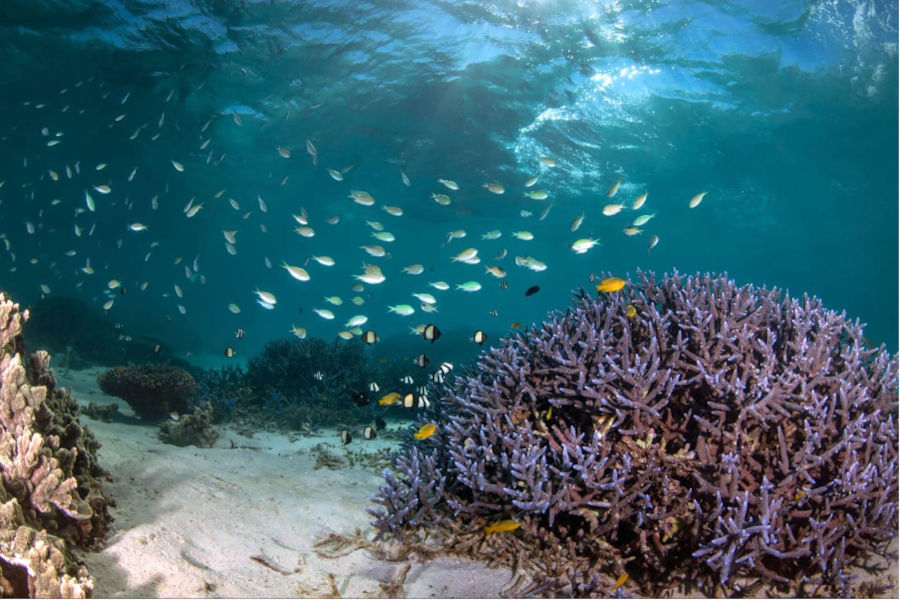
Reef fish play a vital role in the food chain and contribute to reef health by controlling algae populations and helping to circulate nutrients. They also support human activities by boosting the local economy through tourism and fishing. Photo: Ningaloo Reef is a coral reef located off the west coast of Australia. © Rick Stuart Smith
Joshua Cinner, a professor at the University of Sydney (Australia): “One of the most interesting aspects of this article is that it identifies true ‘hot spots’ where reefs provide benefits for both people and nature.”
David Mouillot, professor at the University of Montpellier (France): “As the lead researcher on the international REEF-FUTURES (Biodiversa+) project, in which we have put a great deal of effort into estimating these multiple contributions of reef fish, I see this synthesis as both a milestone and a source of hope for implementing nature-based solutions—inspired by local examples—to steer certain tropical coastal socio-ecosystems away from their negative trajectories.”
Nicolas Mouquet, a researcher at the CNRS and scientific director of the FRB’s Center for Synthesis and Analysis of Biodiversity (Cesab) in Montpellier: “Our work paves the way for addressing the fundamental trade-offs between ecological integrity and human well-being. By moving beyond traditional models of economic growth and adopting a post-growth approach, I believe we can truly foster a sustainable coexistence between biodiversity and humanity.”
Rick Stuart Smith, professor at the University of Tasmania (Australia): “Reef fish are of extraordinary importance to the functioning of marine ecosystems and provide numerous benefits to human societies. I am certain that the general public does not realize just how diverse these contributions are, and I even think that the scientific community underestimates them. For me, this study represents one of the most comprehensive accounts of the diversity of roles played by reef fish.”
Practical Information
- Date: Article published on October 18, 2024
- More information about IPBES
- Bibliography:Fish communities can simultaneously benefit both nature and people across the world’s tropical reefs – Ulysse Flandrin, David Mouillot, Camille Albouy, Sonia Bejarano, Nicolas Casajus, Joshua Cinner, Graham Edgar, Mattia Ghilardi, Fabien Leprieur, Nicolas Loiseau, Aaron MacNeil, Eva Maire, Matthew McLean, Valeriano Parravicini, Loïc Pellissier, Nina Schiettekatte, Rick Stuart-Smith, Sébastien Villéger, Nicolas Mouquet – One Earth (2024)