The Challenges Facing Accounting in the Future
What do our everyday purchases—whether online or at a store—have in common with the revenue or profits of our local baker versus those of Aventis or Google, or with France’s budget versus China’s?
Philippe Chapellier, University of Montpellier; Agnès Mazars-Chapelon, University of Montpellier; Claire Gillet-Monjarret, University of Montpellier; Emmanuelle Nègre, University of Toulouse 1 Capitole; Gérald Naro, University of Montpellier and Yves Dupuy, University of Montpellier
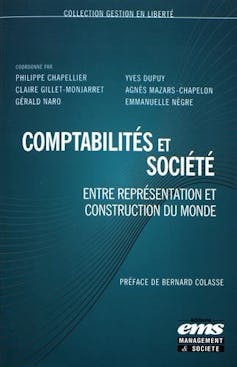
This article is based on research coordinated by Philippe Chapellier (professor of management sciences at the University of Montpellier), Yves Dupuy (professor emeritus of management sciences at the University of Montpellier), Claire Gillet-Monjarret (associate professor at the University of Montpellier), Agnès Mazars-Chapelon (associate professor with HDR status at the University of Montpellier), Gérald Naro (Professor of Management Sciences at the University of Montpellier), and Emmanuelle Nègre (Associate Professor at the Toulouse School of Management), as part of the writing of the book *Comptabilités et société: entre représentation et construction du monde* (Accounting and Society: Between Representation and the Construction of the World), published by EMS.
This book received the 2019 FNEGE Award for Best Management Book in the category of collective research works, for which The Conversation France is a partner.
What do our everyday purchases—whether online or at a store—have in common with the revenue or profits of our local baker, those of Aventis or Google, or the budgets of France and China? Nothing, one might be tempted to say at first glance. Yet all these categories share a fundamental characteristic: they correspond to a numerical and monetary representation—that is, something “that can be counted”—according to, at least on the surface, a single, coherent numerical language.
In this regard, the few examples mentioned at the outset highlight just how pervasive this accounting language has become in our economic, social, and even societal lives: prices, costs, budgetary constraints, and economic interpretations of performance—of all kinds of performance—are thus constantly invoked and publicized to explain or justify the world as it is. Yet it would take a very clever person to clearly define—except perhaps from a strictly technical standpoint—what a price or a cost is, let alone a profit, a budget, or an environmental “impact.” The scope of this strange paradox—which consists of implicitly treating complex and elusive categories as matters of common sense, or even self-evident truths—forms the anchor of this book.
Essential Standards
The fact is that, first of all, accounting is very often understood and accepted as a fully standardized, comprehensive, and reliable technique for representing the real world and its institutional and organizational components. It claims to represent, for example, the total assets held by a given company at a given moment. But we must still agree on the spatial and temporal scope and the components of these assets, as well as on the possibility of producing a numerical representation of them that is comparable to that of the assets of other companies, institutions, and so on. To this end, conventions and standards must necessarily be adopted.
Consequently, representing reality in accounting terms necessarily involves simplifying it and thus prioritizing certain aspects over others. In this sense, “traditional” accounting tends to favor financial aspects at the expense of societal ones, and the interests of companies or investors at the expense of those of society. A typical example of this trend is the use by Internet giants of accounting maneuvers designed to shift their profits by creating a formal disconnect between where business is conducted and where reported profits are located.
No neutral role
This very timely example suggests that, while the primary purpose of accounting is to represent the world, it in turn profoundly influences it. The representations it provides constantly shape the behavior of its direct and indirect users. It is, of course, on the basis of accounting management tools that managers make and justify their decisions. In this way, they determine how their organizations operate and, beyond that, how a wide variety of institutions and communities function.
In this sense, accounting by no means plays the passive or neutral role to which some would sometimes like to confine it. On the contrary, it stands as a principle of action—after all, aren’t assets created precisely to act?—and, beyond that, it contributes to the construction of the world. A key challenge, then, is to collectively lay the foundations for the accounting of tomorrow. Such an accounting system would aim to free itself from its current dead ends and gray areas. Beyond purely monetary and financial figures, it would, in a sense, make visible essential categories that are still largely invisible, such as the commons, the environment, the human sphere, and the social sphere…
Philippe Chapellier, University Professor of Management Sciences, University of Montpellier; Agnès Mazars-Chapelon, Professor in Management Sciences, University of Montpellier; Claire Gillet-Monjarret, Associate Professor of Management Sciences, University of Montpellier; Emmanuelle Nègre, Associate Professor of Management Sciences, Toulouse School of Management Research, University of Toulouse 1 Capitole; Gérald Naro, Full Professor of Management Sciences, University of Montpellier and Yves Dupuy, Professor Emeritus of Management, University of Montpellier
This article is republished from The Conversation under a Creative Commons license. Readthe original article.