Global thematic initiatives on the agenda for the second MIAB Council meeting
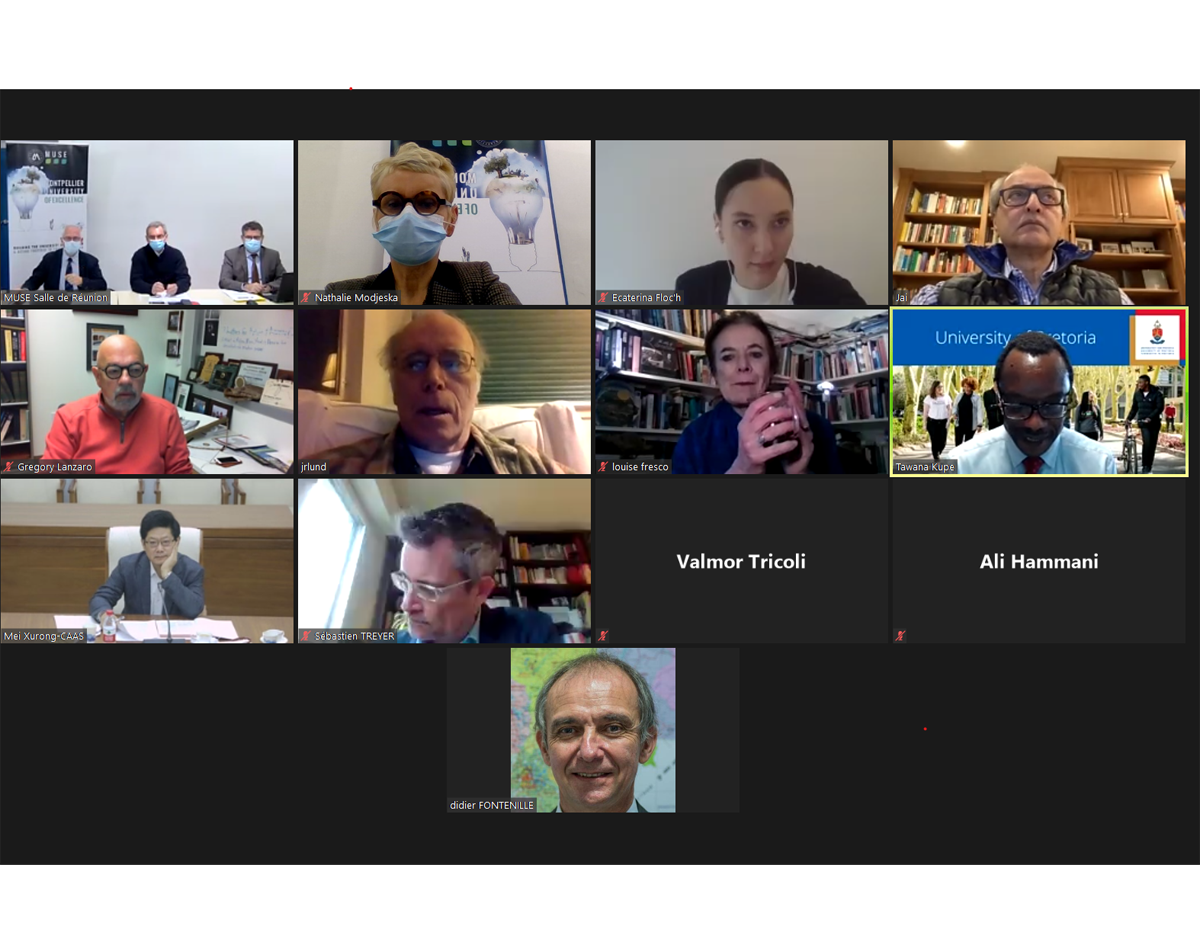
Due to the COVID-19 pandemic, the second meeting of the Montpellier International Advisory Board (MIAB) was held via videoconference over two days, December 10–11, to accommodate the significant time differences among participants. Following its initial recommendations (to prioritize large-scale global projects and infrastructure that generate significant impact), MUSE proposed expanding certain key initiatives internationally with the goal of creating “global thematic initiatives or alliances.”
 The potential of these global thematic initiatives is already evident in the close bilateral collaboration between the members of the MUSE consortium and each of the institutions that make up MIAB[1]. MUSE’s proposal focuses on strengthening, deepening, and broadening these ties by placing them within a multilateral framework. To this end, MUSE proposes to create Key Global Initiatives (Key WIs), whose purpose is to facilitate the emergence of global initiatives in research and education on specific topics.
Thus, at thesecond meeting of this council, MIAB members were able to attend presentations by the respective project leaders of three MUSE Key WI projects : Didier Fontenille for the Key WI VECT-OH (on Vector and Risk within a One-Health perspective); Marie-Jo Amiot-Carlin for the Key WI FOODS; and Eric Servat for the Key WI WATERS. MIAB members were then asked for their input on how to proceed with the process, the relevance of the topics, and the potential interest of member institutions in participating.
The three proposals, whose topics were deemed excellent, interconnected, and relevant, were overwhelmingly endorsed by the assembly. Given the critical mass and the unique level of international cooperation that each of these initiatives fosters in its respective field on a global scale and over the long term, they offer real potential, and their implementation provides added value that sets them apart from other existing global initiatives addressing the same themes.
These Key World Initiatives could be launched as early as 2022, following a year of development for which MUSE proposes to fund the various stages, with guidance from MIAB members and, where appropriate, their participation. A virtual working seminar and discussion session is scheduled for each initiative during the first half of 2021, with discussions set to begin in the summer during thethird MIAB meeting, which everyone hopes will be held in person.
[1] Established in March 2019, MUSE’s International Advisory Board (MIAB) is composed of strategic partners—both French and international, from academic and non-academic backgrounds—who are key to achieving MUSE’s ambitions. It serves in an advisory capacity regarding the structure and strategic direction for the development of the MUSE project in the areas of education, research, innovation, and international outreach.