[LUM#1] It's Hard to Put Into Words
How do you tell a patient that they have a serious illness? To help future doctors find the right words, the Montpellier School of Medicine has turned to theater.
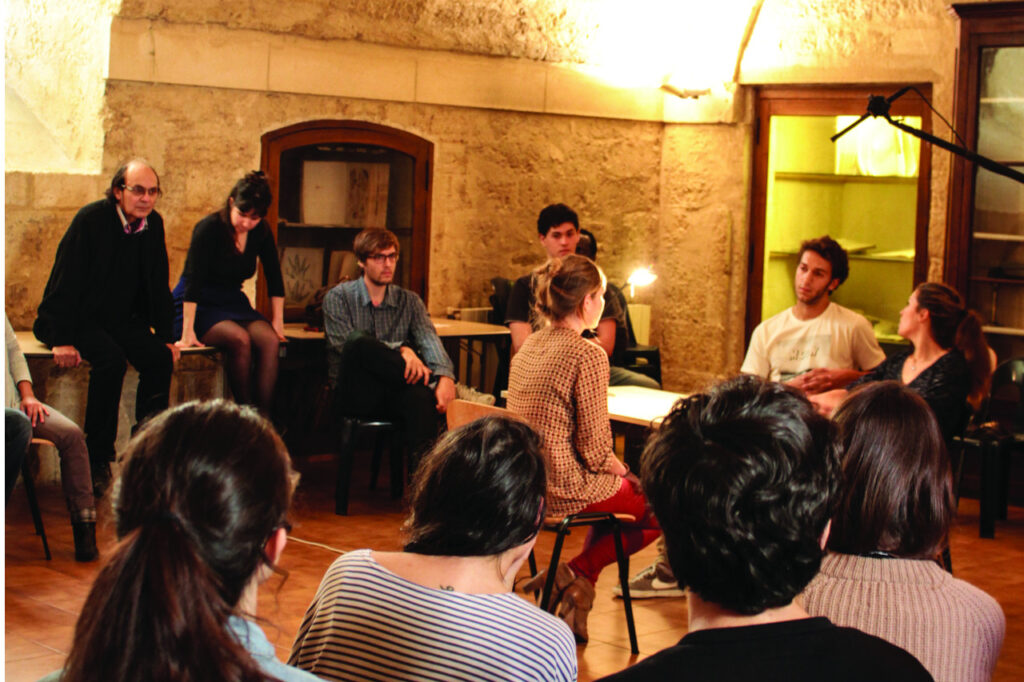
“You have cancer.” Those are harsh words. They sound like a verdict… Every doctor has gone through this at some point: it’s not easy to deliver a serious diagnosis to a patient. “When it comes to interpersonal relationships and communication, there’s a real lack of training for doctors, ”laments Marc Ychou. Yet these pitfalls could be avoided “by not just equipping future doctors with knowledge and technical skills, but also by cultivating their interpersonal skills,”continues the oncologist. He has found an original approach: he has chosen to turn to theater.
Human Dimension
For the third consecutive year, fourth-year medical students are participating in workshops organized in collaboration with the École Nationale Supérieure d’Arts Dramatiques. The premise of these “very serious” exercises is to have the students take on the role of a doctor, facing professional actors playing the part of patients, under the watchful eye of Marc Ychou and director Serge Ouaknine.“The students have a strong desire to state the medical truth. We need to bring them back to the human dimension,” explains the theater director. We also need to teach them to simplify their language, avoiding medical jargon that can sometimes be incomprehensible to the patient. “Theatrical methods help doctors develop their empathy without focusing solely on delivering the diagnosis, ” emphasizes Serge Ouaknine. Do future doctors lack empathy? “On the contrary,” protests Marc Ychou. “They feel a great deal of empathy for the patient. They simply have a hard time managing it.”
Finding the Right Words
Faced with professional actors whose performances ring true, the students quickly find themselves in difficult situations. How do you tell the parents of 9-year-old Camille that their daughter has leukemia? This is where the advice from the oncologist and the director really comes into its own.“It teaches us the importance of relationships and dialogue. We try to choose the right words, the right tone of voice, and the right gestures. It’s very rewarding,” says Jean-Baptiste, delighted after the experience. This enthusiasm is shared by the vast majority of the future doctors. “When we’re faced with these situations in real life, we won’t put our foot in it or get everything wrong,” concludes Bastien.
Check out theUM podcasts, now available on your favorite platform (Spotify, Deezer, Apple Podcasts, Amazon Music, etc.).