Innovation is fostered with Mobilab
In the coming months, farmers in Occitanie may well see a strange rolling object appear in their fields. The “Mobilab,” developed by Le Mas Numérique at the Institut Agro and Occitanumis a traveling fab lab that offers agricultural and viticultural professionals the opportunity to familiarize themselves with digital tools and other connected devices—and even to build their own innovative devices. The Mobilab Tour 2024 kicks off in a few weeks with Simon Moinard, the project manager.
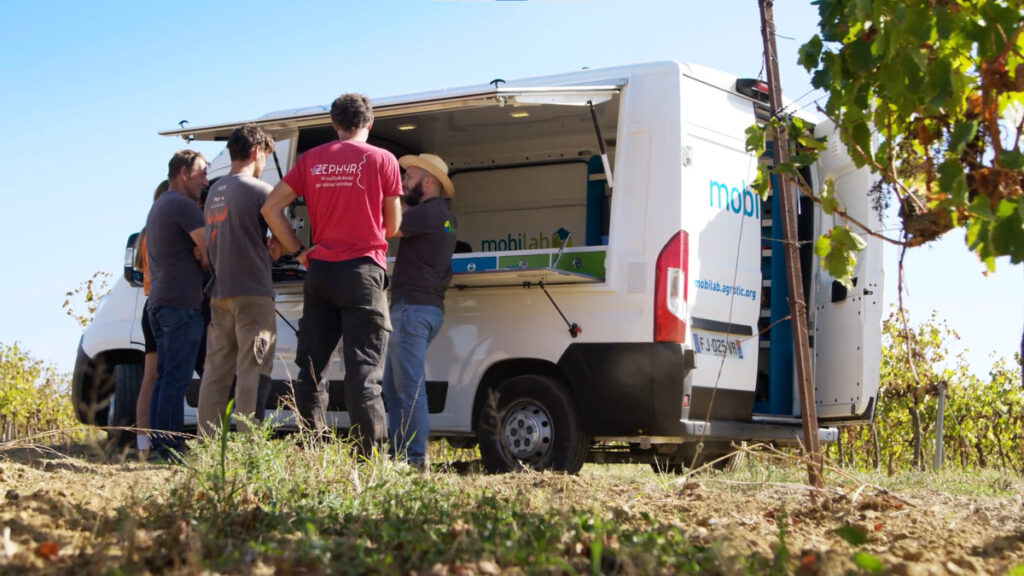
“The ‘low-tech’ approach —also known as ‘do-it-yourself’ —is deeply rooted in agricultural culture. Farmers and ranchers are used to making their own tools tailored to the needs of their operations,” notes Simon Moinard, head of the AgroTIC mobile lab at the Institut Agro Montpellier (a PUI partner). To support farmers in their efforts to optimize their practices, Simon Moinard travels throughout the Hérault countryside at the wheel of the mobile lab.
Exploring New Paths
This mobile workshop, built inside a van, aims to bring innovation directly to farmers at their workplace.“People often think that the worlds of agriculture and digital technology are incompatible, but that’s not true! Farmers love to tinker, and if you show them how digital technology works using a ‘low-tech’ approach, they’re completely open to new ideas and can suggest solutions that would concretely meet their needs… Especially if the solution is simple, fast, and inexpensive! Some of them even become real tech geeks,” the project managercontinues . And in fact, since 2019, more than 1,300 people have been reached. That was all it took to motivate the team to develop a second version of the project using a fully equipped van: 3D printer, drone, all kinds of sensors, tools… Everything needed to collaborate on projects right out in the field.
By reaching out to farmers in this way, the Institut Agro team is able to explore new avenues by identifying their needs and possible solutions. Among his small successes, Simon Moinard cites“Coup de pouce,”a 3D-printed finger that activates an irrigation pump via a simple text message. Thanks to this small device, which cost only 20 euros, farmers no longer have to travel many kilometers every day to turn their pump on or off. ” Another example is AgroCam, a tool for monitoring crops throughout the growing season using time-lapse photography:“Every day at noon, a photo of the field is taken automatically, allowing farmers to track the plants’ growth day by day. There are countless uses for farmers.” To share these ideas with as many people as possible, each of these innovations is then featured in a video tutorial accessible to everyone and posted on the Mobilab website.
Between Technology and the Earth
The Mobilab also serves as a training program designed to make new technologies more accessible to this audience.“We sometimes meet farmers who have purchased sensors but, without guidance, are using them incorrectly. We take the time to explain how these tools work so they can make the best use of them. ” And the benefits can sometimes be very significant for these farmers: time savings, as we’ve seen with“Coup de pouce”; water savings with soil moisture sensors; and environmental benefits thanks to day-to-day crop monitoring, which helps reduce the use of pesticides, among other things.“We’re seeing some amazing new sensors coming onto the market that can measure plants’ photosynthetic indicators, for example,” adds the engineer.
To build lasting bridges between technology and the land, the AgroTIC mobilab is preparing to expand its project to agricultural high schools to train these future farmers in digital tools from the very beginning. The mobilab is also a project widely supported by the Occitanie region through Occitanum, an initiative coordinated byINRAE that brings together more than 46 partners involved in the agroecological transition. The second major funder is the Mas Numérique, a demonstration site for innovative technologies aimed specifically at winegrowers. Located at the Institut Agro’s Domaine du Chapitre in Villeneuve-les-Maguelones, this other living lab also aims to bring technology to the fields with the support of fourteen corporate sponsors: connected weather stations, disease prediction models, spray calibration, and regulatory traceability of pesticides… After a brief tour of Burgundy and Champagne in February, Simon Moinard will embark on the Mobilab Tour 2024 with the goal of making one visit per day for one week in May. Innovation in the service of agroecology is on its way.
The Montpellier University Innovation Hub (PUI)
The Institut Agro is one of the fourteen founding members of the Montpellier University Innovation Cluster (PUI), led by the University of Montpellier. The PUI’s objectives are to encourage collaborative research between laboratories and businesses, to promote technology transfer, and to stimulate business creation. It currently comprises 38 participating organizations, bringing together stakeholders from higher education, research, the socio-economic sector, and Montpellier’s innovation ecosystem.