UM Goes Solar
The University of Montpellier, which has long been committed to the energy transition, is accelerating this process by investing in solar power. Three solar power plants installed in Nîmes, Richter, and on the Saint-Priest campus will help reduce the university’s environmental footprint while lowering its energy costs.
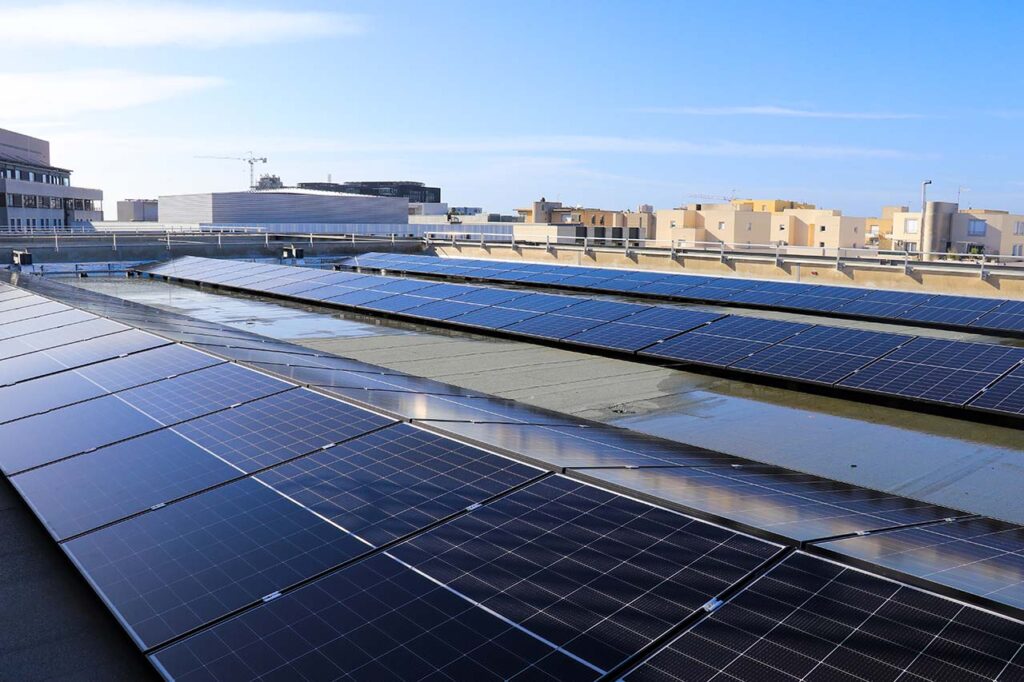
It’s a very subtle change when viewed from ground level, but if you step back a bit, you’ll notice a new reflection on the roofs of Building D on the Richter campus. It comes from the solar panels, whose installation has just been completed and has now entered the testing phase. “This is the first of three solar power plants on UM campuses; it will soon be followed by two others to be installed at the IUT in Nîmes and on the Saint-Priest campus, ”says Bernard Maurin, Vice President for Real Estate, with enthusiasm.
Three locations, three atmospheres
These three sites were not chosen at random for these installations. “To install solar panels on a building, not only must the roofs be properly oriented, but they must also be accessible; typically, on the Triolet campus, there is a lot of technical equipment on the roofs that would complicate the installation.”
The electricity generated at the MoMa building will power the entire Richter campus, while the electricity generated at the Nîmes University Institute of Technology will also benefit the School of Medicine, located 1 kilometer away. This is made possible by the new national scheme for collective self-consumption of public buildings, which allows electricity generation to be distributed across multiple buildings.
The power plant to be installed in Building 5 on the Saint-Priest campus will not be connected to other buildings, and for good reason:“Its baseline consumption is high because it houses many cleanrooms and computers—energy-intensive equipment specific to the research activities conducted there , ” explains Bernard Maurin, who notes that these three different types of power plants will provide“a diverse range of real-world experience.”
Payback period of 6 years
The facility also took advantage of these construction projects to re-waterproof certain roofs and improve their insulation, which also helps reduce energy loss from the buildings. These three photovoltaic power plants comprise a total of 1,260 m² of rooftop panels with a capacity of 300 kWp, which will result in an annual production of approximately 400 MWh. “The financing for the project, which amounts to 300,000 euros for the power plants, was made possible by the Objectives, Resources, and Performance Agreement that the University signed with the government, with the institution covering the costs of the other work , ” explains Bernard Maurin.
This initiative will enable UM to reduce its reliance on fossil fuels to some extent, while also generating financial savings. “We estimate that this investment will pay for itself in just six years,” says Bernard Maurin. While the project makes perfect sense from an ecological and economic standpoint, it also aligns with UM’s research and educational missions. The research aspect will be explored on the Saint-Priest campus, where a team will use this facility to install its own panels—new models currently in the testing phase—whose full potential the researchers aim to explore. The training aspect will take center stage at the IUT in Nîmes, where students in electrical and industrial computer engineering—as well as civil engineering—will be able to analyze production data to conduct detailed, real-time monitoring of the power plant.
Reduce your consumption
While solar power is currently in the spotlight, this initiative is part of the institution’s overall strategy for energy transition.“At the same time, the University of Montpellier is gradually reducing its CO2 emissions and its reliance on natural gas by connecting to various district heating networks, ”adds Bernard Maurin. “This already covers half of its total floor space (half a millionsquare meters).”A figure that will soon reach two-thirds with the upcoming connection of the Faculty of Pharmacy and the Montpellier University Institute of Technology (IUT) to the Nord-Alco District Heating Network, currently under construction by the Montpellier metropolitan area.“This choice also ensures greater price stability and spared the institution from seeing its bill triple or quadruple when gas prices skyrocketed,”explains the vice president in charge of real estate.
“All of these initiatives are in line with the various actions outlined in the UM’s Ecological Transition Master Plan, a guiding document that sets the framework for the institution’s commitment to reducing the environmental impact of its activities,”emphasizes Frédérique Carcaillet, Vice President for Environmental Issues.
“And while all these measures are aimed at reducing greenhouse gas emissions linked to our energy consumption, we must not forget that the key is to reduce our consumption. The transition to lower-carbon energy sources goes hand in hand with energy conservation, and this is everyone’s responsibility,” insists Frédérique Carcaillet. At UM, we remember to turn off the lights.