[LUM#2] Stone Hunters
In the heart of Lozère, slate workers carry on a tradition dating back several millennia, with the help of geologists and their high-tech tools.
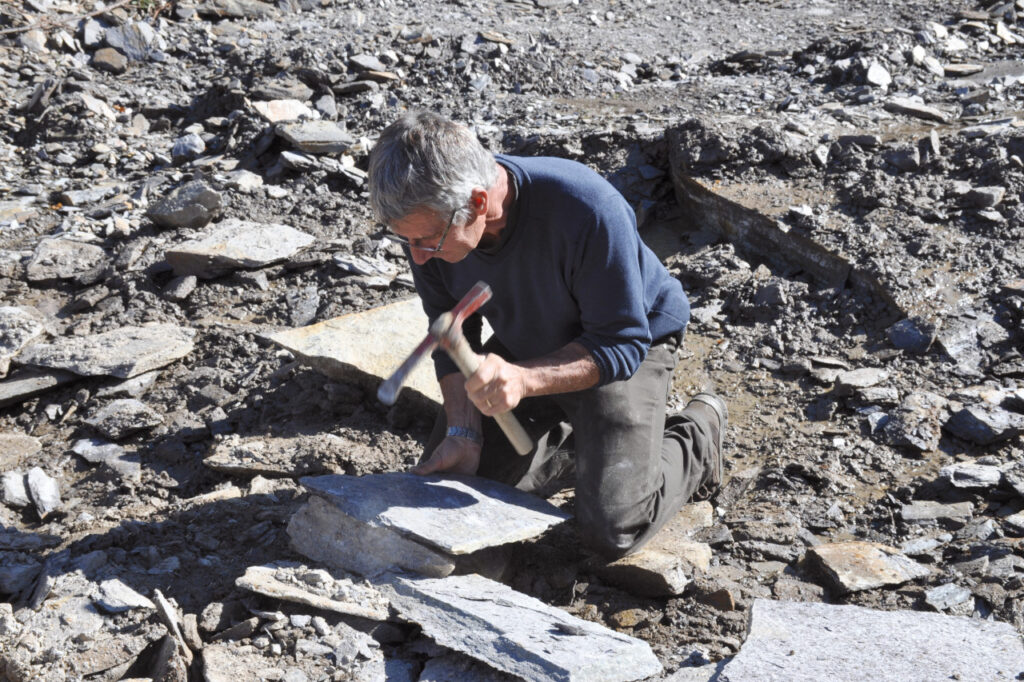
Kneeling in the middle of the quarry, the man hammers away at a boulder weighing several hundred kilograms. From this giant rock with brown veins, he extracts slabs a few centimeters thick—slate tiles that will be used to build roofs. It’s an age-old craft that leaves no room for error. Slate can shatter like glass…
“You have to know the stone, feel it, so you don’t break it,” explains Roland Jacques. His tools? A simple sledgehammer and a trained ear.“You make the stone ring out. You listen to it sing to see if it has a flaw.” His trade? Quarryman. A dying profession: in his village of Lachamp, in Lozère, Roland Jacques operates one of the region’s last slate quarries.
Improving the Detection of Mineral Deposits
“When you’re digging, you never really know what you’re going to find,” explains Roland Jacques. The jackpot: stumbling upon large sections of intact stone that can be cut into beautiful slate slabs. Unfortunately, quarry workers are sometimes in for the unpleasant surprise of uncovering broken, unusable rock.“The sedimentary formations identified at Lachamp are affected by late-stage fracturing, which makes the quality of the extracted stone unpredictable,”explains Cédric Champollion, a geologist at the Géosciences Montpellier laboratory.
How can we help quarry operators better identify mineral deposits? Romain Duhamel, a master’s student in geosciences, took on the challenge. “We sought to identify the least fractured areas using geophysical surveys.” Do quarry operators make the rock sing? He’s going to make it talk. His tools: ground-penetrating radar and electrical resistivity surveys.
Radar to the Rescue of the Hammer
“Ground-penetrating radar sends waves into the ground that travel differently depending on the type of rock. By analyzing how they travel, we can therefore assess the condition of the subsurface,” explains Romain Duhamel. The same principle applies to electrical sounding: using electrodes, the geologist sends an electrical current through the ground; by measuring the subsurface resistivity, this allows for the detection of any fractures.”
“This is the first time such a method has been used,” explains Romain Duhamel. And it wasa success: “It yielded results that were completely consistent when we compared the profiles obtained with the condition of the rocks visible on the surface, ”says the geology student.“It helps me know exactly where to start working on my quarry,”says Roland Jacques.“It’s simply extraordinary for us slate miners—we would never have had this information otherwise. And if a young person wants to open a new quarry tomorrow, they’ll need this.” To preserve an invaluable tradition and craftsmanship—and to ensure that, for many years to come, the residents of Lachamp continue to be called “coperoches,” or “stone cutters.”
Check out theUM podcasts, now available on your favorite platform (Spotify, Deezer, Apple Podcasts, Amazon Music, etc.).