[LUM#3] Coral Reefs in Danger
They are under threat all over the world. How can we better protect coral reefs, those irreplaceable refuges for marine life? A scientific expedition offers some new insights.
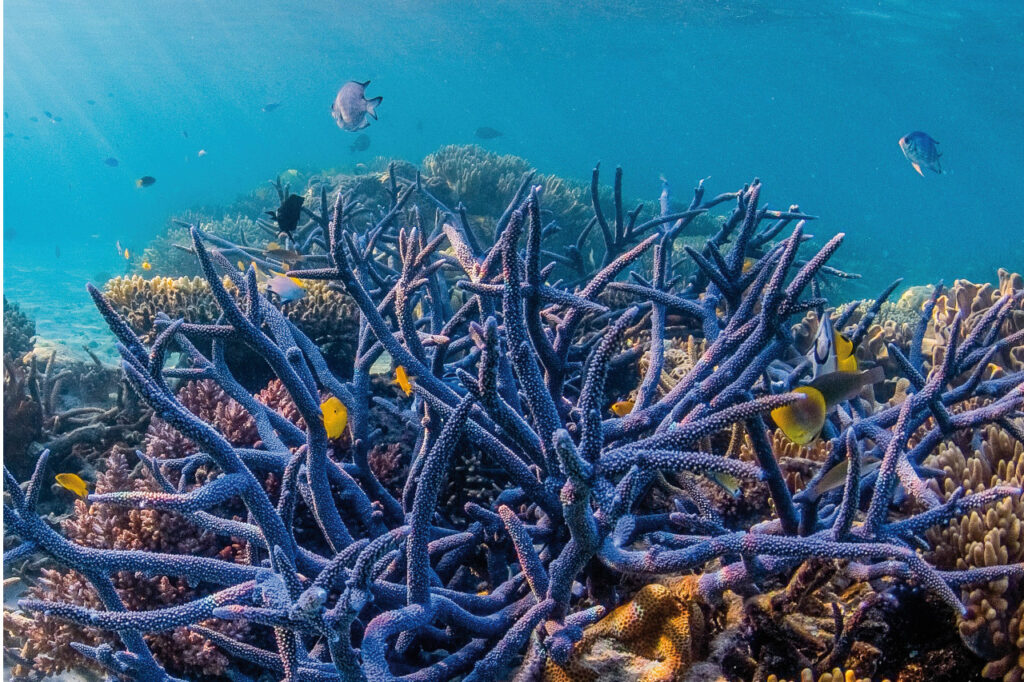
New Caledonia, the Tonga Islands, French Polynesia: this isn’t a list of idyllic destinations for your next vacation, but the research sites for the Pristine project. In these dream islands, home to some of the planet’s last remaining ocean refuges, a team of marine biologists went diving to explore the teeming marine life. Their goal: to assess the health of coral ecosystems.
Protecting Marine Life
Because these havens of life are in danger.“The latest scientific findings are alarming: 75% of the world’s coral reefs are currently threatened, 60% of which face a direct and immediate threat. By 2050, that figure will rise to 100%,” warns David Mouillot of the Marbec laboratory.
To protect marine life, we first need to understand it.“The value of virtually untouched sites is that they provide a point of reference: there, we can assess the state of biodiversity in the absence of any human intervention.” This reference will then serve as a benchmark for measuring the impact of human presence around the world, as well as for assessing the effectiveness of marine protected areas.
While diving off the Actéon Islands in Polynesia, the Minerve Reefs in Tonga, and the New Caledonia archipelago, the researchers were in for quite a surprise. Beneath the waves of the Pacific, they witnessed a forgotten spectacle…“Sharks in abundance, gigantic groupers, Napoleon wrasses, and humphead parrotfish: a teeming array of life animates these ocean depths. Some species that thrive here are on the verge of extinction elsewhere,” describes David Mouillot.
An extraordinary amount of biomass: more than one metric ton of fish per hectare. That’s about 70% more than what is typically found in other protected areas around the world. The difference is staggering. Why this explosion of life? Or rather, why are there so few fish in other areas that are also protected?
Human, all too human
For the scientists on the Pristine project, the answer is clear: human proximity is responsible for the disappearance of fish. This is a factor they have carefully measured.“Coral reefs are closer to humans than we thought. Half of the world’s reefs are located within a 30-minute trip from a village, a market… These reefs are therefore under very heavy pressure. As a result, 90% of the large predators—tuna and sharks—have disappeared from these areas.”
Only reefs located far enough away from human communities would be safe, according to the study, which places the critical threshold at around a 12-hour journey. However, such reefs are now very rare.“Worldwide, barely 1% of coral reefs are located in safe areas—that is, more than 12 hours’ travel time away. This is the study’s other major finding: the rarity of these natural refuges. They are found primarily in the central Indian Ocean and the Pacific.”
Western countries bear the responsibility for protecting these areas, which are vital to biodiversity. This is because most of these last refuges for marine life belong to England, the United States, and France: New Caledonia alone accounts for a quarter of the world’s isolated reefs…
Biodiversity That Is Not Adequately Protected
This is a particularly heavy responsibility, given the state of decline in marine biodiversity. While there are marine protected areas all over the world, their effectiveness is partly called into question by the findings of the Pristine project.“These areas are useful, particularly for allowing small marine life to replenish its populations. But they are insufficient. They do a poor job of protecting certain species, especially large predators.” The main problem is that they are too close to human activity. Their size is also an issue: they are too small and do not cover the entire range of threatened species.
While efforts are currently being made to create new protected areas, David Mouillot says they remain far from sufficient. This is especially true given the tendency to establish these areas as far away as possible from zones where conflicts of interest might arise with coastal users, such as fishermen and tourists. “As a result,public authorities are creating reserves in locations that do not really require protection,”the researcher summarizes.
Government officials, moreover, are often misinformed and sometimes unaware of the value of a natural heritage that is, in fact, irreplaceable.“As scientists, it is our role to inform and raise awareness in order to bring about policy change.” This approach can prove effective: in New Caledonia, following the implementation of the Pristine project, the Entrecasteaux reefs were designated as a protected area.
What solutions are there to protect marine life?
Ask all the countries involved to make a greater investment?“It’s hard to ask developing countries to make additional efforts. How can we deny access to the sea to villages that depend on fishing for their livelihoods? On the other hand, industrialized countries must implement stringent protection measures within their own territories.”
What kinds of protection?“Create ‘No Entry’ zones where access will be prohibited. Or even flip the logic by designating specific areas where fishing is permitted, and automatically designating the remaining areas as protected zones. This approach could prove effective on a regional scale—why not New Caledonia or Corsica, which could serve as models?—and demonstrate that fishermen themselves will ultimately benefit from these measures, which are the only ones capable of rebuilding fish stocks.”
Check out theUM podcasts, now available on your favorite platform (Spotify, Deezer, Apple Podcasts, Amazon Music, etc.).