[LUM#18] Coral Resistance
Because we’re better able to protect what we know well, researchers are delving into the coral genome to identify what gives certain corals a resistance to temperature—a trait that’s particularly useful at a time when water temperatures are constantly rising.
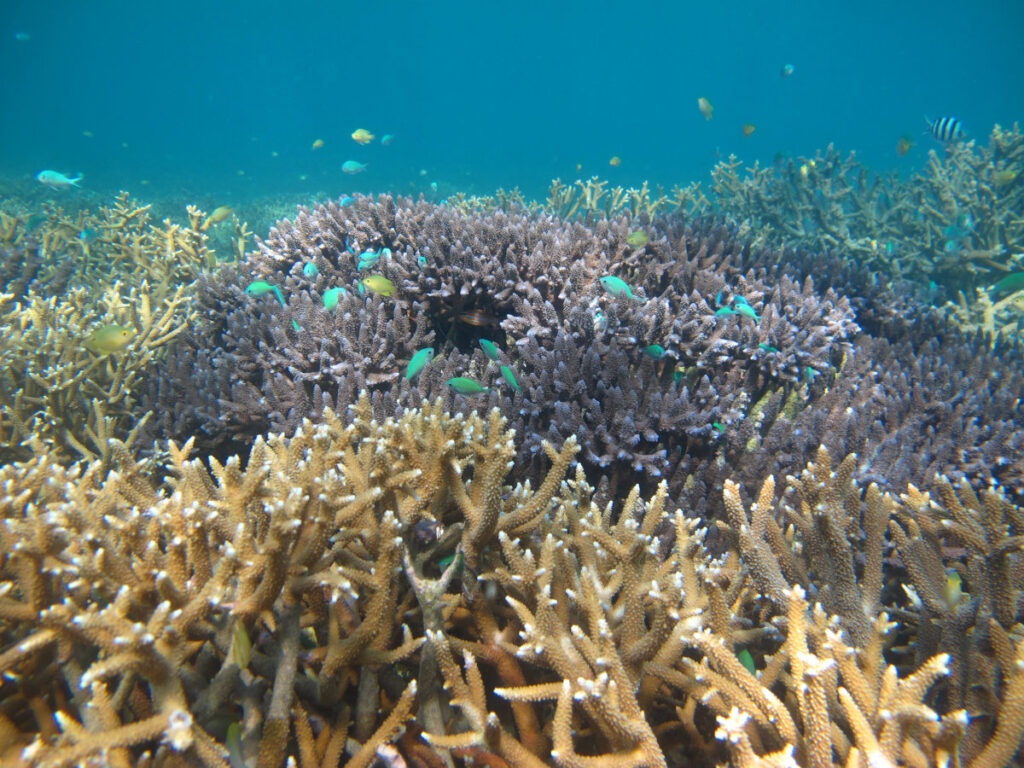
More than 25% of coral reefs have died over the past thirty years. What caused this mass die-off? “Rising water temperatures, ” says Jérémie Vidal-Dupiol, a researcher at the laboratory Host–Pathogen–Environment Interactions*. That’s because coral—that curious creature—lives in symbiosis with zooxanthellae, single-celled algae that provide the coral with oxygen and nutrients in exchange for the shelter and nourishment the coral offers them. “But when the temperature rises, the symbiosis breaks down; the coral loses its zooxanthellae, which is what causes it to bleach.” This phenomenon significantly weakens the coral and increases its mortality rate.
According to a study published by UNESCO in 2017, if ocean warming continues at the current rate, coral reefs could disappear by 2050 as a result of this thermal stress. So how can we preserve this unique biodiversity? “We’re taking protective measures; we’re even restoring reefs by propagating corals to transplant them elsewhere, but for now, all of this is being done without optimization, ” explains Jérémie Vidal-Dupiol. To make these measures more effective, the researcher is turning to epigenetics. The idea is to use sequencing data to identify the epigenetic biomarkers of individuals best adapted to thermal stress—and therefore best able to withstand rising temperatures. “Because these heat-tolerant corals are the ones that will best withstand global warming, ” the specialist explains.
Temperature Tolerance Score
To kick off this ambitious project, aptly named SAVE, we’re heading to New Caledonia, Fiji, and Tahiti to work closely with researchers who have collected corals and their zooxanthellae to subject them to “ecologically realistic” thermal stress in the laboratory . After a month and a half of monitoring, each individual is assigned a temperature tolerance score . “We will then identify the genetic, epigenetic, and transcriptomic biomarkers of these corals and their symbionts.” This data is invaluable for restoration projects because it will allow us to focus on individuals with the best adaptive capabilities—and thus the best chances of survival. “This information is also essential for conservation biology and ecosystem management, as it will help us better identify areas that need to be protected, ” adds Jérémie Vidal-Dupiol.
To support managers in this effort, researchers are collaborating with the Sys2Diag laboratory on a revolutionary idea: “to develop, based on these results, a rapid heat tolerance test that will allow them to easily determine which individuals are most resistant to warming.” For coral reefs, resilience is taking shape.
*IHPE (CNRS, Ifremer, UPVD, UM)
Check out theUM podcasts, now available on your favorite platform (Spotify, Deezer, Apple Podcasts, Amazon Music, etc.).