[LUM#7] Space Mission
In 2015, Camille Cambon helped build the Robusta-1B satellite, which was launched into orbit this summer. It was a formative experience for the former intern at the Montpellier University Space Center, who is now a doctoral student.
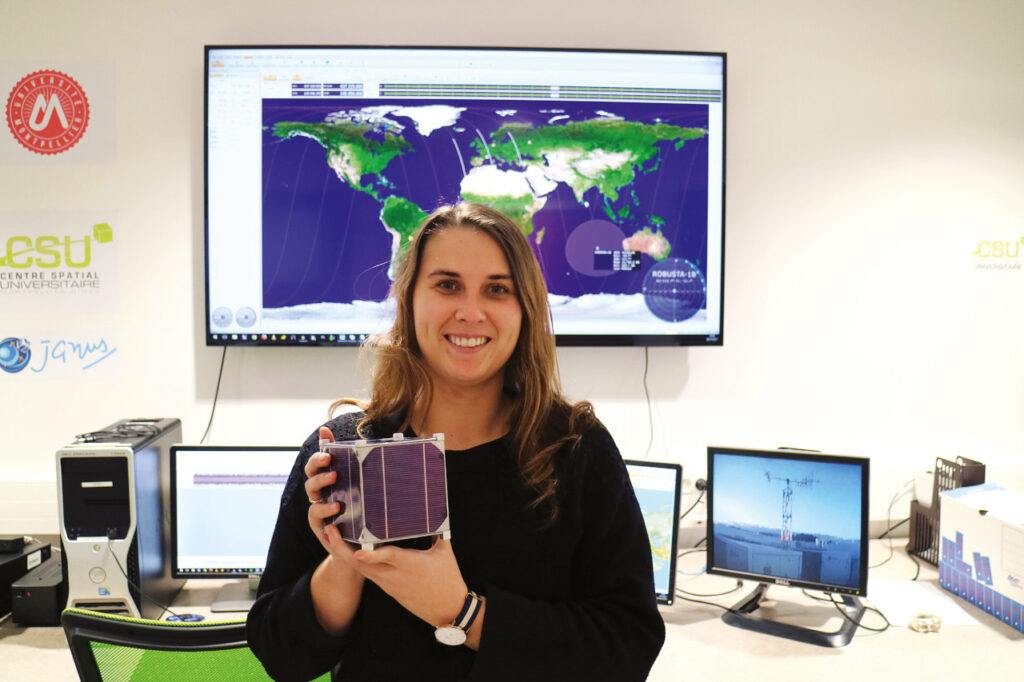
It left Earth in late June and passes over Montpellier twice a day, orbiting at 28,000 km/h in the vacuum of space. With palpable emotion, Camille Cambon recalls the launch of the Robusta-1B nanosatellite. The former intern at the University Space Center (CSU) put the finishing touches on this absolute marvel of technology in 2015. A cube measuring 10 cm on each side and weighing 1 kg, it was the result of the combined efforts of fifty student interns at the CSU. It was an experience that left a lasting impression on her youth… and confirmed her calling.
"A little piece of you out there in space"
From childhood, in Villetelle in the Hérault region, Camille Cambon developed a passion for astronomy and stargazing. While studying engineering in La Rochelle, she chose to complete her first internship at the University Space Center. It was 2015, and the student-built nanosatellite Robusta-1B—a project launched three years earlier—was entering its final manufacturing phase. The student set to work: she tested the solar panels that would be installed on the satellite, integrated the battery, and used 3D printing to fabricate parts for the final tests.
Camille Cambon and her fellow interns then had to wait two years before seeing their collective work blast off into space. Following a rocket explosion, the company originally responsible for the launch revised its schedule. On June 23, the satellite finally left Earth from India.
That day, student interns and CSU supervisors gathered before dawn to watch the launch broadcast on a big screen. Excitement gave way to wonder.“It was strange to see the satellite take off. Something you’ve touched leaves Earth—it’s as if a little part of you is out there in space,” says the doctoral student. Added to that sense of magic is the pride of a job well done. The satellite, now operational, sends daily signals that allow researchers to collect data on the effects of radiation on electronic components. At the end of its two-year mission, Robusta-1B will fall back to Earth, burning up as it enters the atmosphere.
Absolute rigor
This challenging mission only served to reinforce Camille Cambon’s enthusiasm for space.“The conditions there are extreme: intense vibrations, heat or cold, vacuum, radiation. Even a simple adhesive can explode in space! The space industry is very demanding and teaches us to exercise absolute rigor.” In 2017, the young woman worked on a new CSU nanosatellite, Robusta-3A. Now 23, she is beginning her doctoral thesis at the i2s doctoral school on the topic of 3D printing, a field with great promise in the space sector. Afterward, she hopes to join a major company such as ArianeGroup or Airbus Defence and Space. Her focus and work are always directed toward the cosmos.
Check out theUM podcasts, now available on your favorite platform (Spotify, Deezer, Apple Podcasts, Amazon Music, etc.).