[LUM#9] The Immunology Virus
Nadège Nziza is completing her Ph.D. in biology in the Stem Cells, Cellular Plasticity, Regenerative Medicine, and Immunotherapy laboratory (IRMB). Her work aims to improve the diagnosis and understanding ofvarious forms of juvenile arthritis. Last June, she was a finalist in the prestigious “My Thesis in 180 Seconds” competition.
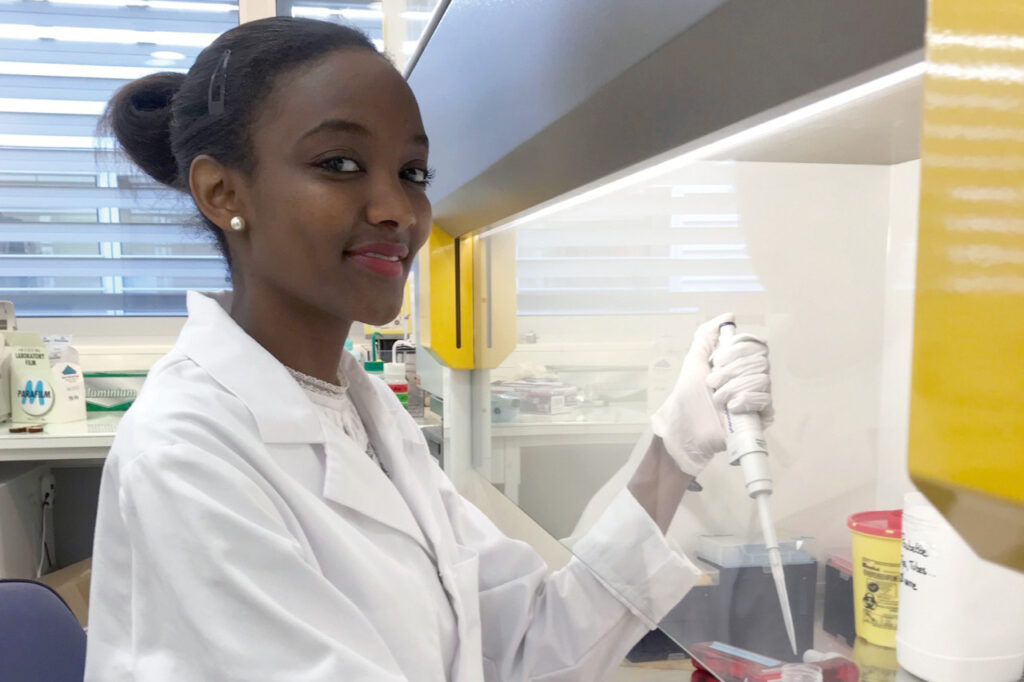
“Cluedo 2.0—that’s the title I’d give my dissertation. Forget Colonel Mustard; let’s focus on a child’s joint that’s all swollen from inflammation.” It was with this investigative scenario that Nadège Nziza, a doctoral student in cell biology, captivated the audience and the jury at the national competition for My Thesis in 180 Seconds.
Juvenile Arthritis
The inflammation she’s talking about has a name: juvenile arthritis.“An autoimmune disease that affects one in every 3,000 children in France and can lead to joint destruction,” she explains, “a disease in which the immune system—which is supposed to protect us—goes haywire and turns against us.” Immunology. A passion the young researcher caught“as a child” and that led her, at age 17, to leave Rwanda to study in Belgium before pursuing her Ph.D. in France “in order to meet specialists in the field.”
For the past three years at Inserm, under the supervision of Florence Apparailly and with funding from the Arthritis Foundation, Nadège has been collecting blood and synovial fluid samples from the joints of young patients at the Montpellier University Hospital to learn more about this disease. While effective treatments exist, diagnosing it remains a slow and complex process. “Juvenile idiopathic arthritis, the autoimmune form of arthritis in children, comes in seven subtypes that respond to different treatments. There is also septic arthritis, which is infectious and treated with antibiotics.” The only solution today is to try the different treatments one by one until a successful outcome is achieved.
The Good Guilty Ones
In her thesis, the student therefore aims to identify the true culprits more quickly:“I’m analyzing several types of white blood cells and microRNAs—small fragments derived from DNA—and looking for differences between the various forms of arthritis. My goal is to find different signatures that would allow for a direct diagnosis and thus facilitate the choice of treatment.”This research has already led to the filing of a patent“with a list of microRNAs that are expressed differently between septic arthritis and juvenile idiopathic arthritis,” explains Nadège Nziza.
In a few months, the young researcher hopes to fly“to the United States, Canada, or Australia”for a postdoctoral fellowship.“Still in immunology, but focusing on infectious diseases—and more specifically, malaria—because I’d like to return to Rwanda, and that’s the disease that affects the people of my country the most.”
Check out theUM podcasts, now available on your favorite platform (Spotify, Deezer, Apple Podcasts, Amazon Music, etc.).