The University of Montpellier is making progress and reaffirming its scientific standing in the 2022 CWTS Leiden World University Rankings
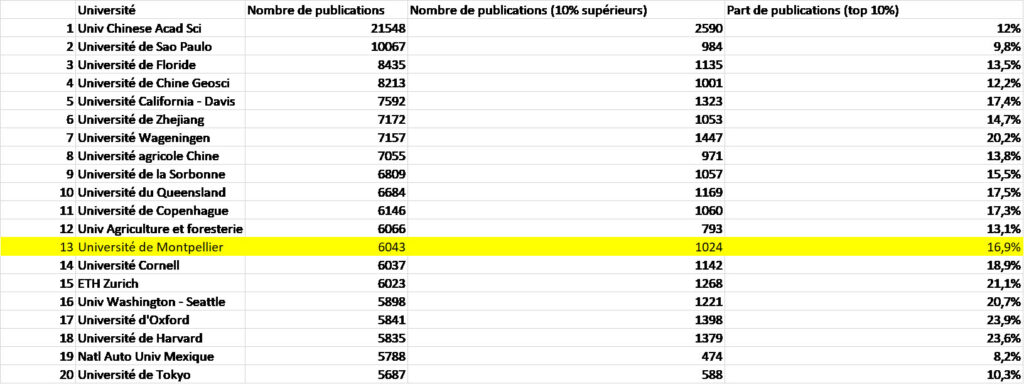
The University of Montpellier continues to climb in the CWTS Leiden Ranking. This ranking, which provides important information on the scientific performance of more than 1,300 leading universities worldwide, is based on scientific publications and their citations. In the 2022 global ranking of the most-cited publications (+10%), published on June 22, the University of Montpellier moved up 16 spots compared to 2021, ranking151st worldwide. Another notable indicator in this ranking is that theUM has climbed to13th place globally in the “Life & Earth Sciences” category and16th among the most-cited publications (+10%).
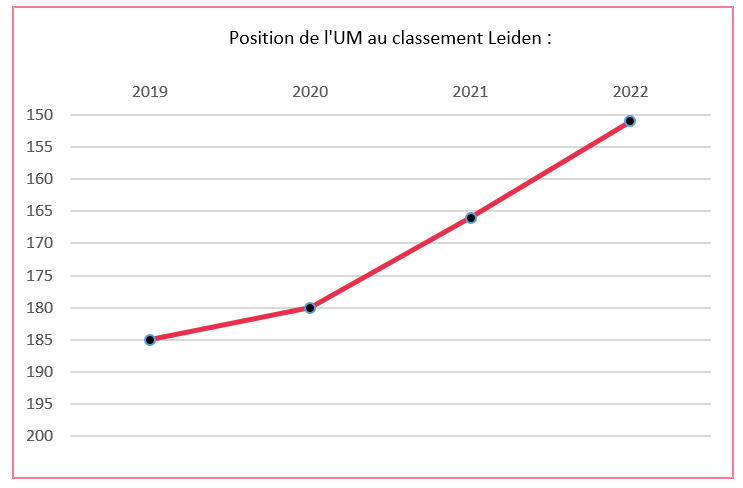
“Last year, the University of Montpellier made it into the Top 200 of the world’s best universities in the Shanghai Ranking. TheUM ’s steady rise in international rankings reflects the collective efforts made at the Montpellier campus to gain greater recognition for the excellence of our researchers’ scientific output. “We are firmly committed to further strengthening the global impact of our research,” said Philippe Augé, President of the University of Montpellier.
The University of Montpellier stands out particularly in the field of “Life and Earth Sciences,” ranking13th worldwide among prestigious universities:
A unique ranking with a multidimensional perspective
Established in 2011, the ranking produced by the Center for Science and Technology Studies (CWTS) at Leiden University measures the scientific reputation of institutions and their research collaborations. The 2022 rankings include 1,318 institutions and cover five disciplinary fields—medicine, physics, life and earth sciences, mathematics, and humanities and social sciences—as well as twelve time periods (2006–2009 through 2017–2020).
The Leiden Ranking is based on scientific publications, particularly articles published in scientific journals, which enable it to select sophisticated bibliometric indicators in order to generate results and analyze university rankings based on one or more selected indicators. It is also based on publications indexed in the Web of Science database produced by Clarivate Analytics.
The Leiden Ranking offers a multidimensional perspective on academic performance. For each combination of a university, a main field, and a time period, the ranking provides values for 50 indicators across four broad categories of information: the number of publications and the extent to which these publications are cited by other works, the extent of collaboration between different universities, open access to publications, and the gender of authors. Each year, the ranking is recalculated for all previous years using the updated methodology. Compared to other university rankings such as those by Times Higher Education, QS, and ARWU (Shanghai), the Leiden Ranking “aims to promote a more responsible approach to university ranking.” It provides information exclusively on research conducted at universities—research that is notably reflected in scientific publications and the carefully collected data that form the foundation and ensure the independence of this ranking.
Practical Information:
More information on the 2022 CWTS Leiden rankings: www.leidenranking.com