The University of Montpellier has signed a five-year partnership agreement with the Institut Agro in Montpellier
On Monday, September 20, 2021, Philippe AUGÉ, president of theUM , and Anne-Lucie WACK, executive director of Institut Agro (the National Institute of Higher Education for Agriculture, food, and the environment), signed a partnership agreement to formalize the specific, pre-existing relationship between the two institutions, thereby demonstrating their shared commitment to continuing the momentum established through the Montpellier University of Excellence (MUSE) project and to contributing to the development and influence of the University of Montpellier and its partners.
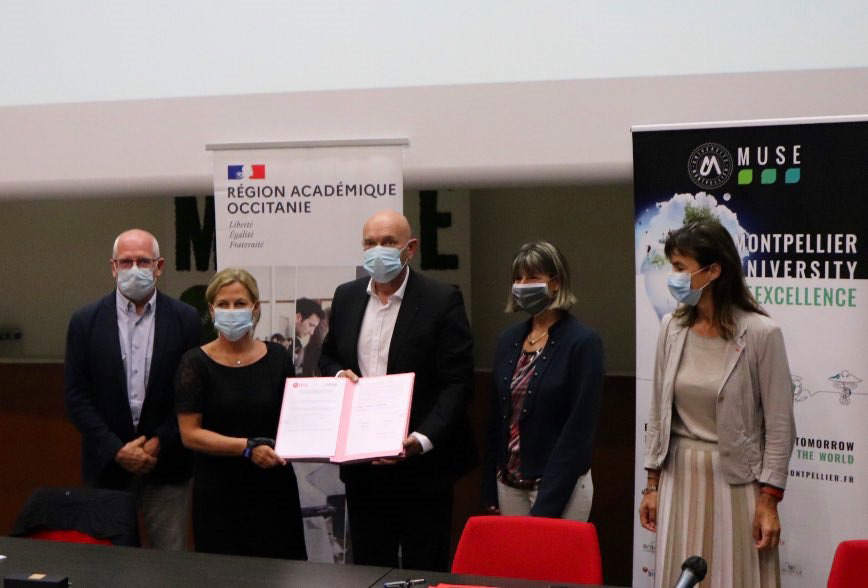
(from left to right): François PIERROT, Executive Director of I-Site MUSE – Anne-Lucie WACK, Executive Director of Institut Agro – Philippe AUGÉ, President of the University of Montpellier – Carole SINFORT, Director of Montpellier SupAgro – Sophie BÉJEAN, Rector of the Occitanie Academic Region.
The University of Montpellier and Montpellier SupAgro have maintained close ties for many years in the areas of education and scientific policy. These collaborations were strengthened in 2017 with the approval of the I-SITE MUSE project, led by the University of Montpellier, with Montpellier SupAgro as one of its partners.
Since the creation of the Institut Agro on January 1, 2020, Montpellier SupAgro has become an affiliated school of this new national institution, which also includes Agrocampus Ouest in Rennes and Angers, and will soon include AgroSup Dijon.
An agreement to formalize the terms of the collaboration
The primary goal of the I-SITE MUSE project is to help establish a world-class university in Montpellier by harnessing the strengths of all partners and gaining recognition, in particular, for its leadership in three key areas: human health, the environment, and agriculture and food. This ambition requires action across all areas of university life—education, research, international relations, innovation, and student life—as well as the development of a new organizational structure for the university, one capable of integrating partners.
Following the signing of an initial agreement in November 2019, which laid the groundwork for this partnership, the purpose of this partnership agreement is to formalize the terms of collaboration between the University of Montpellier and Institut Agro through its affiliated school, Montpellier SupAgro.
“I welcome this agreement between the University of Montpellier and the Institut Agro on behalf of Montpellier SupAgro—which is now a school within the Institut Agro—and with whom we have been collaborating successfully for several years. This agreement thus formally reflects the relationship of trust that exists between our teaching and research teams. But it is also a strong testament to our shared commitment to addressing the recommendations of the international Idex-Isite jury for the “Investment for the Future” program. Together, we share the ambition to foster the development and influence of the University of Montpellier.”
Philippe AUGÉ, President of the University of Montpellier
“With this partnership agreement, we are strengthening and expanding our longstanding collaborations with the University in the fields of agriculture, food, and the environment. We are developing joint strategies for education, research, and doctoral programs, as well as for educational and digital transformations, student life, and connections to the business community and the local region… Through our school in Montpellier, we aim to work together to tackle the major challenges posed by the transformation of professions and skills in the face of agricultural, food, and environmental transitions, and to contribute to the appeal and international influence of this major scientific hub in Montpellier, illuminated by its academic beacon.”
Anne-Lucie WACK, Executive Director of the Institut Agro, and Carole SINFORT, Director of Montpellier SupAgro
Pooling Expertise
At the institutional level, the commitment of the institutions is reflected in cross-participation not only in the governing bodies of both institutions but also in their various areas of activity.
The pooling of expertise will focus in particular on science policy, and collaboration will take place within the Joint Research Units ( Research ) under joint supervision and the partner units, particularly within the “Agriculture-Environment-Biodiversity” research cluster.
Collaboration within the doctoral college, the joint charter for authoring scientific publications, and contributions to international rankings are other aspects of this fruitful partnership.
In terms of academic programs, the partnership between Montpellier SupAgro and the University of Montpellier will primarily take the form of bachelor’s, master’s, and doctoral degree programs, and will result in the joint signing of diplomas.
They also intend to work together to develop initiatives that foster synergy, such as the “Agriculture & Food” Collegium.
Finally, the two institutions aim to pool their expertise in student life, international relations, and human resources, and to implement joint initiatives in the administrative sphere.
Through the commitments they have made in implementing the Common Charter for Scientific Publications and by co-signing degree certificates, the institutions are meeting the expectations of the I-SITE MUSE review panel.