Made at IAE
Emmanuel Houzé enrolled at the University of Montpellier as a student in 1993 and has never left. This stability is accompanied by a constant need to travel internationally, to continually draw inspiration from new projects. An interview with the new director ofthe Institute of Business Administration.
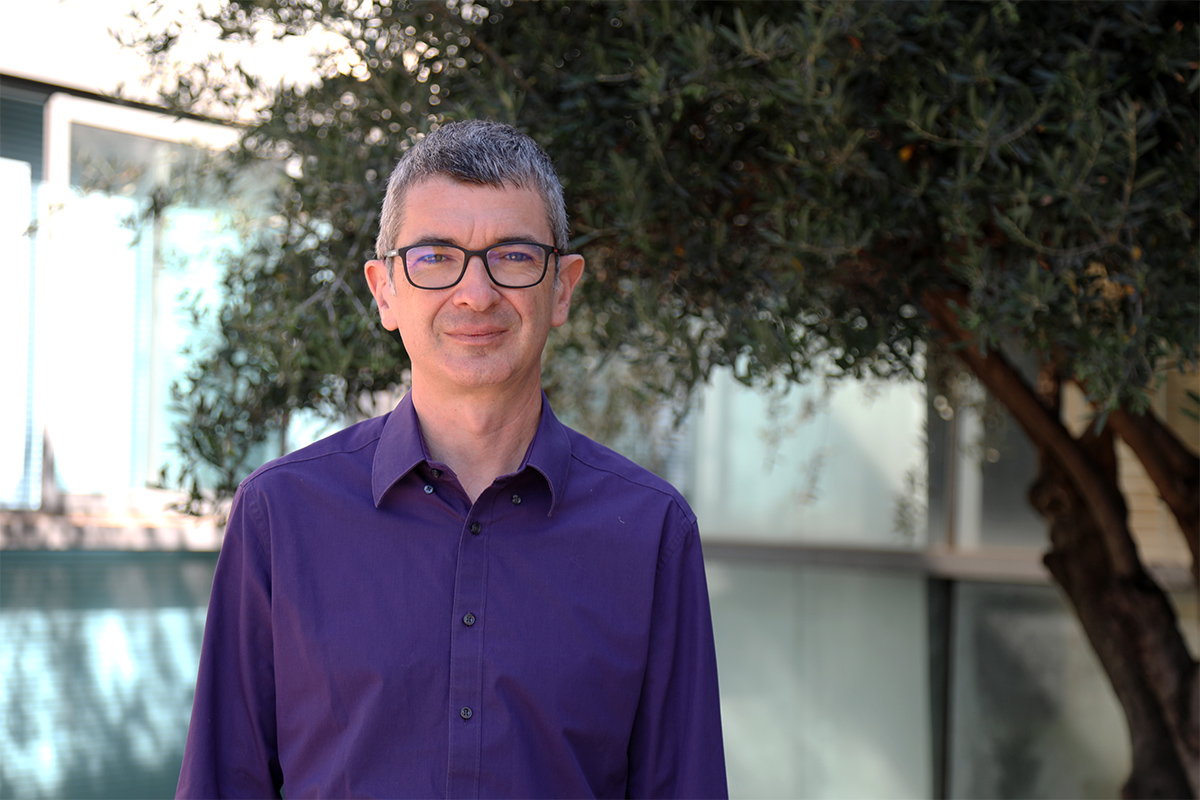
“A true product of the University of Montpellier.” That’s how Emmanuel Houzé describes himself. It must be said that the new director ofthe IAE has been with the university for 28 years now:“I arrived in 1993, when the Richter campus opened,” recalls theProfessor, who heads the Information Systems Management program. He stumbled upon this field“by chance” after starting out in a DEUG A program, where mathematics, physics, and chemistry didn’t really spark his interest. He then discovered management and specialized in information systems. “It’s a field that began to emerge in the 1970s and seeks to better understand the challenges involved in deploying information technology in businesses,” explains the specialist.
Pioneer
Emmanuel Houzé devoted his DEA thesis at the IAE to this field under the guidance of Robert Reix, the founder of IAE Montpellier—“a fascinating professor! He was the one who helped popularize information systems management in France.” In 2000, while still a student, he defended his doctoral dissertation on virtual teams in information systems management,“a topic that is highly relevant today, given the pandemic, which has led to a dramatic increase in the use of remote work.”
After completing his dissertation, Emmanuel Houzé became an associate professor in 2001 at a laboratory that would later become the Montpellier Research , specializing in management, and continued his work at the IAE. At the time, the young researcher, in collaboration with La Poste, launched the IAE’s first apprenticeship program.“We had 10 apprentices back then; today we have 364, and we work with three apprentice training centers.” Why the work-study program?“Because students’ transition into the workforce depends, on the one hand, on academic training and, on the other, on vocational training; we need to find the right balance between the two.”A balance that has clearly been achieved, since IAE Montpellier now boasts a 90% employment rate six months after graduation.
International Responsibilities
Emmanuel Houzé quickly took on international responsibilities as well, notably establishing the IAE’s very first dual degree program in international business with Burapha University in Thailand, from which he was later awarded an honorary doctorate.“In one year, students earn a degree from both institutions—a policy we have since promoted, with eight dual degree programs currently in place.”
Since 2017, this international investment has also included managing the Erasmus Capacity Building program known as Gecko. This program aims to improve the employability of engineering students by equipping them with managerial skills in the Philippines, Indonesia, and Thailand—"countries that do not include many management courses in their engineering school curricula." For Emmanuel Houzé, international projects are“vital.”Vital, but time-consuming: with an average of seven or eight international trips outside the European Union each year, theProfessor spends—or rather, spent before the onset of COVID—a great deal of time on airplanes.
A Desire to Innovate
A routine he’ll have to set aside for the next five years due to a lack of time. Elected director of the IAE on June 21, Emmanuel Houzé will take office on September 14, having previously served as deputy director of the IAE from 2007 to 2016 and again in 2020. “I wanted to make a modest contribution to the IAE, where I have received so much; it was a logical next step.”
A new adventure driven by a desire to innovate, particularly by taking a major step forward in digital transformation.“I want to move toward innovative educational models by offering a format that combines in-person, remote, and asynchronous classes to provide greater flexibility. To do this, we need to understand the current changes that are altering the needs of our students. If we’ve managed to roll out this model in five years, then it will be a success.” See you in 2026…