Mircea Sofonea: “Modeling is simply another form of quantitative data analysis—not a form of divination.”
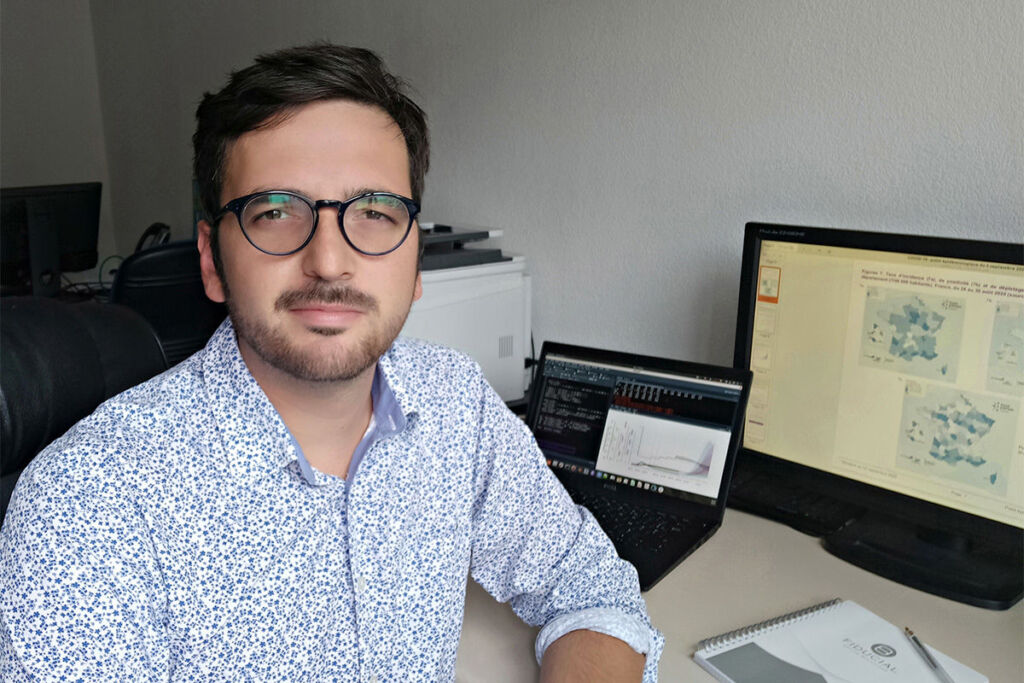
Mircea Sofonea is an epidemiologist at the Infectious Diseases and Vectors: Ecology, Genetics, Evolution, and Control (Mivegec[i]) laboratory. For nearly a year now, his field has been in the spotlight, and the Montpellier-based researcher has been in high demand by the media. He looks back on what has certainly been an extraordinary year.
How did you get into epidemiology?
After studying biology at the École normale supérieure, I defended my dissertation in evolutionary epidemiology at the University of Montpellier in 2017. It is a city with an exceptional vibrancy in the life sciences: from population biology to health. And epidemiology—which is the study of health determinants over time and space—lies at the intersection of many disciplines. The epidemiology of infectious diseases, in particular, requires the involvement of clinicians, microbiologists, and public health physicians, as well as ecologists, evolutionary biologists, and applied mathematicians… In Montpellier, I found a very supportive environment for developing interdisciplinary approaches.
Has the COVID-19 pandemic changed the way you work?
The situation took an unprecedented turn very quickly; on March 12, 2020, most of the research conducted by the Theoretical & Experimental Evolution team led by Samuel Alizon at the Mivegec laboratory shifted its focus to COVID-19. Our team was among the first to publicly release research and software for France: on April 6, we launched a simulator online to estimate how many people had been infected in order to determine if and when herd immunity would be achieved and when hospital occupancy would peak. We were thus one of the few French teams to have applied expertise in modeling the epidemic at the national level, and as early as late April, we were contacted bythe Parliamentary Office for the Evaluation of Scientific and Technological Choices (OPECST, chaired by Cédric Villani). However, a scientific discipline must be careful not to assume a monopoly; we contribute to the dissemination of science but we are not public policy makers, even though many media outlets push us to speak in that capacity.
Speaking of which, you’ve been in high demand by the media regarding COVID-19—were you familiar with this kind of interaction with the press?
At first, the media and journalists weren’t familiar with epidemiology, and we were primarily contacted through word of mouth regarding our educational materials on the subject. Then the need for understanding and quantitative projections of the epidemic led to daily requests, mainly from the media but also from healthcare professionals and even the private sector. We thought this media attention would last a few weeks, but now, nearly a year later and after more than 300 interviews, the requests show no sign of slowing down, and I have had to turn some down because I lack the time to maintain my research activities in this unprecedented context of scientific output, as well as to fulfill a full teaching load. I have also observed the effect of taking a break from responding to media requests: the observation shared by other colleagues is that scientific analysis quickly gives way to misleading narratives, which not only erode public trust in the scientific community but also weaken the public’s understanding of and support for public health measures.
What do you think of the various statements—which haven't always been consistent—that we've heard?
We must not exploit the sense of urgency or the media frenzy
to fill the void, and some scientists took advantage of this frenzy to assert unproven claims outside their areas of expertise. These statements ultimately caused the public to lose confidence. For example, a lockdown is not a decision to be made on a whim but must be based on quantitative arguments, data, and appropriate scientific analysis.
We’ve seen a lot of media articles featuring interviews with you titled“We Need to Lock Down”—do you recognize those as your own words?
This is one of the challenges encountered in dealing with the media: we often find that our words are not quoted entirely accurately, and the published article omits both the conditional tense we used and our rhetorical caveats—even though we are trying to convey a nuanced and balanced perspective on research, which is, by definition, exploratory. It is, in fact, crucial to distinguish between science and research. The former represents a body of knowledge that is established and accepted as such by a community of experts, whereas research is a human activity like any other, with a unique approach to conducting it for each individual—ranging from intuition to preliminary results that have not yet reached the level of consensus. All too often, the media confuses the two.
How do you envision your work evolving in the post-COVID era?
I hope we can once again look toward long-term research and contribute to a transdisciplinary scientific understanding of infectious diseases, as well as to the dissemination of this knowledge—in particular by promoting better health education for future generations. More generally, researchers in epidemiology and the evolution of infectious diseases are currently seen as bearers of bad news, even though many of these diseases are preventable and investing in prevention before an epidemic emerges and spreads is crucial. There is a certain degree of ingratitude in public health: if you predict and anticipate an event, every effort is made to prevent it from happening, and you’re labeled a doomsayer. If you don’t anticipate it and it happens, you’ve done your job poorly. It’s important to keep in mind that epidemiology answers three questions: understanding the past, describing the present, and shedding light on the future—but not predicting it. Modeling is essentially just another form of quantitative data analysis, not a form of fortune-telling, as some observers like to characterize it—observers who forget that behind every interpretation of the numbers lies a model, however simplistic and implicit it may be.
Had you ever dealt with other epidemics before COVID-19?
Together with Samuel Alizon and two interns from the MEME master’s program, we studied the Ebola epidemic that occurred in West Africa from 2013 to 2016. This epidemic was unprecedented in its scope and duration, so it was important to study its long-term consequences. It is a good example of the interaction between public health and viral evolution. In developed countries, it was believed that antibiotics and vaccines would quickly solve the problem of infectious diseases and that the focus should now shift to chronic diseases. The COVID-19 pandemic has proven us wrong.
[i] Mivegec: UM, CNRS, IRD