Nature in School: Is It Time to Hold Classes Outdoors?
As soon as the measures to ease lockdown restrictions were announced, the idea of a school where classes would be held outdoors began to take shape. Several opinion pieces called for schools to open up to the community and hold classes outdoors. With the implementation of strict health protocols, this “outdoor school ” became both a “healthy and beneficial solution” and a symbol of regained freedom.
Sylvain Wagnon, University of Montpellier
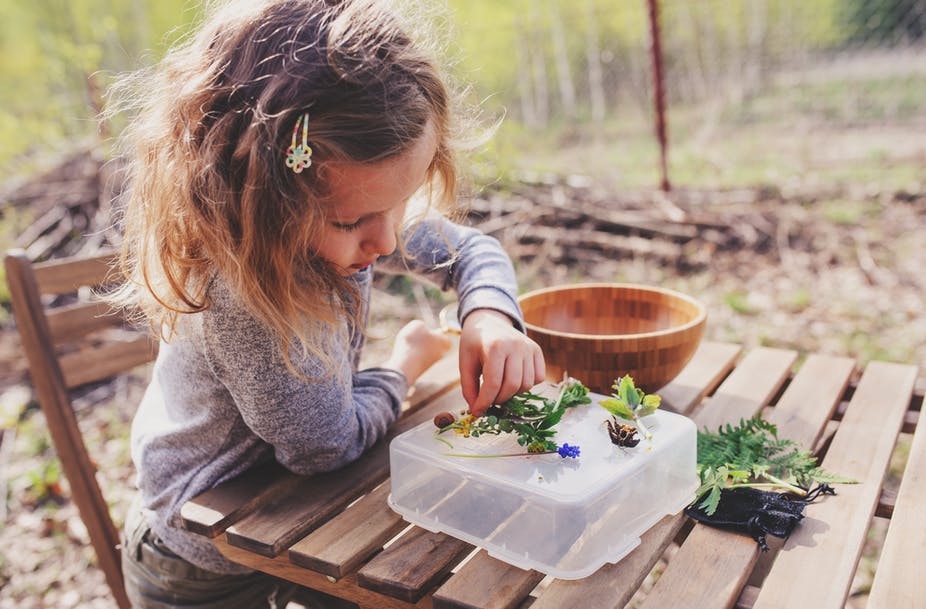
This movement toward connecting with nature is not new. It is a long-standing, international educational trend that is currently experiencing a genuine resurgence of interest. So has the time come to move from theory to practice, from experimentation to widespread adoption, and thereby establish a new relationship between human beings and their environment in education?
Nature and Well-Being
The benefits of children connecting with nature are numerous and have been recognized by many studies. The past few months have shown us just how vital a connection with nature is. Is this simply a temporary initiative in response to the lifting of lockdown restrictions, or—as Moina Fauchier-Delavigne and Mathieu Chereau have written—the emergence of a “green revolution” in education?
Outdoor activities in nature are important not only for children’s health but also for their well-being. Playing, spending time in nature observing, running, singing, listening, and smelling are all ways to help children develop independence and self-confidence. This fosters a different relationship with themselves and their environment. Being in nature influences our behavior and emotions.
From an educational perspective, its psychological benefits are reflected not only in behavior but also in cognitive development, as the child’s needs and interests are taken into account.
While still in their infancy in France, there are numerous scientific studies on the subject in Anglo-Saxon countries. Katherine Mycock’s research demonstrates, with regard to Great Britain, the importance of learning in nature for child development. In France, interest in this form of education—an alternative to traditional schooling—has been growing for about a decade.
Practical knowledge
We can refer to this as nature-based education, with the goal of reconnecting children with the environment. Exploring natural elements is a way to move beyond learning that is limited to books and to apply that knowledge to engage with the environment through one’s senses, body, and mind.
Outdoor education aims to foster hands-on exploration to raise young children’s awareness of nature. Children play, climb trees, and build things. While these are experiences that already exist at summer camps or in Scouting, here they take on an academic dimension. This learning not only leads to exploration and social interaction but also to the acquisition of a wide range of skills in math, vocabulary, and scientific, geographic, historical, and artistic understanding.
“Luxembourg: A Preschool Has Opened in a Forest” (Télé Matin, 2017).
Today, these outdoor activities are also seen as important for well-being in the face of a growing sedentary lifestyle that is leading to an increase in health problems such as hyperactivity, anxiety, obesity, and stress.
Several principles unite the schools that make this choice:
- the concept of the pleasure that nature brings to a child
- the commitment to a well-rounded education that takes into account the various facets of a person's personality
- the idea of developing a relationship with one's environment.
Historical Precedents
Ever since Jean-Jacques Rousseau and Johann Heinrich Pestalozzi, educational reformers have emphasized the importance of nature in the harmonious development of children. Early20th-century educators of the “New Education” movement, such as Freinet and Decroly, developed theories about this “school of life,” in which students should step outside the classroom to observe, experiment, and understand.
In the early20th century, outdoor schools represented a European educational movement that sought to open up school architecture to the outdoors and to develop a pedagogy connected to nature. The current exhibition on the Suresnes outdoor school highlights the architectural and pedagogical innovations of this type of school.
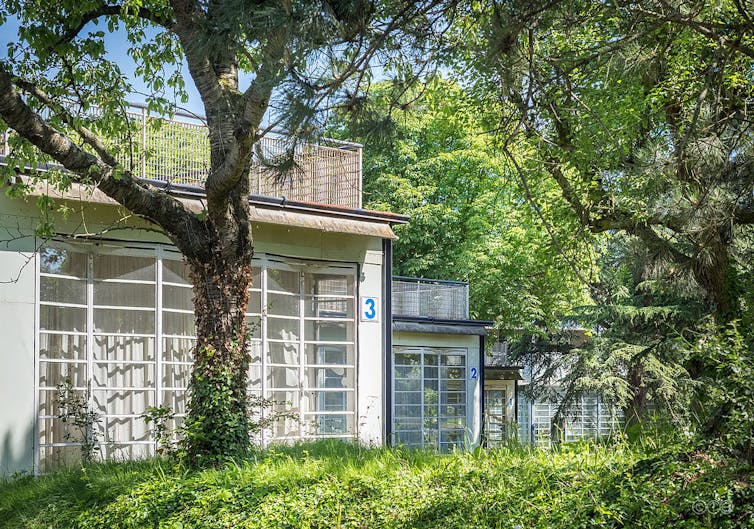
Thomas Brenac/Wikimedia, CC BY-SA

Forest schools and outdoor education programs now form a structured global network. As early as the 1920s, schools in the United States were already making nature the very reason for their existence. “Forest schools” are experiencing steady growth in Europe, primarily in Germanic and Scandinavian countries. In Denmark, the concept of forest schools has become an integral part of the curriculum for preschool-aged children (under seven years old).
Over the past decade, a national program has been implemented in Great Britain, and the country now has more than 140 schools specifically dedicated to forestry.
In France, nature-based schools are still growing slowly. The “nature-based education” movement seeks to formalize educational experiences that are grounded in nature. Since 2018, several schools have joined this movement.
Eco-Citizen Schools
Beyond introducing students to sustainable development, environmental awareness, and respect for the environment—topics that are now integral parts of school curricula— eco-citizen schools engage students in concrete actions, such as removing asphalt and replanting vegetation in school playgrounds. For its part, the Eco-School network represents several thousand schools that, since 2005, have been working to develop specific skills in the areas of sustainable development and education.
Introduction to the Eco-Schools Network.
The challenge is to move beyond mere talk of connecting with nature and to implement interdisciplinary practices that bring the classroom outdoors. Experiments are underway in the public school system. Schools in the Doubs department are developing “open-air” practices, and stakeholders on the ground are advocating for these practices.
Bringing children closer to nature and the environment means approaching education in a profoundly different way. The health crisis, concerns about the future, and the need to take action for the ecological transition all provide a favorable context and opportunities for “outdoor schooling.” Will the various stakeholders in education—schools, parents, and teachers—recognize this for the sake of children’s futures and undertake a genuine educational reform based on harmony between human beings and their environment?
Sylvain Wagnon, Full Professor of Education, School of Education, University of Montpellier
This article is republished from The Conversation under a Creative Commons license. Readthe original article.