[LUM#21] We Won't Go to the Woods Anymore
Storms have long posed the greatest danger to France’s forests. But for the past twenty years or so, another threat has loomed over their future, forcing us to face a painful reality: not only will the forest not help us combat climate change, but worse still, this change is already killing it.
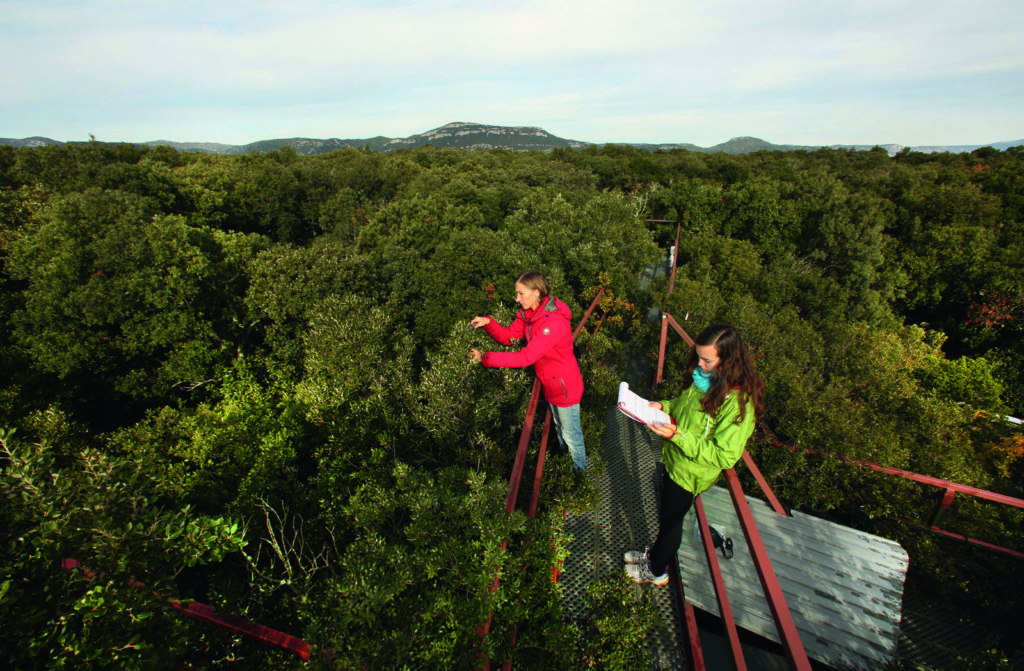
“We are seeing a 50% increase in tree mortality and a decline in tree growth. Based on current projections, by the end of the century, the forest in southern France could give way to a wooded savanna. In the north, competition for water will thin out the stands,” notes Isabelle Chuine, a researcher at the Center for Functional and Evolutionary Ecology1 and coordinator for the Academy of Sciences of a report on the state of French forests.
Drought is one of the first lethal consequences of climate change for trees (Climate Change and the Biosphere). “When it gets hotter, evaporation and transpiration from trees increase, so the water stored in the soil is released more quickly into the atmosphere, leaving them with fewer available water resources.” This trend is exacerbated by declining rainfall, which is affecting many regions of France to varying degrees.
Extensive damage
Equally linked to climate change is the increasingly frequent occurrence of early heat waves, as was the case in June 2019.“Even the Mediterranean forest, which is particularly well-adapted to these phenomena, has suffered considerable damage.” (The holm oak’s reproductive capacity is not adapting to a drier world), the researcher recalls. The reason: the specific biology of these evergreen species, which do not shed their leaves in winter and produce new foliage later in the season.“This adaptation allows them to avoid late spring frosts. But if a heat wave strikes before the leaves have fully matured, they won’t be able to withstand these temperatures as well as they would have in the middle of summer.”
Drought and heat waves trigger an immediate response in trees, whose leaves are equipped with stomata—tiny pores that open and close to capture the CO2 essential for photosynthesis, but which also allow water to escape.“During a drought, the leaves close their stomata to conserve water. But in doing so, they no longer absorb CO2 and therefore cease to photosynthesize,” explains Isabelle Chuine. If the drought persists, the leaves—and even the branches, or the entire tree, depending on the severity of the event—will die. The survivors will emerge weakened and become prime targets for pests and pathogens. Not to mention wildfires, which are also fueled by drought.
The laurels have been cut
Another threat is beginning to emerge: warmer winters.“In our latitudes, a tree produces new leaves and flowers in the spring, bears fruit in the fall, and then sheds its leaves,” the expertexplains . This fall, in the Massane beech forest in the Eastern Pyrenees and in the Puechabon forest, scientists observed a massive burst of bud break in the fall. In 2015, massive fall blooms were also observed throughout France. “This is an extremely risky behavior because these young leaves do not survive the winter, and the flowers do not produce fruit, which is a net loss for the tree. All of these situations will become increasingly frequent by the end of the century.” (Understanding the Multiple Effects of Climate Change on the Timing of Leaf Unfolding) How can we even begin to combat climate change with forests that are dying off?
French forests currently store nearly 3 gigatons of carbon, but the carbon sink they represent has been cut in half in just about a decade,“and if we look region by region, many are no longer carbon sinks.” The political response so far has been an increase in harvesting—in other words, logging. “ The national low-carbon strategy in France was built on the idea that, since the forests were going to die anyway, it would be better to harvest them and store the carbon from the trees in long-lasting wood products, then replant more resilient tree species.The problem is that only 3% of the harvested wood is currently being turned into long-lasting wood products .”
Life-size
Another approach is to let nature take its course. Diversifying the tree species and genetic material in forests to make them more resilient is one possible solution.“No one really knows if we’ll be able to preserve the forests as we know them in certain regions. Because we failed to anticipate this situation despite warnings from scientists, we’re now conducting a full-scale experiment,”concludes Isabelle Chuine.
Your papers, please!
What would a profile of France’s metropolitan forests look like?“They cover about 30% of the country’s territory, and three-quarters of them are privately owned, ” explains Isabelle Chuine.“Two-thirds of the trees are hardwoods, while one-third are softwoods.” Among the most common species areoak—“including some very old oaks”—beech, spruce in the northeast, and maritime pine, which is very prevalent in the Landes region, now France’s largest forest area.
French forests are characterized by their composition of even-aged stands.“It’s a centuries-old practice that has been added to the national inventory of intangible cultural heritage. It’s the classic image of a forest with tall trees of a single species and thick trunks…”Otherwise, the landscape consists mainly of coppices—lower-growing stands of trees that are often harvested—or coppice-under-high-forest.
Check out theUM podcasts, now available on your favorite platform (Spotify, Deezer, Apple Podcasts, Amazon Music, etc.).
- Cefe (CNRS, UM, IRD, EPHE) ↩︎